 airbrakecompressor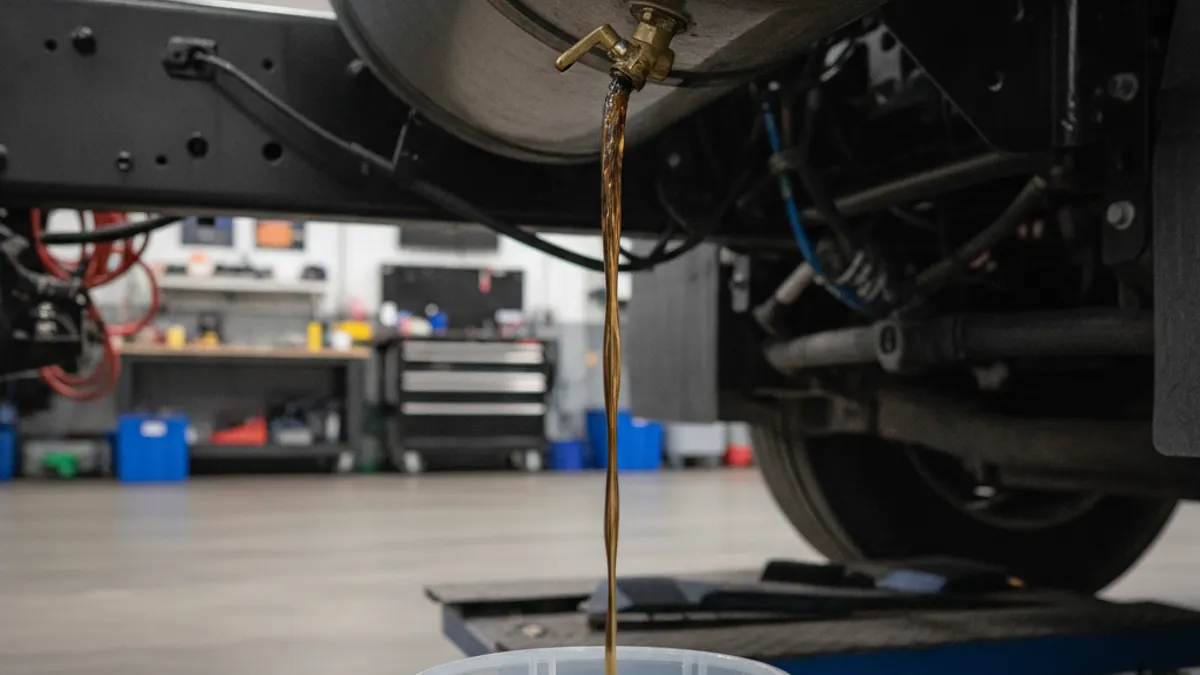
Water in an air brake tank is condensation. The compressor pumps hot, humid air — atmospheric moisture drawn in through the intake and concentrated by compression — and as that air cools through the discharge line, the air dryer, and into the reservoirs, the moisture drops out as liquid. A small amount is normal. What isn't normal is water building up faster than the dryer and drain valves can get rid of it, because standing water rusts a steel tank from the inside, carries downstream into every valve in the system, and freezes solid the first cold night.
Crack a drain and get a cup of water, and you have a maintenance problem. Get a quart, or a gray-brown milky sludge, and you have a component problem — usually a saturated or non-purging air dryer, or a compressor passing oil.
Where the water actually comes from
Air at ambient temperature holds a certain amount of water vapor. Squeeze it down to system pressure — roughly 120 psi in a fully charged system — and it can no longer hold that much vapor at the same temperature. Compression heats the air on top of that, so hot, saturated air leaves the compressor head, travels down the discharge line, and cools. Every degree it cools, more vapor condenses into liquid.
That's why the discharge line is designed to act as a heat exchanger: it cools the air before the dryer, so the desiccant sees air it can actually handle. Climate matters too — a truck working a hot, humid coast makes far more water than one in a dry, cold region. Humid air in, water out.
The system fights this in three places:
- The discharge line — cools the air and drops out the first, biggest slug of moisture.
- The air dryer — a desiccant cartridge adsorbs what's left, then purges it out the bottom each time the governor reaches cut-out (typically in the 120–135 psi range). That's the loud pssht under the truck.
- The tank drain valves — the last line of defense. Whatever the first two miss ends up here.
Read what comes out of the drain
When any of those three stop working, water piles up in the reservoirs — and what comes out of the drain tells you which one failed. Drain into a clean pan or onto a light-colored rag so you can see it.
| What you drain out | What it means | What to do |
|---|---|---|
| A tablespoon or less of clear water, or nothing | Normal. The dryer is working. | Keep draining daily. |
| A cup or more of clear water, every day | Dryer saturated, purge valve not purging, or cartridge past its service life. | Listen for the purge at cut-out. Replace the cartridge. |
| Water with black flecks | Desiccant beads breaking down and migrating downstream. | Replace the cartridge now — that debris is headed for your valves. |
| Milky gray or tan emulsion, oily film | Water mixed with compressor oil, which has ruined the desiccant's ability to adsorb. | Diagnose the compressor for oil carryover. A new cartridge alone will just get contaminated. |
| Rust-colored water, flakes | The tank is corroding internally, and has been for a while. | Inspect the tank. Corroded reservoirs get replaced, not patched. |
| Nothing from a drain you've never opened | The drain valve is plugged with sludge or seized. | Clean or replace the drain valve. The tank isn't dry — you just can't reach what's in it. |
What the water does to your system
Internal tank corrosion
Steel reservoirs sitting with water in the bottom rust from the inside out. You won't see it — the outside looks fine while the floor of the tank thins. That's structural and a contamination source at once, because rust flakes travel downstream. Worth knowing how air tanks and reservoirs work and what to inspect on them.
Valve failure
This is where water costs real money. Every pneumatic valve in the system — relay valves, quick-release valves, the foot valve, the tractor protection valve, the ABS modulators — has rubber seals and precision bores. Water washes out the lubrication, rust and desiccant debris score the bores, and the valve starts leaking or sticking. A sticking relay valve means brakes that drag or apply slowly. That's a safety issue, not a shop issue.
Freezing
Below freezing, water in the lines turns to ice. Ice in a small-diameter line means that circuit does nothing; ice in a valve means it stays wherever it was when it froze. That's how you get brakes that won't release in the morning, or a trailer that won't build pressure. Alcohol evaporators were the old fix; a working air dryer is the real one.
The fix: draining
Drain every tank, every day — not just the wet tank. Trucks have a supply (wet) reservoir plus primary and secondary service reservoirs, often a separate one for the parking/spring brake circuit, and trailers have their own. Water that gets past the wet tank ends up in the service tanks, and those feed your brake chambers.
- Park on level ground, chock the wheels, set the parking brakes.
- Open each drain fully and let it blow until nothing but air comes out — don't crack it a quarter turn and call it done.
- Note what came out. Use the table above.
- Close the drains. A drain left open means the system can't charge, and the low-air warning will light around 60 psi on your way out of the yard.
If the truck has automatic drain valves, don't assume they're working — they fail silently. Verify each one manually at least monthly.
A cup of water in a service tank isn't a nuisance. It's the first installment on a valve replacement.
The fix: the air dryer
The dryer is what makes daily draining a formality. It does two jobs: adsorb moisture into a desiccant cartridge, then blow it out during the purge cycle when the governor hits cut-out. Checks, in order:
- Listen for the purge. Build to cut-out and listen underneath. No pssht, no purge — the dryer isn't regenerating and will saturate within days.
- Check the purge valve and exhaust. Stuck open, it bleeds air continuously and the system fights to hold pressure. Stuck closed, no moisture leaves.
- Check the heater. Most dryers have a heater and thermostat to keep the purge valve from freezing. A dead heater is a winter no-start-of-day.
- Replace the cartridge on schedule. Desiccant has a finite service life — commonly about a year. Follow the manufacturer's interval; shorten it for humid or high-duty-cycle work.
If cartridges keep dying early, the dryer isn't the root cause — oil is. Oil that gets past the compressor rings coats the desiccant, the beads stop adsorbing, and you get a dryer that looks fine and does nothing. Fix the compressor first. For the full picture on the component, see how air dryers for trucks work; when it's time to service the unit, air dryer valves from VADEN Original are built to original-equipment tolerances.
Still getting water after a new cartridge?
- Compressor duty cycle too high. Loaded a large fraction of the time, it makes more moisture than the dryer can handle. Chase air leaks first — a leaking system runs the compressor constantly.
- Discharge line too short, insulated, or badly routed. The line needs airflow across it to cool. Re-routed or wrapped, it hands the dryer air too hot to dry.
- Discharge line carboned up. Coke buildup restricts flow, drives up discharge temperature, and cooks the dryer.
- Compressor passing oil. Oil kills desiccant. Fix it, or replace cartridges forever.
- Dryer mounted wrong. It has an orientation. Off-angle, the purge won't clear the sump.
The short version
Water is a byproduct of making compressed air. You can't eliminate it, only manage it — with a dryer that actually purges, a cartridge replaced on schedule, and a drain valve opened every single day.
Need the part, not just the answer?
OE-grade air brake compressors and repair kits, manufactured and tested to commercial-vehicle standards.
Shop VADEN partsPublished by VADEN Original. Product links point to the manufacturer’s official catalogue. Specifications are general — always confirm figures against your vehicle’s service manual.