 airbrakecompressor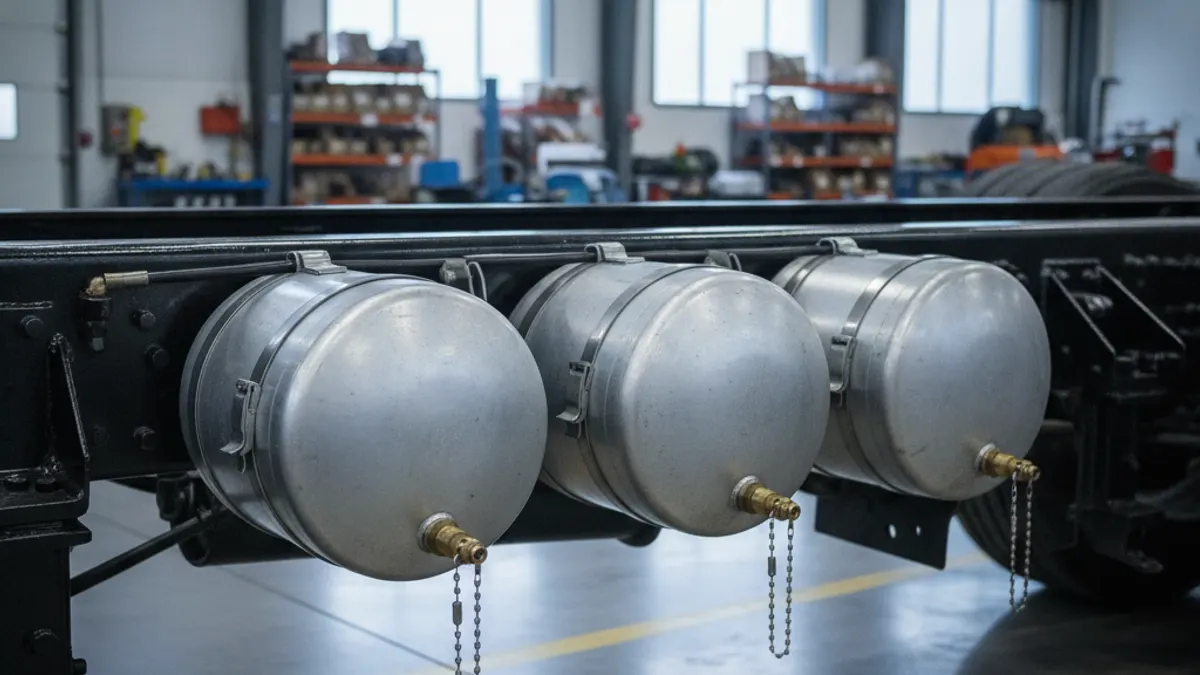
Air brake reservoirs are the storage tanks that hold the compressed air your service and parking brakes run on. A typical tractor carries at least three: a supply tank (also called the wet tank), a primary tank, and a secondary tank. The compressor fills the wet tank first; from there air passes through one-way check valves into the primary and secondary reservoirs, which feed two separate brake circuits so that a failure on one side still leaves you with working brakes on the other.
If you understand nothing else about the reservoir system, understand this: it exists for redundancy and reserve. The tanks give you a bank of stored air so you can make repeated brake applications with the engine off or the compressor cut out, and the split design keeps a single leak from emptying the whole system. Draining them keeps that stored air dry and the steel from rotting out.
The three reservoirs and what each one does
Air flows from the compressor to the reservoirs in a fixed order, and each tank has a job.
| Reservoir | Also called | Primary job |
|---|---|---|
| Supply tank | Wet tank, wet reservoir | Receives raw compressed air from the compressor; collects water and oil that carries over before air reaches the working tanks |
| Primary tank | Service reservoir (primary) | Feeds the primary brake circuit, usually the rear axle(s) |
| Secondary tank | Service reservoir (secondary) | Feeds the secondary circuit, usually the front axle and often the trailer supply |
The wet tank is named for what collects in it. Hot air leaving the compressor carries water vapor and a small amount of oil mist. As that air cools inside the first reservoir, moisture condenses and drops out. That is by design, so the primary and secondary tanks stay comparatively dry. On modern trucks an air dryer sits ahead of the reservoirs and removes most of that moisture before it ever reaches the tanks, but the wet tank still acts as the last-chance collection point. To see where these tanks sit in the full circuit, review how air brake systems work.
Why the split (dual) design matters
Federal rules require heavy vehicles to have two independent service brake circuits. The primary and secondary reservoirs are the storage half of that requirement. If the primary circuit springs a leak, the secondary tank still holds pressure and can stop the truck, and vice versa. You lose some braking performance, but you are not left with an empty system. This is the foundation of a dual air brake system, and it is why the dash carries two needles or a split gauge, one for each circuit.
One-way check valves: the isolation between tanks
Between the wet tank and each service reservoir sits a one-way check valve. Air can flow forward into the primary and secondary tanks, but it cannot flow back out. That one-way behavior is what makes the redundancy real.
- If the wet tank or a supply line fails, the check valves trap the air already stored in the primary and secondary tanks so you keep braking.
- If one service circuit leaks down, its check valve keeps that leak from draining the other tanks.
- During normal charging, the valves simply let each tank fill and hold.
A stuck or leaking check valve defeats this protection. If a single leak drops both gauge needles together, a bad check valve is a prime suspect, because the tanks are no longer isolated from one another. Persistent whole-system leak-down is worth diagnosing alongside the guide on an air brake system losing pressure.
Draining tanks and the moisture problem
Every reservoir sits at the low point of its circuit and carries a drain valve at the bottom, either a manual pull-cable or petcock, or an automatic drain that dumps periodically on its own. Draining is not optional maintenance you can skip.
Water that stays in the tanks causes a chain of problems:
- Internal corrosion. Standing water rusts the tank from the inside, thinning the steel and eventually causing pinhole leaks or condemning the tank.
- Freeze-ups. In cold weather, collected water freezes in lines, valves, and drain cocks, which can block air delivery or hold a valve open.
- Valve contamination. Water and oil sludge carry downstream into relay valves, quick-release valves, and brake chambers, gumming up seals and slowing response.
- Reduced usable air. Water takes up volume that should be holding compressed air.
Drain each reservoir until only air comes out. If you get a steady stream of water day after day, the air dryer desiccant is likely spent or the system is pulling too much moisture, not just a draining habit problem.
Best practice is to drain the tanks daily, at the end of a shift while the system is warm and pressurized so contaminants blow out cleanly. Trucks fitted with automatic drain valves still deserve a periodic manual check, because a stuck automatic drain can either leak constantly or stop dumping altogether. If you are pulling large amounts of oil (not just water) out of the wet tank, that points upstream to the compressor and is covered in why an air brake compressor pumps oil.
Reservoir capacity and sizing
Reservoir volume is not arbitrary. Regulations require total reservoir capacity to be sized relative to the combined volume of the brake chambers it serves, so the system holds enough stored air for multiple full brake applications after the compressor stops building. In practice the tanks are large enough that you can make several hard stops, or hold the truck on the service brakes, before pressure falls to the low-air warning point around 60 psi.
The governor keeps the tanks topped up. It cuts the compressor out near the top of the range, commonly around 120 to 135 psi, and cuts it back in when pressure falls to roughly 100 to 110 psi. A fully charged system typically sits near 120 psi across the working tanks. If your tanks never reach that range, the fault is usually upstream in the compressor or governor, not the tanks themselves; see an air brake compressor not building pressure.
| Pressure point | Typical range | What it means |
|---|---|---|
| Governor cut-out | ~120-135 psi | Tanks full; compressor stops building |
| Fully charged | ~120 psi | Normal running reserve in the tanks |
| Governor cut-in | ~100-110 psi | Compressor resumes building |
| Low-air warning | ~60 psi | Buzzer/light; reserve is getting low |
| Spring brakes apply | ~20-45 psi | Parking/emergency brakes set automatically |
Inspecting reservoirs and preventing corrosion
During a walk-around and in scheduled service, the tanks deserve a look, not just the drain pull.
- Drain and check what comes out. Mostly air is good. Heavy water means the dryer needs attention; heavy oil means the compressor does.
- Look for external rust and pitting, especially around the drain fitting and the weld seams and mounting straps where road salt collects.
- Check mounting straps and brackets. A tank that vibrates loose will chafe lines and eventually crack a fitting.
- Inspect fittings and lines for weeping leaks with soapy water; a slow reservoir leak shows up as pressure that bleeds down overnight.
- Confirm the check valves hold. If shutting off the engine and stepping on the brakes drops one circuit far faster than expected, or drops both together, test the check valves.
Corrosion is the reservoir's main enemy, and it is almost always a moisture-management failure. Keep the air dryer serviced, drain the tanks on schedule, and a steel reservoir will last many years. Let water sit and the tank rots from the inside where you cannot see it until it fails. A tank with visible external rust-through, or one that has been damaged or dented, should be replaced rather than patched, because a reservoir is a pressure vessel and a failure under pressure is dangerous.
The reservoirs are simple parts with an important job. They store the air, keep the circuits separated, and give you the reserve that makes air brakes safe. Treat draining as a daily habit, keep the moisture out, and the rest of the system, from the relay valves to the brake chambers, stays cleaner and lasts longer.
Source (VADEN Original): How to Read an Air Brake Diagram: Circuit Guide
Need the part, not just the answer?
OE-grade air brake compressors and repair kits, manufactured and tested to commercial-vehicle standards.
Shop VADEN partsPublished by VADEN Original. Product links point to the manufacturer’s official catalogue. Specifications are general — always confirm figures against your vehicle’s service manual.