 airbrakecompressor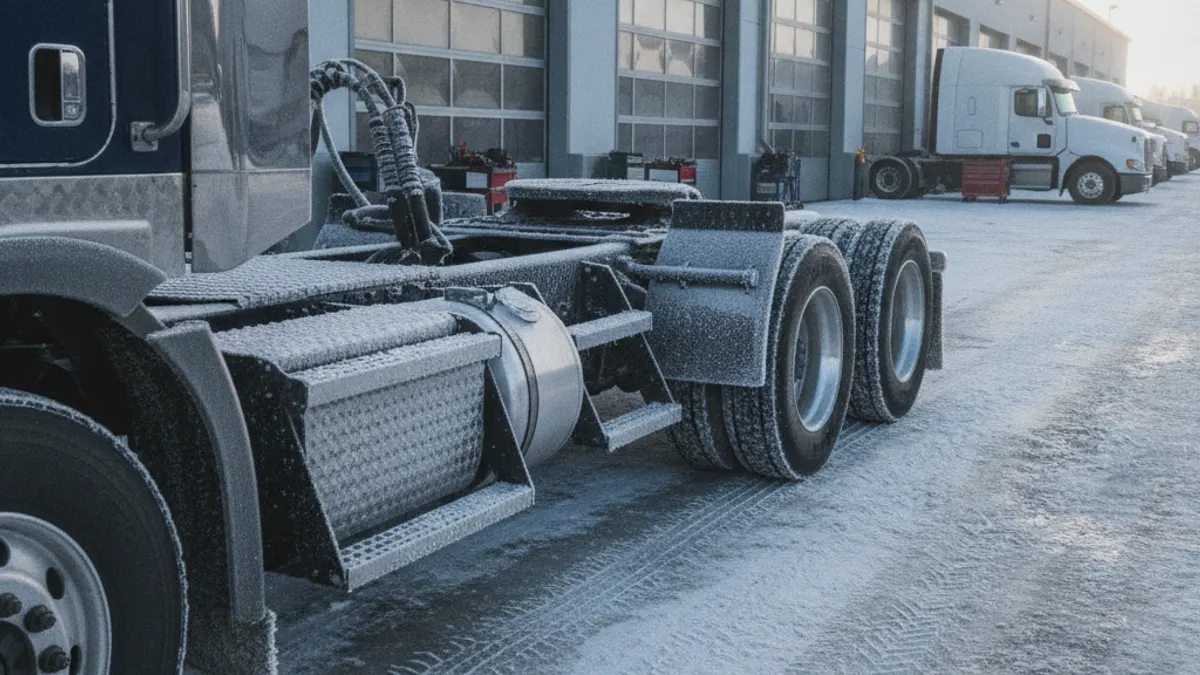
Air brakes freeze in winter because the compressor pumps water vapor into the system along with the air, and that water condenses and then freezes in valves, lines, and low spots when the temperature drops. The cold itself is not the problem — moisture is. The fix is drying the air before it reaches the tanks: a working air dryer with a good desiccant cartridge, plus daily tank draining. Air brake antifreeze (methyl alcohol) has a place, but it is a supplement or a get-home measure, not a replacement for a dry system.
Why Air Brakes Freeze: Where the Water Comes From
Every cubic foot of air the compressor draws in carries humidity. Compression heats the air, and hot compressed air holds that moisture as vapor. As the air travels down the discharge line into the tanks it cools, and the vapor condenses into liquid water — often mixed with carried-over compressor oil into a gray sludge.
In summer that water is a corrosion problem. In winter it is an operational one. Free water pools in reservoirs, sits in the low loops of nylon air lines, and collects in the small internal passages of valves. Below freezing it turns to ice, and ice does three things:
- Blocks small ports. Control ports in relay and quick-release valves are tiny. A drop of ice is all it takes to stop a signal.
- Holds valves off their seats. Ice under an exhaust seat means the valve cannot close and you leak air continuously — enough of that and pressure falls to the low-air warning, which trips around 60 psi on most trucks.
- Plugs lines outright. Ice in a service line means the brakes at that axle either do not apply or, once applied, do not release.
Common Freeze Points and What They Look Like
| Component | Symptom when frozen | Typical cause |
|---|---|---|
| Air dryer purge valve | No purge burst at cut-out; dryer blows air continuously | Sump water icing around the purge valve; failed heater |
| Governor | Compressor never unloads, or never loads | Ice in the signal line or governor ports |
| Relay valve | Slow apply or release; brakes stay applied on one axle | Frozen service signal line; ice in the exhaust port |
| Quick-release valve | Brakes drag after pedal release | Ice holding the diaphragm or blocking exhaust |
| Spring brake / park circuit | Parking brake will not release | Ice in the supply line or control valve |
| Gladhands and trailer lines | No air to trailer; trailer brakes stay applied | Water in the coupling; ice in the service or supply line |
| Brake shoes to drum | Truck will not roll; loud crack when it breaks loose | Wet linings freezing to the drum overnight |
That last one is not a system fault at all: park a wet truck with the shoes touching the drums and the moisture between lining and drum freezes the two together. The cure is heat and patience; the prevention is chocking the wheels and releasing the brakes when it is safe to do so.
The Air Dryer Is Your Real Antifreeze
The air dryer sits between the compressor and the supply tank. Compressed air passes through a desiccant bed that adsorbs water vapor; at governor cut-out — typically in the 120–135 psi range, with a fully charged system sitting around 120 psi — the dryer purges, blowing collected water and oil out the purge valve and regenerating the desiccant with a little dry air. A healthy dryer delivers a dew point below ambient, so there is no free water available to freeze downstream. For a closer look at the unit, see our page on the air dryer for trucks.
Dryers fail quietly: the desiccant saturates, the coalescing filter loads with oil, and the unit passes wet air while looking fine from the outside. Before winter, check three things.
- Cartridge age. Follow the manufacturer's interval — roughly a year or a set mileage for line-haul, sooner in severe duty. If you cannot remember changing it, change it.
- Purge at cut-out. Charge the system and listen for a distinct exhaust burst when the governor cuts out. No purge means the dryer is not regenerating.
- Heater circuit. Most dryers have a thermostatic heater at the purge valve, and a working one draws current with the key on. A dead heater is the most common cause of a dryer frozen solid in December.
The other half of the equation is oil. A compressor passing oil coats the desiccant and kills its ability to hold water, so the system runs wet no matter how new the cartridge is. Oil at the purge or a puddle under the dryer points upstream; see air brake compressor pumping oil to confirm it. VADEN's air processing unit range covers the dryer and air treatment components that keep water out of the tanks in the first place.
Air Brake Antifreeze: What It Is and When to Use It
Air brake antifreeze is methyl alcohol (methanol), sometimes with a lubricant additive. It mixes with free water, depresses its freezing point, and dissolves ice that has already formed. It comes as a pour-in additive, as an aerosol for gladhands, and as a charge for an alcohol evaporator.
Legitimate uses
- Roadside thaw. A frozen gladhand or trailer line at 2 a.m. — spray it in, connect, and get moving.
- Systems without an air dryer. Older equipment with an alcohol evaporator is designed around it.
- Extreme cold as a backup. Some fleets running well below zero add a measured amount to the wet tank on top of a working dryer.
Where it goes wrong
Methanol strips lubrication from valve seats and O-rings over time, and it degrades desiccant — routine alcohol in a system with a modern air dryer can shorten cartridge life considerably. Check the dryer manufacturer's position first; many advise against continuous alcohol use with desiccant dryers. And be clear about what must never go in:
| Product | Verdict | Why |
|---|---|---|
| Methyl alcohol air brake antifreeze | Acceptable, sparingly | Made for air systems; still hard on desiccant and seals |
| Engine coolant (glycol) | Never | Attacks seals and diaphragms; contaminates the circuit |
| Windshield washer fluid | Never | Detergents and dyes attack air system rubber |
| Ether / starting fluid | Never | Destroys seals; fire hazard |
| Brake fluid (DOT 3/4) | Never | Hydraulic fluid — swells and ruins air brake rubber |
| Diesel, gasoline, penetrating oil | Never | Petroleum swells seals and poisons desiccant |
Rule of thumb: if the container does not say it is for air brake systems, it does not go in the air brake system.
Prevention: The Winter Routine That Works
- Drain the tanks daily. Every reservoir, every day, until nothing but air comes out. This is the highest-value item on the list.
- Drain warm, not cold. Pull the drains at the end of the shift, while the tanks are warm and the water is still liquid. A cold morning drain valve is often frozen shut anyway.
- Service the dryer before the season. New cartridge, verify purge, test the heater.
- Fix oil passing. A compressor pumping oil guarantees a wet system by mid-winter.
- Check the governor. One that never unloads the compressor means constant charging, more heat, more water; our air brake governor page covers cut-in and cut-out verification.
- Cap and cover gladhands. Dummy couplers keep road spray and slush out of open lines.
- Park dry when you can. If the truck sits for days in freezing weather, chock the wheels and release the brakes so wet linings are not clamped to the drums.
Thawing a Frozen System Safely
- Get the vehicle into a heated shop if you have one. It is slow, but it thaws everything, including the water you cannot see.
- Otherwise use a heat gun on low, warm shop air, or a portable heater aimed at the frozen area. Keep it moving — do not park heat on a nylon line or a rubber diaphragm.
- Never use an open flame. Torches near air lines, plastic components, fuel, or grease is how trucks catch fire.
- For a frozen gladhand, antifreeze spray plus warm air is fast and effective.
- Once thawed, drain every tank completely — the ice you melted is now water waiting for tonight.
- Do not drive out a frozen parking brake or shoes frozen to the drums. You can shear a lining off its shoe or damage the drum.
A truck that froze is telling you the drying side is not doing its job. Check the dryer, check for oil, confirm the tanks are actually being drained — and next winter is uneventful.
Need the part, not just the answer?
OE-grade air brake compressors and repair kits, manufactured and tested to commercial-vehicle standards.
Shop VADEN partsPublished by VADEN Original. Product links point to the manufacturer’s official catalogue. Specifications are general — always confirm figures against your vehicle’s service manual.