 airbrakecompressor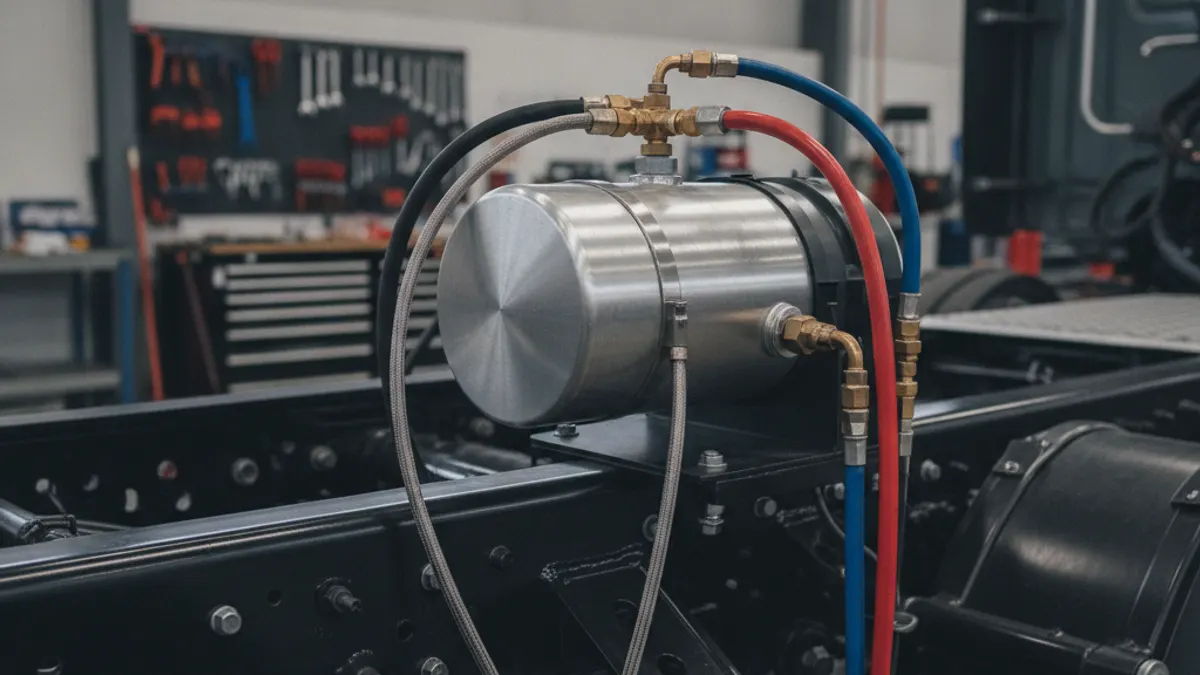
A truck air dryer is the canister mounted between the air compressor and the supply (wet) tank whose job is to remove moisture and oil aerosol from the compressed air before it reaches the brake system. It does this with a bed of desiccant that adsorbs water vapor, then blows that water back out during a short purge cycle each time the compressor stops pumping. Keep the dryer working and your air stays dry, your valves stay clean, and your brakes work in the cold. Let it saturate, and water and oil move downstream into every tank and valve on the vehicle.
What the air dryer does
Every time the compressor runs, it pumps hot, wet air. That air carries water vapor pulled in from the atmosphere plus a fine mist of compressor oil. As the air cools in the lines and tanks, the water condenses into liquid. Left unchecked, that water pools in the tanks, corrodes them from the inside, washes lubricant out of valves, and freezes solid in winter, locking up brake valves and air lines.
The air dryer intercepts that problem at the source. Hot air enters the dryer and passes through a desiccant cartridge, which adsorbs the water vapor onto its surface. Many dryers also include a coalescing or oil-separation stage that catches the oil aerosol. What leaves the dryer and enters your tanks is clean, dry air. On a modern semi truck the dryer is usually a spin-on or bolt-on cartridge with an integral heater to prevent the purge valve from freezing in cold weather.
How the purge cycle works
Drying air is only half the job — the dryer also has to get rid of the water it collected, or the desiccant would saturate within hours. That happens during the purge cycle. When system pressure reaches the governor cut-out (typically around 120-135 psi), the compressor governor unloads the compressor. That same unload signal opens the dryer's purge valve.
With the purge valve open, a reserved volume of dry air — held in the dryer's purge volume, or on some systems in a dedicated purge reservoir — rushes backward through the desiccant bed and out to atmosphere. You hear this as the sharp "chuff" or blast of air from under the truck a second or two after the compressor stops building. That reverse flow scours the collected water and oil off the desiccant and expels it, regenerating the cartridge so it is ready to dry air on the next compressor cycle. No purge, no regeneration — which is why a stuck purge valve quickly kills a dryer.
The desiccant cartridge and when to replace it
The desiccant cartridge is the wear item. The beads gradually lose their capacity to hold moisture, and any oil that gets past the compressor coats them and blinds them off. Once the cartridge can no longer dry the air, water starts showing up downstream even though the dryer looks fine from the outside.
Replacement interval depends heavily on how the truck is used and how much oil the compressor passes. Always follow the OEM or dryer manufacturer's schedule, but these ranges are typical:
| Duty cycle | Typical cartridge interval |
|---|---|
| Severe / vocational (stop-start, high humidity, heavy air use) | ~ every year or ~100,000 miles |
| Regional / mixed haul | ~ every 1-2 years or ~150,000 miles |
| Line-haul highway (steady, low air demand) | ~ every 2-3 years or ~250,000-300,000 miles |
Many fleets simply fold the cartridge into an annual PM to keep it predictable. Whatever interval you pick, change the cartridge sooner if you start finding water in the tanks. Draining the wet tank at each service and checking for water is the cheapest way to know whether the desiccant is still doing its job.
Symptoms of a saturated or failing air dryer
A dryer rarely fails all at once. Watch for these signs:
| What you notice | Likely cause |
|---|---|
| Water drains out when you crack the tank drain cocks | Desiccant saturated — air is no longer being dried |
| Frozen air lines or brakes that won't release in cold weather | Moisture passing downstream and freezing; possible dead purge-valve heater |
| Continuous air hiss / leak at the dryer's purge valve | Failed purge valve, or the valve stuck open |
| Oil sludge on or below the dryer, oily discharge at purge | Compressor passing oil and fouling the desiccant |
| No "chuff" when the compressor unloads | Purge valve stuck closed — cartridge won't regenerate |
Water in the tanks is the headline symptom. If you are draining more than a trickle of moisture at every service, the dryer is no longer keeping up and the cartridge (or the whole dryer) needs attention before that water reaches your valves. Persistent moisture that a dryer can't keep up with is also a common thread in air brake compressor maintenance problems downstream.
The link between the dryer and compressor health
Here is the connection technicians learn the hard way: a dryer that keeps getting oil-soaked is usually telling you the compressor is worn, not that you bought a bad cartridge. As piston rings and bores wear, the compressor pushes progressively more oil downstream. That oil coats the desiccant, destroys its ability to adsorb water, and no purge cycle can scrub it back off. You can replace the cartridge, but it will foul again in short order until the real source is fixed. If you are seeing oil at the dryer, read up on an air brake compressor pumping oil and inspect the compressor before you spend money on dryers.
When the compressor itself is the culprit, a fresh cartridge is a bandage. A worn unit should be rebuilt or swapped for a sound one so the dryer can stay clean and the whole system stays dry. VADEN's range of OE-grade truck air compressors covers the common single- and twin-cylinder units, and pairing a healthy compressor with a fresh dryer cartridge is what actually keeps water and oil out of your tanks — far cheaper than chasing frozen valves in January.
The dryer, the compressor, the governor, and the tanks all work as one moisture-management loop. If any part of the air brake system is neglected, the failure eventually shows up somewhere else — most often as water and corrosion in components that should have stayed dry.
Source (VADEN Original): Air Dryer Cartridge and Moisture Management: Selection, Service Life and Winter Conditions
Need the part, not just the answer?
OE-grade air brake compressors and repair kits, manufactured and tested to commercial-vehicle standards.
Shop VADEN partsPublished by VADEN Original. Product links point to the manufacturer’s official catalogue. Specifications are general — always confirm figures against your vehicle’s service manual.