 airbrakecompressor
When you replace an air brake compressor, the quote should also carry a new air dryer desiccant cartridge, a new discharge line, the governor (or a tested governor refitted with a new gasket), and every gasket, O-ring and sealing washer disturbed when the old unit comes off. Add the drive, coolant, oil and intake parts your installation uses and, if the old compressor was passing oil, the downstream parts it contaminated. This page is the parts checklist; removal and fitting are covered in our air brake compressor replacement guide.
Why a compressor is never a one-part job
By the time a compressor is condemned it has usually pushed oil and carbon into the discharge line, loaded the dryer desiccant with oil, and spent its whole life being loaded and unloaded by a governor of the same age. A new unit fitted into that system inherits the conditions that shortened the old one's life. Seals add a second reason: gaskets, O-rings and copper sealing washers are made to seal once, and reused ones are how a sound installation starts weeping oil or coolant a week later.
The core bundle: quote these every time
These lines belong on every compressor quote, whatever the make, drive type or reason for replacement.
| Part | Quote as | Why it belongs on the same job |
|---|---|---|
| Air dryer desiccant cartridge, plus the coalescing oil filter element where fitted | Replace | Oil carryover from the old compressor has been reaching the desiccant, and once oil-fouled it cannot be cleaned or restored |
| Compressor discharge line, with its end seals | Replace | Carbon inside the line restricts flow and raises head temperature on the new unit |
| Governor | Replace, or test and refit with a new gasket | A sticking or oil-contaminated governor keeps the new compressor loaded or cycling erratically |
| Mounting gasket or flange O-ring | Replace | Single-use seal to the engine gear housing or mounting bracket |
| Oil feed and return seals, including banjo sealing washers | Replace | Crush washers and O-rings do not reseal reliably once disturbed |
| Coolant port O-rings or gaskets (water-cooled units) | Replace | A slow weep at the head goes unnoticed until the coolant level drops |
| Governor signal and unloader control lines | Inspect; replace if oil-wet, kinked or brittle | Small-bore lines clog with oil and carbon and delay unloading |
Keep the cartridge and discharge line on the quote
These are the two lines most often struck out to lower the total, and they do more than any other companion part to decide whether the new compressor lasts. Quote the discharge line as the specified part for that chassis, not generic hose: its length, bore and material are set by the vehicle manufacturer so the air cools before it reaches the dryer.
Governor: replace it or prove it
Keep the existing governor only if its ports are free of oil and it cuts out within roughly 120-135 psi and cuts back in around 100-110 psi. Oil contamination, a sticking cut-in, or an age matching the failed compressor is reason to quote a new one. On many late-model trucks the governor function is built into the air dryer or air processing unit, so that assembly gets checked instead.
Lines that depend on the installation
This group is set by how the engine drives, cools and feeds the compressor. Note what applies before the old unit comes off.
- Gear drive. The drive gear is usually transferred. Quote a new gear if teeth are chipped or worn, plus any retaining nut or fasteners the service manual lists as single-use.
- Belt drive. Quote the belt and inspect the pulley grooves before the pulley is transferred.
- Accessory driven through the compressor. Where the power steering pump or another accessory runs off the back of the compressor, add the drive coupling, its seal and replacement fluid.
- Coolant hoses and clamps. Heat-aged hoses often crack once disturbed; quote new ones if they are hard or swollen, plus coolant to the engine specification.
- Oil feed and return. Replace a kinked or chafed feed line, and check the return path, whether it is a separate line or drains through the mounting face. A restricted return floods the crankcase and pushes oil past the rings.
- Intake connection. A split intake hose lets unfiltered dust in to wear the rings and bore. A compressor with its own intake filter needs a new element.
Lines that depend on why the old unit failed
| What you found | Add to the quote |
|---|---|
| Worn out at normal service life, no oil downstream | Core bundle and installation lines only |
| Heavy oil carryover into the dryer, supply reservoir (wet tank) or valves | Check valves, reservoir drain valves, dryer purge valve parts, oil-soaked nylon tubing, and labor to drain and flush the reservoirs |
| Coolant leaking at the head, or coolant in the air system | Coolant hoses and clamps, coolant, and cleaning of any reservoir or line the coolant reached |
| Knocking, seized unit or damaged drive | Drive gear or coupling, a check of any through-driven accessory, and an engine oil and filter change if bearings failed, since the compressor runs on engine oil |
| Ran constantly or cycled too often | Governor, control lines, and repair of the air leaks that kept it working |
| Head or discharge-port safety valve venting | Safety valve, plus a confirmed cause for the blocked discharge path |
If oil got past the dryer, the list grows valve by valve; our air system decontamination guide sets out what to replace and what can be cleaned.
Confirm what ships in the box
Contents vary by part number, by supplier, and between new and remanufactured units, so read the listing before the quote is final.
- Unloader or clutch. The unloader is normally built into a new or remanufactured unit; on clutched designs, confirm whether the clutch comes with it.
- Governor. Included with some part numbers only. If it is not in the box, it stays a separate line.
- Mounting gasket or O-ring. Often included, not always; quote one if the listing is silent.
- Drive gear, pulley, coupling, fittings and any safety valve. Usually transferred from the old unit, so inspect them and check thread types before the old unit is sent away.
- Core. Remanufactured units are commonly sold against return of the old compressor; check the condition terms before anyone strips parts from it.
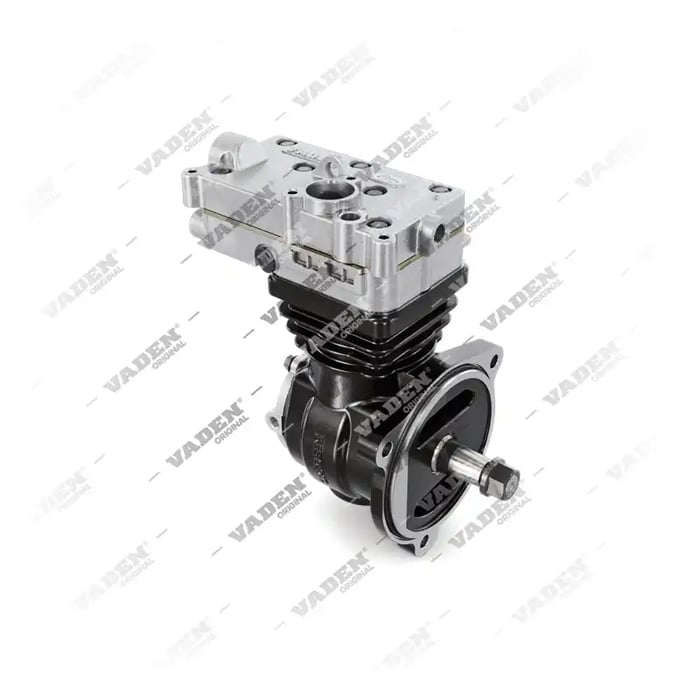
Cross-reference from the number stamped on the old unit, not from the truck model alone. An OE-referenced catalog such as VADEN's air brake compressor range lists each unit against the OE numbers it replaces, which ties the compressor line of the quote to the exact configuration.
Writing the quote so the job does not stall
Split the quote into three blocks: firm lines for the compressor and core bundle, installation lines confirmed once the layout is checked, and conditional lines pre-authorized with a stated trigger, such as "replace the governor if cut-out falls outside the normal range". The technician can then act on what the old unit reveals without the truck sitting idle while approval is chased. Put the part number and new or remanufactured status against the compressor line, and note which companion parts the supplier includes. For what this bundle adds to the invoice, see our breakdown of air brake compressor replacement cost.
A quote that cannot say why the old compressor failed is not finished. The cause of failure decides much of the parts list.
Need the part, not just the answer?
OE-grade air brake compressors and repair kits, manufactured and tested to commercial-vehicle standards.
Shop VADEN partsPublished by VADEN Original. Product links point to the manufacturer’s official catalogue. Specifications are general — always confirm figures against your vehicle’s service manual.