 airbrakecompressor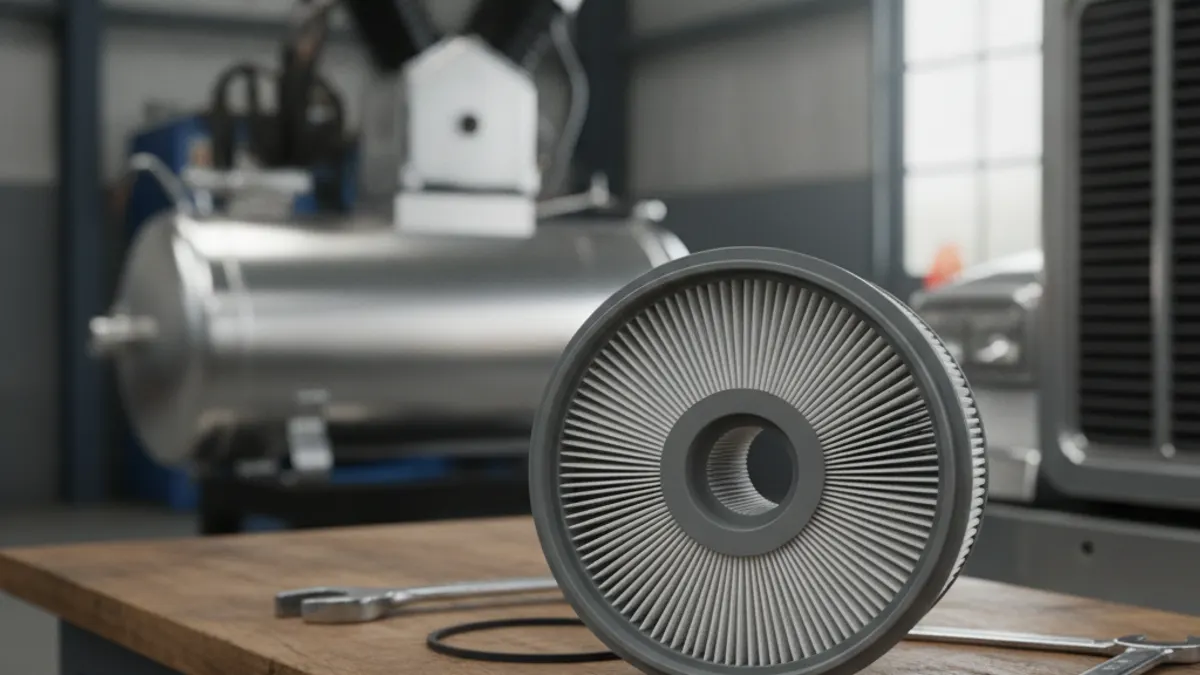
The compressor intake filter keeps dust, soot and road grit out of the air brake compressor's cylinder. On most heavy trucks the compressor has no filter of its own: it draws clean air from the engine air cleaner or from the turbocharger's boost side, so the engine filter is the compressor's intake filter. Where a separate intake filter is fitted (older units, industrial installations and some bus and vocational applications), a plugged element chokes the compressor. Build times get longer, discharge temperature climbs, and the pressure difference across the piston starts dragging crankcase oil past the rings into the air system.
That last point is the reason this two-minute check matters. A restricted intake is the most common reason a mechanically sound compressor starts pumping oil.
What the intake filter actually protects
An air brake compressor is a reciprocating pump driven off the engine gear train, and it inhales the same abrasive environment the engine does. Anything it swallows either scores the bore or travels downstream into the discharge line, the air dryer and the reservoirs.
- Bore and ring wear. Silica dust is harder than the cylinder wall. Unfiltered air polishes rings and glazes the bore in a fraction of normal service life.
- Valve seat damage. Grit lodged under an inlet or discharge valve disc causes leak-back, low output and a hot discharge port.
- Downstream contamination. Whatever passes the intake ends up in the air dryer desiccant and the tanks, where it combines with moisture and oil to form the sludge that shows up at the drain valve.
Where your compressor gets its air
Before you go looking for a filter, identify how the compressor is fed. Three arrangements cover almost every truck on the road.
| Arrangement | How it works | What you service |
|---|---|---|
| Engine air cleaner feed | A hose runs from the clean side of the engine air cleaner to the compressor inlet | Engine air filter element; inspect hose for collapse, cracks and loose clamps |
| Boosted (turbocharged) intake | Compressor inlet is plumbed to the charge side, so it receives pressurised filtered air | Engine air filter; check the inlet line, fittings and any restriction orifice for carbon and oil |
| Dedicated intake filter | Compressor carries its own paper, sponge or spin-on element at the inlet port | The element itself, on a fixed interval |
On a boosted setup there is no separate element to change, but the line still fails. A collapsed hose, an oil-logged inlet fitting or a cracked adapter restricts or contaminates the intake exactly like a plugged filter would, and it is far easier to overlook.
Symptoms of a clogged or restricted intake
| Symptom | Why the intake causes it |
|---|---|
| Oil in the tanks, at the dryer purge, or blowing out of the gladhands | Restriction creates a vacuum in the cylinder on the intake stroke, drawing crankcase oil past the rings |
| Slow build-up, or compressor running almost constantly | Less air mass per stroke means longer run time to reach governor cut-out |
| Compressor and discharge line running hotter than normal | Extended duty cycle plus poor charge cooling raises head temperature |
| Carbon build-up choking the discharge line | High discharge temperature bakes carried-over oil into hard deposits |
| Air dryer cartridge saturating early or purging oily mist | The desiccant bed is being loaded with oil it was never meant to absorb |
| Whistle or suction hiss at the compressor inlet | Air being pulled hard through a plugged element or a kinked, undersized line |
The oil symptom is the one to take seriously. Many compressors are condemned for "pumping oil" when the real fault is upstream; see air brake compressor pumping oil for the full diagnostic sequence. A healthy system should reach a fully charged pressure of roughly 120 psi, with governor cut-out typically in the 120 to 135 psi band and cut-in around 100 to 110 psi. If the vehicle will not build to those figures, or the low-air warning near 60 psi keeps activating, treat the intake as one item on a wider pressure-loss investigation rather than the only suspect.
Why restriction turns into oil carryover
Think of the compressor as a pump with oil on one side of the piston rings and air on the other. Normally the crankcase and the cylinder see only a modest pressure difference. Plug the intake and the cylinder pulls a strong vacuum on every intake stroke while the crankcase stays near atmospheric. That differential is a pump in its own right, and it moves oil in one direction only: upward, into the air.
The same logic applies to the crankcase breather and the oil return line. A blocked breather or a restricted drain raises crankcase pressure and produces identical symptoms, so check all three whenever oil shows up in the system.
If a compressor is replaced for oil carryover and the intake restriction is not corrected, the replacement unit will fail the same way. Change the air dryer cartridge and clear the discharge line at the same time, or the old oil simply recirculates.
Inspection and service procedure
- Park on level ground, chock the wheels, shut the engine down and drain the reservoirs before opening any intake plumbing.
- Trace the intake line from the compressor back to its source. Note whether it terminates at the engine air cleaner, the charge side, or a dedicated filter housing.
- Remove and inspect the element if one is fitted. Hold a paper element up to a light; if the media is grey-black or oil-soaked, replace it. Do not blow paper elements out with shop air, which opens the media.
- Check the hose along its whole length for collapse, softening, chafing and internal delamination. A hose can look sound outside and be closing up inside.
- Check every clamp and adapter fitting. Any leak on the intake side draws unfiltered air straight into the cylinder.
- Clean oil or carbon from the inlet port and adapter. Heavy oil there points to a crankcase pressure problem, not just a dirty filter.
- Replace the engine air filter on schedule where the compressor shares it, because that filter is now doing two jobs.
- After service, run the engine up to governor cut-out, confirm normal build time, then check the dryer purge for oil mist.
Measuring intake restriction
The workshop method is a water manometer or a low-range vacuum gauge teed into the intake line close to the compressor inlet, read at rated engine speed with the compressor loaded. Manufacturers publish a maximum restriction figure in inches of water for each unit, and it varies with displacement and intake arrangement, so treat the value in the current service manual for your compressor and engine as the only authority. If the reading exceeds that limit, correct the filter or the plumbing before condemning the compressor.
Service intervals and parts
Where a dedicated element exists, most builders call for replacement at each major PM, and more often in construction, quarry, agricultural or other high-dust work. Trucks sharing the engine air cleaner inherit that filter's interval, which is fine as long as the shared line is inspected too. Quality matters here: media that sheds fibres or collapses under suction defeats the purpose, so use properly specified air filters built for commercial vehicle air systems rather than whatever fits the port.
Fold the intake check into routine air brake compressor maintenance alongside tank draining and dryer cartridge changes. It costs two minutes, and it is the step that most often prevents a compressor replacement.
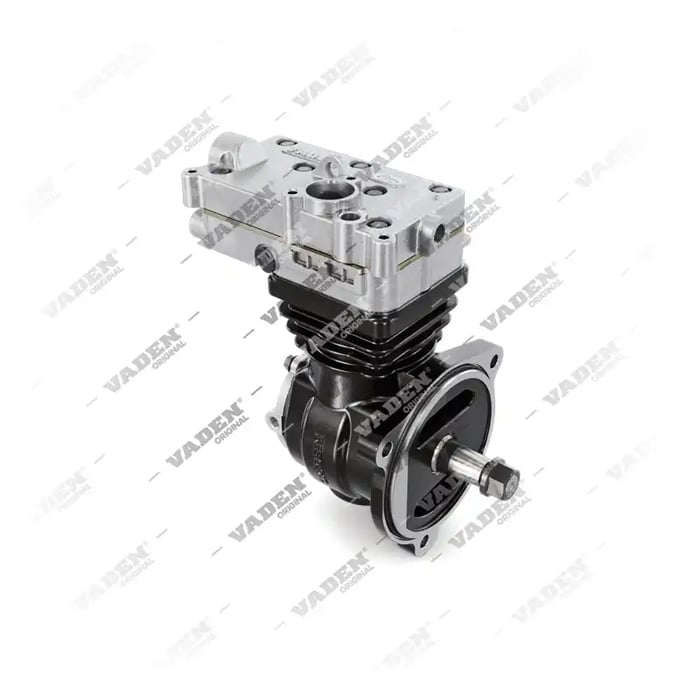
Need the part, not just the answer?
OE-grade air brake compressors and repair kits, manufactured and tested to commercial-vehicle standards.
Shop VADEN partsPublished by VADEN Original. Product links point to the manufacturer’s official catalogue. Specifications are general — always confirm figures against your vehicle’s service manual.