 airbrakecompressor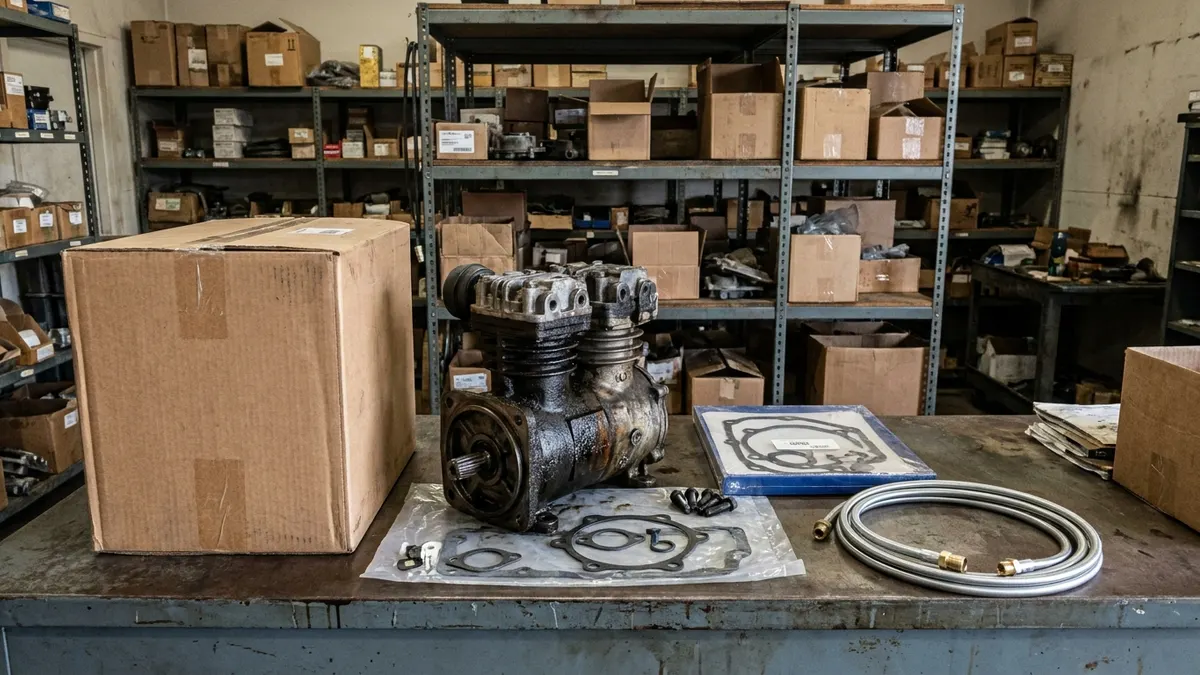
Choose a minor (seal-and-gasket) kit when the compressor still pumps well but leaks, weeps, or fails to unload cleanly, and step up to a major (overhaul) kit when it pumps oil, builds pressure slowly, or has high mileage. The minor kit renews the soft parts — unloader seals, O-rings, gaskets, and valve seals — while the major kit adds the mechanical wear items: piston rings, the valve plate or reed valves, and often the main bearings. Match the kit to the symptom and the hours on the unit, not to the cheapest box on the shelf.
What each kit actually contains
Air brake compressors are engine-driven, air-cooled pumps that feed the reservoirs until the governor reaches cut-out (roughly 120-135 psi), then unload until pressure drops to cut-in (about 100-110 psi). A fully charged system sits near 120 psi; the low-air warning trips around 60 psi. Every part in a repair kit exists to keep that cycle tight and oil-free. The difference between a minor and a major kit is how deep into the pump you go.
| Component | Minor kit | Major kit |
|---|---|---|
| Unloader plunger seals / O-rings | Yes | Yes |
| Head and base gaskets | Yes | Yes |
| Discharge and inlet valve seals | Yes | Yes |
| Piston rings | No | Yes |
| Valve plate / reed valve assembly | Sometimes | Yes |
| Main and connecting-rod bearings | No | Often |
| Cylinder head (if included) | No | Some kits |
If you want a full parts breakdown before you order, our page on what comes in an air compressor repair kit lists the typical contents so you can cross-check against your unloader style and cylinder count.
Choose by symptom first
The fastest way to pick a kit is to read what the compressor is telling you. Before you condemn the pump, rule out the governor and air dryer — a governor that won't cut out or a saturated dryer mimics a tired compressor.
Leaks, weeping, or won't hold cut-out
Air hissing at the head, a governor that cycles too fast, or the compressor never fully unloading points to hardened unloader seals and gaskets. That is a minor kit job. You are renewing rubber, not iron, and the cylinder bore is still good.
Oil at the discharge or in the air dryer
Oil carryover — wet, black residue at the discharge port, oil-fouled dryer cartridges, or oil pooling in the wet tank — means the piston rings and valve plate are passing crankcase oil past the pistons. That is a major kit every time; new seals will not stop a worn ring pack. See our diagnosis of an air brake compressor pumping oil to confirm before you open it up.
Slow to build or won't reach cut-out
A compressor that takes far longer than normal to bring the system up, or that stalls below normal cut-out, usually has worn rings and leaking discharge valves losing compression on the up-stroke. A major kit restores the seal; a minor kit will not recover lost pumping capacity.
Choose by mileage and measured wear
Symptoms tell you what failed; hours tell you what is about to. Use this as a rough guide, then verify with a measurement.
| Condition | Sensible choice |
|---|---|
| Low hours, soft-part leak only | Minor kit |
| Any oil carryover | Major kit |
| High mileage but bore still in spec | Major kit |
| Scored bore, excess bearing play, knock | Replace or reman |
When you have the head off, measure before you commit. Check the cylinder bore for scoring and taper, inspect the valve plate for pitting, and feel the crankshaft for radial and end play. If the bore is glazed but unscored and within the maker's wear limit, a major kit gives you a like-new pump. If the bore is scored or the crank is loose, no kit will save it — reboring a truck air compressor is rarely economical.
When a kit is not the right call
There is a point where rebuilding stops making sense. A knocking bottom end, a cracked casting, deep cylinder scoring, or a unit that has already been overhauled once is usually better replaced with a reman or new compressor. Weigh the labor hours against the price gap, since much of the cost is in removing and refitting the unit either way. Our comparison of rebuild vs replace for an air compressor walks through where that line falls for common single- and twin-cylinder pumps.
Whichever kit you land on, buy OE-grade components matched to your exact compressor casting and unloader type — an internal-unloader kit will not fit an external-unloader head, and reed-valve pumps use different plates than poppet-valve designs. VADEN supplies genuine air brake compressor repair kits organized by application, so you can order the correct minor or major set the first time and avoid a second teardown.
A quick decision path
- Confirm the governor cuts out near 120-135 psi and cuts back in near 100-110 psi, and that the air dryer is purging.
- Check the discharge line and dryer for oil. Oil present means a major kit.
- No oil, but leaking or unloading poorly? A minor kit is enough.
- Slow to build or short on cut-out with no external leak? Plan on a major kit.
- Pull the head and measure the bore and bearings. Out of spec means replace, not rebuild.
Done in that order, you order once, tear the compressor down once, and put the truck back in service with a system that charges cleanly and holds pressure through every cut-in and cut-out cycle.
Need the part, not just the answer?
OE-grade air brake compressors and repair kits, manufactured and tested to commercial-vehicle standards.
Shop VADEN partsPublished by VADEN Original. Product links point to the manufacturer’s official catalogue. Specifications are general — always confirm figures against your vehicle’s service manual.