 airbrakecompressor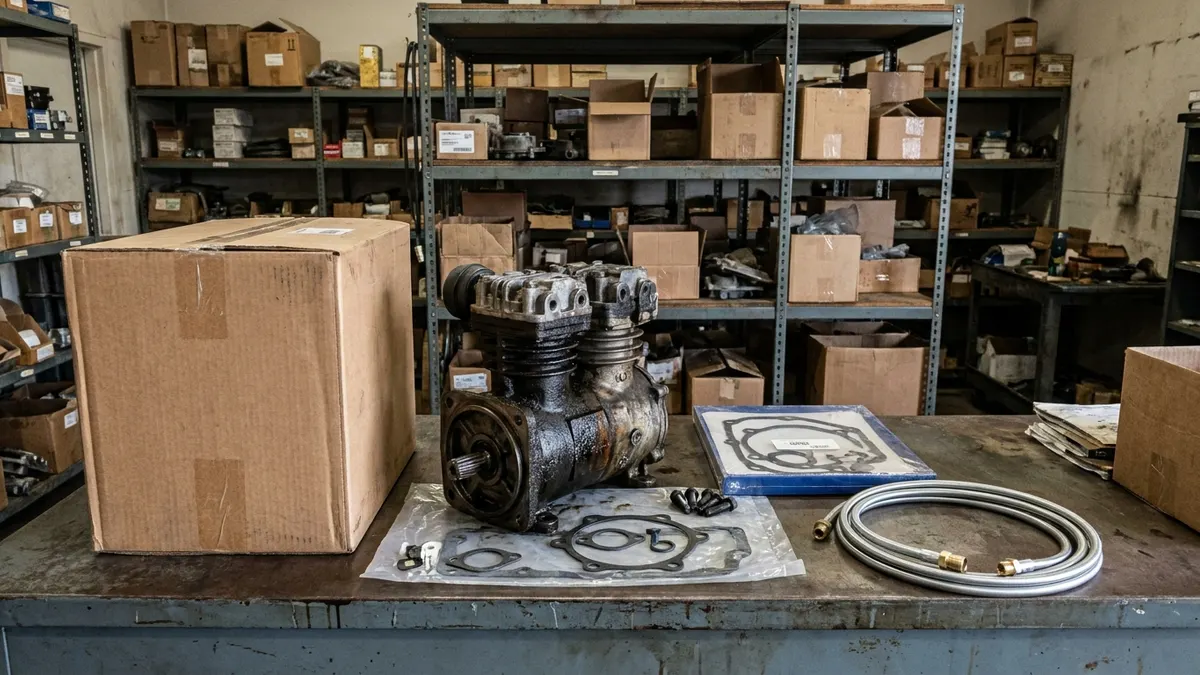
Replacing an air brake compressor on a heavy truck usually lands between roughly $500 and $2,500 installed — about $250–$1,800 for the unit itself, plus two to six hours of labor at typical shop rates. Small single-cylinder compressors on light vocational trucks sit at the bottom of that band; twin-cylinder, high-output units on large-displacement diesels with coolant and oil feed lines sit at the top. If the casting, bore and bearings are still healthy, a repair kit and a couple of hours of bench time often cures the same complaint for a few hundred dollars total.
Keep in mind what you are buying. Air brakes are pneumatic, not hydraulic, so the compressor is not a wear item you can nurse along the way you might a marginal pad on a car. It is the air supply for the whole vehicle. When it stops keeping up, pressure bleeds down, the low-air warning comes on around 60 psi, and the spring brakes set themselves somewhere in the 20–45 psi range. That is why this is really a downtime conversation with a parts bill attached.
What actually drives the price
- Displacement and cylinder count. A modest single-cylinder unit costs a fraction of a large twin-cylinder compressor sized for a heavy tractor with air suspension and accessories.
- New, remanufactured or rebuilt. A quality reman with a new head, valves and unloader assembly typically undercuts a new unit by 30–50 percent and is the sweet spot for most fleets.
- Mounting and access. A gear-driven compressor buried behind the air conditioning compressor or under the intake takes far longer than a belt-driven unit hanging off the front of the block. Labor is where quotes diverge most.
- What rides along. Discharge line, governor, air dryer cartridge, gaskets, O-rings, coolant and oil feed lines. Skipping these to save $100 is how you end up doing the job twice.
- Where the work happens. A scheduled bay slot is cheapest. A roadside or mobile call-out adds a call fee and usually a premium labor rate.
Typical cost breakdown
The ranges below are indicative shop figures and move with region, engine family, duty cycle and parts availability. Use them to sanity-check a quote, not as a price list. Our air brake compressor cost breakdown walks through the same line items component by component.
| Line item | Typical range | Notes |
|---|---|---|
| Unloader / repair kit | $40–$150 | Unloader pistons, seals, springs, valve plate hardware |
| Cylinder head gasket kit | $30–$120 | Common fix for a compressor that builds slowly or weeps |
| Reman single-cylinder compressor | $250–$700 | Core charge often applies |
| Twin-cylinder / high-output compressor | $700–$1,800 | Heavy tractors, large-displacement diesels |
| Air dryer desiccant cartridge | $40–$120 | Replace with the compressor, not later |
| Discharge line or braided hose | $60–$250 | Carbon-choked lines must be replaced, not cleaned out |
| Governor | $50–$180 | Cheap insurance if cut-out has been drifting |
| Labor, 2–6 hours | $200–$1,000 | Access is the variable; gear-driven units take longest |
| Mobile or roadside call-out | $150–$400 extra | On top of parts and labor |
When a repair kit is the smarter spend
Plenty of compressors get condemned that only needed a head or an unloader kit. Before authorizing a full unit, have the technician confirm the symptom against the governor and the discharge side. A kit is usually the right call when the compressor still pumps but cut-out is weak or slow, when air leaks steadily from the governor exhaust or unloader area with the system charged, or when the head gasket is seeping and oil consumption is normal.
Go the whole-unit route when there is a knock or rumble under load, when the crankcase is making metal, when the bore is scored or the shaft has play, or when the unit is pumping oil into the supply side badly enough to foul the dryer and downstream valves. A rebuild on a worn-out casting is money spent twice. Our rebuild versus replace comparison walks through the inspection points that decide it, and the step-by-step replacement guide covers what the labor hours actually buy you.
Do not pay for the same job twice
The most expensive version of this repair is the one you do twice in a year. Two causes account for most repeat failures. The first is a saturated or neglected air dryer letting moisture and oil vapor circulate; replacing the cartridge at the same time is the cheapest line on the whole invoice, and how the dryer protects the system is worth understanding before you decline it. The second is a restricted discharge line — carbon builds inside it, back-pressure rises, head temperature climbs, and the new compressor cooks itself. Replace the line if it shows any restriction.
Also check the duty cycle. A compressor that runs more than roughly a quarter to a third of the time is being asked to cover leaks somewhere else in the system, and the leak is the actual repair. Chasing that first is far cheaper than another compressor.
Test before you condemn
A five-minute check separates a compressor problem from a governor or leak problem. With the engine running, the governor should cut out somewhere in the 120–135 psi range and cut back in around 100–110 psi, with a fully charged system sitting near 120 psi. A common yardstick on a dual system is building from about 85 to 100 psi in roughly 45 seconds at fast idle. Then shut down, chock the wheels, and watch static leak-down with the brakes released and again applied. If build time is normal and cut-out is on spec, the compressor is likely fine and you are looking at a leak or a control valve instead.
Downtime is the bigger invoice
For an owner-operator, a day out of service usually outweighs the price difference between a mid-grade and an OE-grade compressor. Plan the job into a scheduled service window, have the dryer cartridge, discharge line, gaskets and governor on the shelf before the truck goes up on the lift, and confirm the engine's exact compressor variant by part number rather than by engine family. If you are sourcing the unit yourself, matching a correct OE-grade air brake compressor to the original casting and mounting pattern avoids the classic delay of a part that will not bolt up.
Getting a fair quote
Ask the shop four things: which specific compressor part number they are quoting and whether it is new or reman, whether the dryer cartridge and discharge line are included, how many labor hours they have booked, and what warranty covers the unit and the labor. A quote that omits the dryer and the discharge line is not cheaper — it is incomplete. And if the diagnosis was made without a build-time and leak-down test, ask for one before parts are ordered.
Need the part, not just the answer?
OE-grade air brake compressors and repair kits, manufactured and tested to commercial-vehicle standards.
Shop VADEN partsPublished by VADEN Original. Product links point to the manufacturer’s official catalogue. Specifications are general — always confirm figures against your vehicle’s service manual.