 airbrakecompressor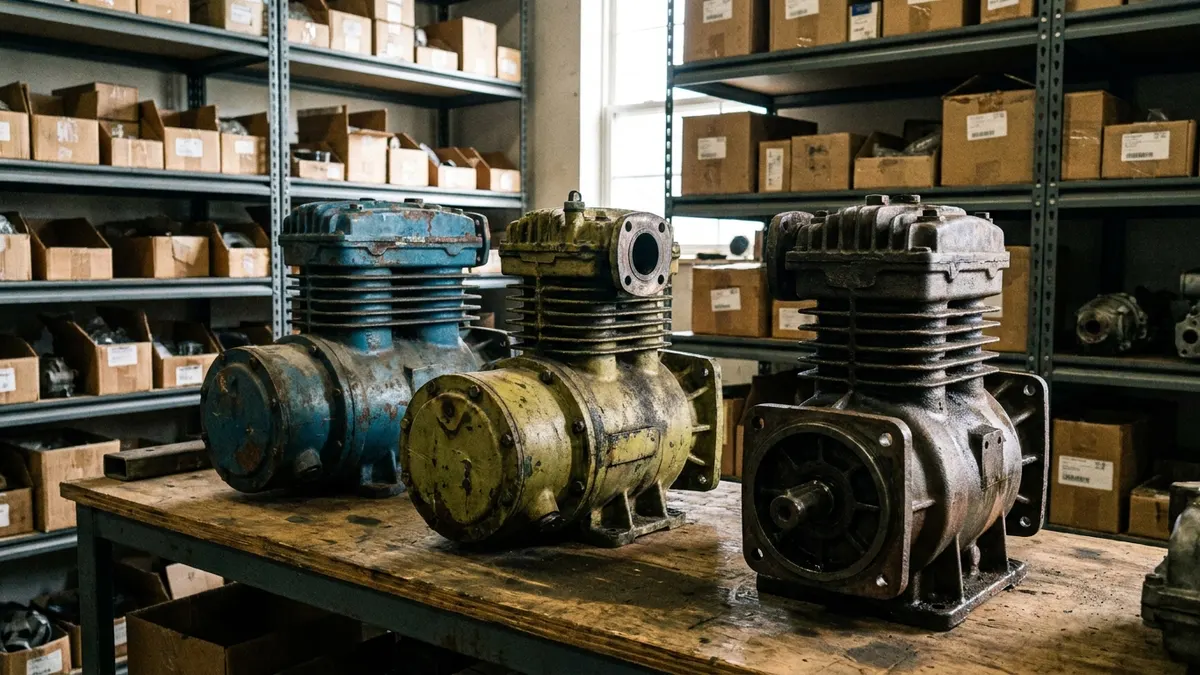
The identifying number on a truck air compressor is stamped, tagged, or cast into the crankcase, the cylinder head, or the mounting flange — most often on a flat machined pad near the discharge port or on a metal plate riveted to the body. Clean the surface with solvent and a wire brush, read the entire string including prefix letters and any dash suffix, and photograph it before you order anything. Treat that number as a catalogue lookup key rather than a code you decode from first principles: on heavy-duty pneumatic compressors, the number rarely tells you displacement, drive type, or cooling method on its own.
Where the number lives on the compressor
Location varies by manufacturer and by engine installation, but the number is almost always in one of these places:
- A machined pad on the crankcase, usually on the side facing away from the engine block.
- The cylinder head casting, near the discharge port or between the head bolts.
- A riveted or bonded ID tag on the crankcase or the end cover — common on remanufactured units.
- The mounting flange face, on gear-driven units bolted to the engine timing case.
- A bar-coded label on the side of the body, which often survives poorly under road grime and heat.
If the compressor is still installed, expect the number to be facing the block or buried behind the discharge line. A mirror and an inspection light beat guessing. If the string is corroded, lay a sheet of paper over it and take a pencil rubbing — raised cast digits transfer well.
Which number is which
Most compressors carry more than one number, and picking the wrong one is the single most common cause of a wrong shipment.
| Number type | How it appears | What it is good for |
|---|---|---|
| Service or OE part number | Stamped into a machined pad, or printed on an ID tag | The primary ordering number; cross-references to replacements and kits |
| Casting number | Raised or recessed digits moulded into the crankcase or head | Identifying the body family when the tag is gone; not an ordering number |
| Engine or truck OEM number | Separate stamped number or a second tag, often longer | Ordering through the vehicle manufacturer's parts system |
| Serial and date code | Short alphanumeric string near the part number | Warranty claims and serial-break kit selection |
| Remanufacturer tag | Added plate, sometimes covering the original stamp | Tracing the rebuild; the original number may be underneath |
A casting number can be shared across several finished part numbers that differ only in head configuration, unloader type, or drive. Ordering from a casting number alone is how a twin-cylinder body turns up with the wrong drive gear.
What the string actually encodes
Some manufacturers use a readable structure: a prefix identifying the product line, a base number identifying the compressor family, and a suffix or dash number identifying the variant — head porting, unloader arrangement, drive, or a running engineering change. Others use a flat sequential number with no internal logic at all, and truck OEM numbers are frequently just internal inventory keys.
Practical rule: the base number gets you to the family, the suffix gets you to the exact build. Never drop the suffix to "get a match." A number ending in a dash and two digits is telling you something the base number does not, and that something is usually the mounting or the unloader configuration. Cross-referencing by engine is often faster and safer than reading the string — see compressor cross-reference by engine if the tag is unreadable.
Confirm the physical build before you order
Even with a clean number in hand, verify the unit on the bench. Supersessions, mid-production changes, and previous incorrect repairs all break a paper match.
| Check | What to look for | Why it matters |
|---|---|---|
| Cylinder count | One or two bores in the head | Sets air delivery and the whole kit family |
| Drive type | Gear, splined shaft, keyed shaft, or belt pulley | Wrong drive means the unit will not fit or turn |
| Mounting | Flange bolt pattern and pilot diameter, or bracket-mount feet | Flange patterns differ between engine families |
| Cooling | Coolant ports in the head or crankcase, or finned air-cooled head | Air-cooled and water-cooled variants share body castings |
| Unloader | Integral unloader pistons in the head, or remote control | Determines governor plumbing and repair kit contents |
| Ports | Discharge, inlet, governor and oil feed thread sizes | Thread mismatches surface only at installation |
| Lubrication | Pressure-fed oil gallery or self-lubricated | Feed and return lines must match the engine |
Turning the number into a part
Once the number is confirmed, you have three routes. A new or reman complete unit is the cleanest fix when the bores are scored or the crankcase is damaged. A repair kit makes sense when wear is confined to rings, valves, gaskets, or the unloader — see what a compressor repair kit contains before deciding. If you are replacing the whole assembly, the replacement procedure covers discharge line, gasket and timing considerations.
For sourcing, search a catalogue that indexes by OE number rather than by vehicle description alone; VADEN's air brake compressor range listed by OE reference is organised that way, which lets you confirm a match against the number you read off the body.
Mistakes that cost a second shipment
- Reading the reman tag only. The rebuilder's number may not cross-reference anywhere outside their own system.
- Dropping letters. Prefix characters routinely separate air-cooled from water-cooled builds.
- Confusing 5 with S, 0 with D, 8 with B. Cast digits distort. Verify against a second number on the unit.
- Assuming the fitted compressor is correct. A previous owner may have installed a near-match. Cross-check against the engine data plate.
- Ignoring the governor. Some numbers include a compressor-mounted governor; ordering the bare unit leaves you short a part.
After fitting, verify system behaviour rather than assuming the number was right. A correct unit on a healthy system should build to a fully charged pressure of roughly 120 psi, cut out somewhere in the 120 to 135 psi band, and cut back in around 100 to 110 psi. Slow build, a cut-out that never arrives, or a compressor that runs constantly points to a mismatched or undersized unit, a governor problem, or a leak — not to a break-in period.
Need the part, not just the answer?
OE-grade air brake compressors and repair kits, manufactured and tested to commercial-vehicle standards.
Shop VADEN partsPublished by VADEN Original. Product links point to the manufacturer’s official catalogue. Specifications are general — always confirm figures against your vehicle’s service manual.