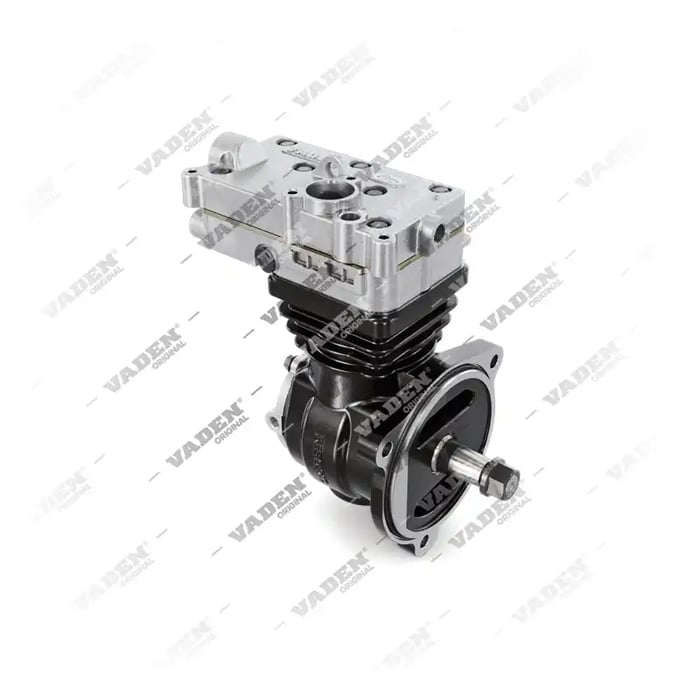
 airbrakecompressor
The annual DOT inspection under 49 CFR 396.17 has to be done on every commercial motor vehicle at least once every 12 months. A qualified inspector does it, using the minimum standards in Appendix G to 49 CFR Subchapter B. The carrier keeps the signed report for 14 months, and the vehicle carries proof of inspection: either the report itself or a decal. Brakes are the first and most detailed section of that standard.
This is not the same job as the daily walkaround. The air brake pre-trip inspection is the driver's check before each trip. The periodic inspection is a documented, part-by-part examination, and a qualified person certifies it with a signature.
Who and what the rule covers
Section 396.17 applies to commercial motor vehicles in interstate commerce. Under 49 CFR 390.5 that generally means any of these:
- a vehicle or combination rated at 10,001 lb or more
- a vehicle built to carry 16 or more people, or 9 or more for compensation
- any vehicle hauling placarded hazardous materials
Many states apply the same rule to intrastate carriers.
Each unit counts on its own. A tractor, each trailer and each converter dolly needs its own inspection, its own report and its own proof. A current decal on the tractor does nothing for an uninspected trailer behind it.
Brake items on the annual inspection
Section 1 of Appendix G lists the brake conditions that fail a vehicle. On an air-braked truck, the inspector covers these areas:
| Component | Typical failing conditions (summarized) |
|---|---|
| Service brakes | No braking action on an axle that must have brakes. Missing or broken shoes, linings, pads, springs, anchor pins, spiders, cam rollers or pushrods. Loose service brake chambers or camshaft support brackets. An audible air leak at a chamber. Pushrod stroke past the readjustment limit. |
| Parking brake | No brakes apply when the parking brake control is actuated |
| Brake drums and rotors | External cracks, or cracks that open when the brakes are applied. Any piece missing or about to fall away. |
| Brake hose | Damage through the outer reinforcement ply, bulging under pressure, audible leaks, improper splices, or cracked or crimped hose |
| Brake tubing | Audible leaks, cracks, heat damage or crimping |
| Low-pressure warning device | Missing, not working, or not coming on at the required threshold (around 60 psi on most modern trucks) |
| Tractor protection valve | Missing or not working |
| Air compressor | Drive belt close to failure, loose mounting bolts, a cracked, broken or loose pulley, or cracked or broken mounting brackets, braces or adapters |
| Antilock brake system | A required ABS malfunction lamp is missing or does not work |
| Automatic slack adjusters | Missing where required, or not holding stroke within limits |
Measuring pushrod stroke
Stroke is the item written up most often. The inspector shuts the engine off, sets reservoir pressure to about 90-100 psi and holds a full service application. Then they measure how far each pushrod travels and compare it with the readjustment limit for that chamber type and stroke design. A standard-stroke and a long-stroke chamber of the same type have different limits, so identify the chamber correctly first. The full limits are in our brake adjustment limits chart. If an automatic slack adjuster is out of adjustment, look for a problem in the foundation brake. Backing it off by hand only hides the problem.
System checks a good inspector adds
Appendix G is only the minimum. Some faults show up only when the system is under pressure, so a proper inspection tests the air system as a whole:
- Governor settings. Cut-out is typically between 120 and 135 psi and cut-in between 100 and 110 psi. Check both against the vehicle manufacturer's specification.
- Build-up time. Time the pressure rise to cut-out and compare it with the manufacturer's figure. A slow build points to compressor wear, a restricted intake or a leak.
- Leakage. Charge the system fully, shut the engine off and watch the pressure drop, first with the brakes released and then with a full application held. State CDL manuals commonly give about 2 psi per minute released and 3 psi applied for a single vehicle, and about 3 and 4 psi for a combination.
- Warning and spring brake application. Pump the brakes to bleed pressure down. The low-air warning should come on at around 60 psi, and the spring brakes should apply somewhere in the 20-45 psi range.
- Reservoirs. Drain each tank and note any oil or water. Heavy oil carry-over points to a compressor or air dryer fault and belongs on the report.
- Tractor protection system. Disconnect the trailer supply line at the gladhand coupler. The tractor should hold its own air, and the trailer supply should shut off as pressure drops.
What the inspection report must contain
Under 49 CFR 396.21, the report must:
- identify the person who did the inspection
- identify the motor carrier or other entity responsible for the vehicle
- show the inspection date
- identify the vehicle, for example by VIN or fleet unit number
- list the components inspected and describe the results
- include a certification that the report is accurate and complete
FMCSA does not require a specific form. A carrier checklist, a shop form or an electronic record is fine, as long as it has these elements and covers the Appendix G components.
Decal, retention and proof on the vehicle
| Requirement | What the rule says |
|---|---|
| Frequency | At least once every 12 months, for each unit |
| Proof on the vehicle | A copy of the report, or a sticker or decal based on it |
| Decal contents | Inspection date; name and address of the carrier or entity holding the report; vehicle identification if it is not clearly marked on the vehicle; certification that the vehicle passed a 396.17 inspection |
| Report retention | The carrier or the entity responsible for the inspection keeps the original or a copy for 14 months from the inspection date |
| Inspector qualification records | Kept while the person does inspections for the carrier, plus one year |
The decal does not replace the report. It shows where the report is kept, and in a compliance review the carrier must produce that report. A vehicle that passes a roadside inspection done under a state or FMCSA program meeting Appendix G is treated as meeting the annual requirement. That credit runs for 12 months from the last day of the month the inspection took place. A few states also run periodic inspection programs that FMCSA recognizes as equivalent.
Who can sign the inspection
Two qualification rules apply:
- Section 396.19 (periodic inspector). The person must understand the Appendix G standards and know how to inspect for them. They qualify through a state, federal or other recognized training program, a valid state-issued certificate, or at least one year of combined training and experience as a commercial vehicle mechanic or inspector.
- Section 396.25 (brake inspector). Anyone who inspects, adjusts or repairs brakes during the inspection must also qualify as a brake inspector. That means an approved apprenticeship or training program, or at least one year of brake-related training or experience.
The carrier can use a third-party shop, but it stays responsible for the result.
When a brake item fails
The vehicle does not pass until the defect is repaired and rechecked, and no decal goes on while a brake defect is still open. The annual standard and the roadside out-of-service criteria are separate documents. A condition can fail Appendix G without being bad enough to put the truck out of service at roadside. "It would pass a roadside check" is not a pass on the annual.
Replace failed parts with components that match the original specification. Several details affect whether the repaired brake meets the standard:
- chamber type and stroke design
- slack adjuster arm length
- valve port sizes
- compressor mounting
Confirm the OE number before ordering. The VADEN Original brake system parts catalog lists components by OE reference. After the repair, write what was replaced on the report and in the vehicle's maintenance file. Under 49 CFR 396.3, that file is kept for one year, and for six months after the vehicle leaves the carrier's control.
Need the part, not just the answer?
OE-grade air brake compressors and repair kits, manufactured and tested to commercial-vehicle standards.
Shop VADEN partsPublished by VADEN Original. Product links point to the manufacturer’s official catalogue. Specifications are general — always confirm figures against your vehicle’s service manual.