 airbrakecompressor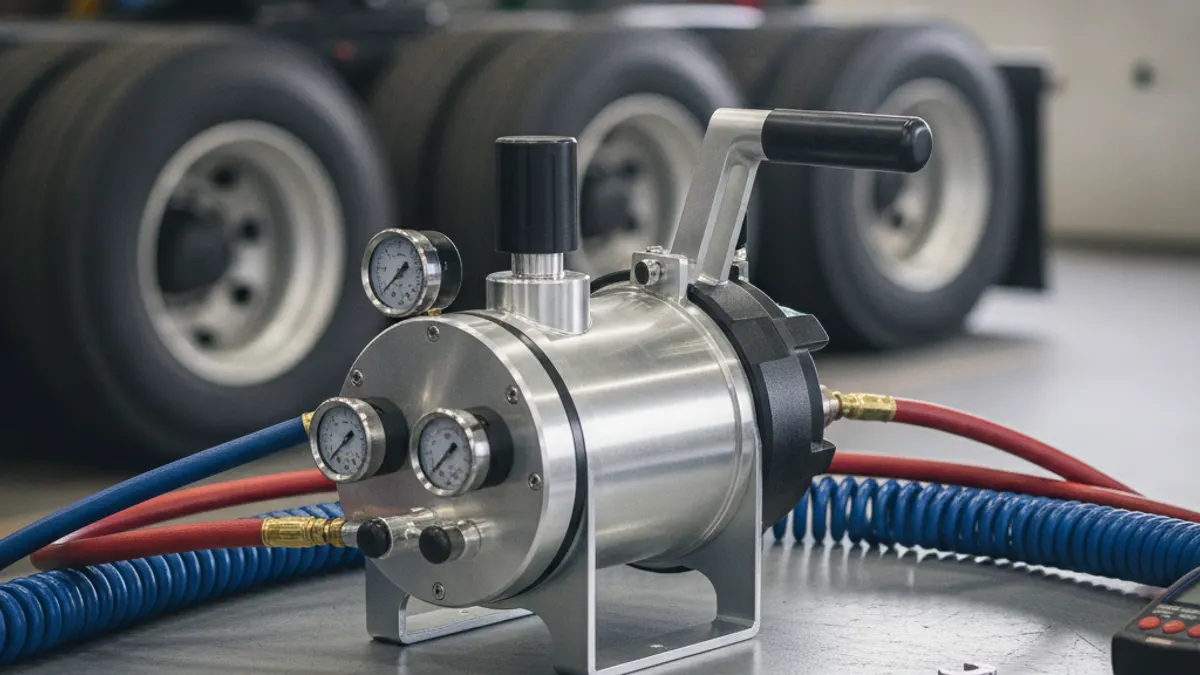
At a UK annual test — what most drivers still call the "HGV MOT" — the air brake system is assessed in three ways: a brake performance test (normally a roller brake test at an Authorised Testing Facility), a pneumatic system check covering build-up time, governor operation, leakage and warning devices, and a visual and under-vehicle inspection of every component from the compressor to the brake chambers. A vehicle fails if measured braking efficiency is below the required percentage, if the system leaks or will not charge properly, or if any single component is defective enough to be recorded as a major or dangerous defect. DVSA examiners apply the same standards at the roadside, where the outcome is a prohibition notice rather than a refused test certificate.
"MOT" versus the HGV and PSV annual test
Strictly speaking, the MOT is the test for cars, vans and light vehicles up to 3.5 tonnes. Air-braked heavy goods vehicles, buses, coaches and trailers go through the annual test, carried out by DVSA at an ATF or a DVSA site, with the first test due 12 months after first registration and every 12 months after that. Trailers are tested in their own right and carry their own test record.
A light vehicle with air-over-hydraulic brakes — some horseboxes and recovery bodies — goes through a class 7 MOT instead, but the tester will still check that the air side charges, holds pressure and warns correctly. Either way the annual test is a snapshot, not a substitute for the periodic safety inspections an operator licence requires, where DVSA also expects a brake performance assessment.
The brake performance test
The roller brake test (RBT) is the default method. Each wheel is driven on rollers, the brake is applied progressively, and the machine records braking force at each wheel against the weight imposed on that axle. From that the tester calculates service, secondary and parking brake efficiency, plus the imbalance across each axle.
| Brake system | Motor vehicle (HGV/PSV) | Notes |
|---|---|---|
| Service brake | 50% | Trailers are assessed to their own, lower service figure |
| Secondary brake | 25% | Usually achieved through the graduated spring brake control |
| Parking brake | 16% | Spring brakes only, with no service air assisting |
| Axle imbalance | Assessed per axle | A large side-to-side difference fails even when total efficiency passes |
A decelerometer road test is permitted where a roller test is not practical, and for trailers DVSA accepts EBPMS (Electronic Brake Performance Monitoring System) reports as evidence of performance in place of a laden roller brake test.
Why load matters
An unladen air-braked vehicle will often lock its wheels on the rollers long before full brake force is developed, so the machine records a misleadingly low figure. DVSA guidance is that brake testing should be done with a meaningful load on the axles — commonly quoted as at least 65% of design axle weight. Turning up empty is an easy way to fail on a vehicle whose brakes are sound.
The air system checks
Alongside the performance test, the examiner works through the pneumatic system itself:
- Build-up time — the compressor must charge the system from low pressure to governor cut-out within a reasonable time. A slow build points at a worn compressor, a leaking unloader or a restricted governor line.
- Governor operation — cut-out and cut-in must fall inside the manufacturer's band, with a clear purge from the dryer at cut-out. On most heavy vehicles cut-out sits somewhere around 8 to 9 bar (roughly 120–135 psi) and cut-in around 7 to 7.6 bar (roughly 100–110 psi), but the vehicle's service data is what counts.
- Leakage — with the system fully charged (typically about 8 bar, near 120 psi), engine stopped and the foot valve fully applied, pressure drop must stay inside a defined limit over a set period. Combinations are allowed slightly more than a solo vehicle. Any audible leak is investigated.
- Low-air warning — the buzzer and lamp must operate as pressure falls, usually somewhere around 4 to 4.5 bar (about 60–65 psi), and must clear correctly on recharge.
- Automatic application — the spring brakes must apply automatically as reservoir pressure falls away, and the trailer must brake automatically on a lost service line.
- ABS and EBS — warning lamps must illuminate on ignition and extinguish correctly, on both tractor and trailer.
Much of this mirrors what a driver covers on a daily walkaround, so a disciplined air brake pre-trip inspection routine catches most of it long before test day.
Common air brake failure points
| Area | Typical defect | Pre-test fix |
|---|---|---|
| Pipework and hoses | Chafing on chassis rails, kinked nylon line, perished rubber, missing clips | Walk the chassis with a lamp; re-clip and sleeve anywhere a line touches metal |
| Couplings | Leaking or damaged gladhand seals, worn palm couplings, split susie outers | Renew the seals; they are cheap and cause a large share of leak failures |
| Brake chambers | Excessive push-rod stroke, corroded or split housing, weeping diaphragm | Measure stroke against the limit for the chamber size, then adjust or replace |
| Slack adjusters | Automatic adjuster not adjusting, seized clevis, worn splines | Grease and function-check; a non-functioning automatic adjuster is a defect in itself |
| Reservoirs | External corrosion, insecure mounting straps, seized or missing drain valve | Clean, inspect and drain; replace corroded straps before the test |
| Air dryer | Cartridge past service life, no purge at cut-out, water and oil in the tanks | Change the cartridge; water in the tanks is a strong hint at compressor wear |
| Compressor | Slow build, oil carry-over contaminating valves, noisy or knocking | Time the build-up and check tank discharge for oil before booking the test |
Stroke limits vary with chamber type and size, so measure against the figure for the hardware actually fitted rather than a rule of thumb — the brake adjustment limits chart covers the common sizes.
Roadside checks and prohibitions
DVSA enforcement stops apply the same standards. Examiners can carry out a portable brake test, check the load, inspect under the vehicle and interrogate the EBS. Defects are graded on a defect assessment scale and result in either a delayed prohibition, giving the operator a short window to rectify, or an immediate prohibition that stops the vehicle where it stands. Both prohibitions and annual test results feed the Operator Compliance Risk Score, which drives how often the fleet is stopped.
A brake defect that would be a routine workshop job in the yard becomes a prohibition, a recovery bill and an OCRS hit when an examiner finds it at the roadside.
Operators running into North America meet a parallel regime with its own thresholds; the DOT brake inspection and out-of-service criteria use different numbers, so do not carry UK figures across.
Preparing an air-braked vehicle for test
- Drain all reservoirs and look at what comes out. Clean, dry air is the target; water or oil means the dryer or the compressor needs attention first.
- Charge the system, note the build-up time, then confirm governor cut-out and cut-in and a clean dryer purge.
- Carry out a static leak test with the foot valve fully applied, then repeat coupled to a trailer.
- Bleed pressure down and confirm the low-air warning operates and the spring brakes apply automatically.
- Measure push-rod stroke on every chamber and check the automatic slack adjusters are taking up.
- Inspect all pipework, couplings, reservoirs and mounting hardware for chafing, corrosion and security.
- Load the vehicle properly and bring the paperwork: plating details, the EBPMS report if used, and the maintenance record.
Pressure and stroke figures here are typical ranges for guidance only: the manufacturer's service data governs the settings, and the current DVSA Inspection Manual and Guide to Maintaining Roadworthiness govern how the system is assessed. Where a figure here differs from those documents, the DVSA publication is the authority.
Where the test finds a defect rather than an adjustment, it must be rectified before the retest, and chafed pipework, weeping valves and tired chambers are the usual candidates off the brake system components shelf.
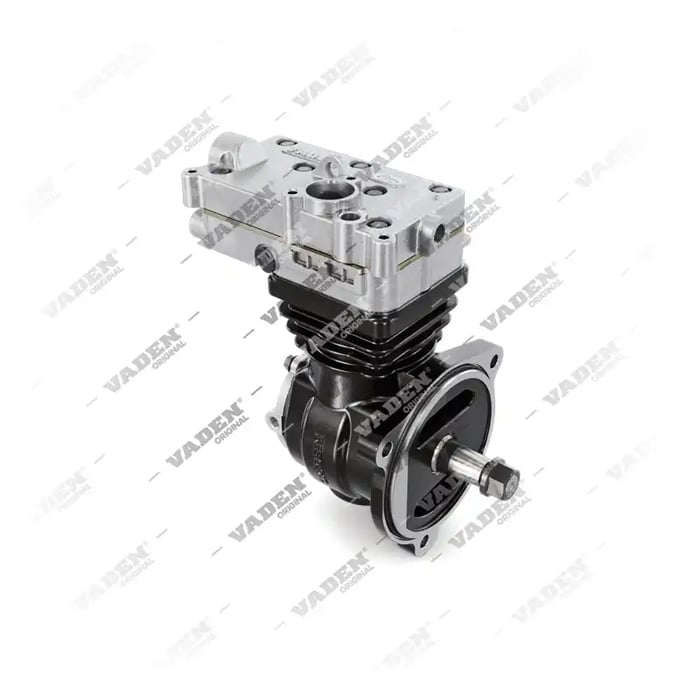
Need the part, not just the answer?
OE-grade air brake compressors and repair kits, manufactured and tested to commercial-vehicle standards.
Shop VADEN partsPublished by VADEN Original. Product links point to the manufacturer’s official catalogue. Specifications are general — always confirm figures against your vehicle’s service manual.