 airbrakecompressor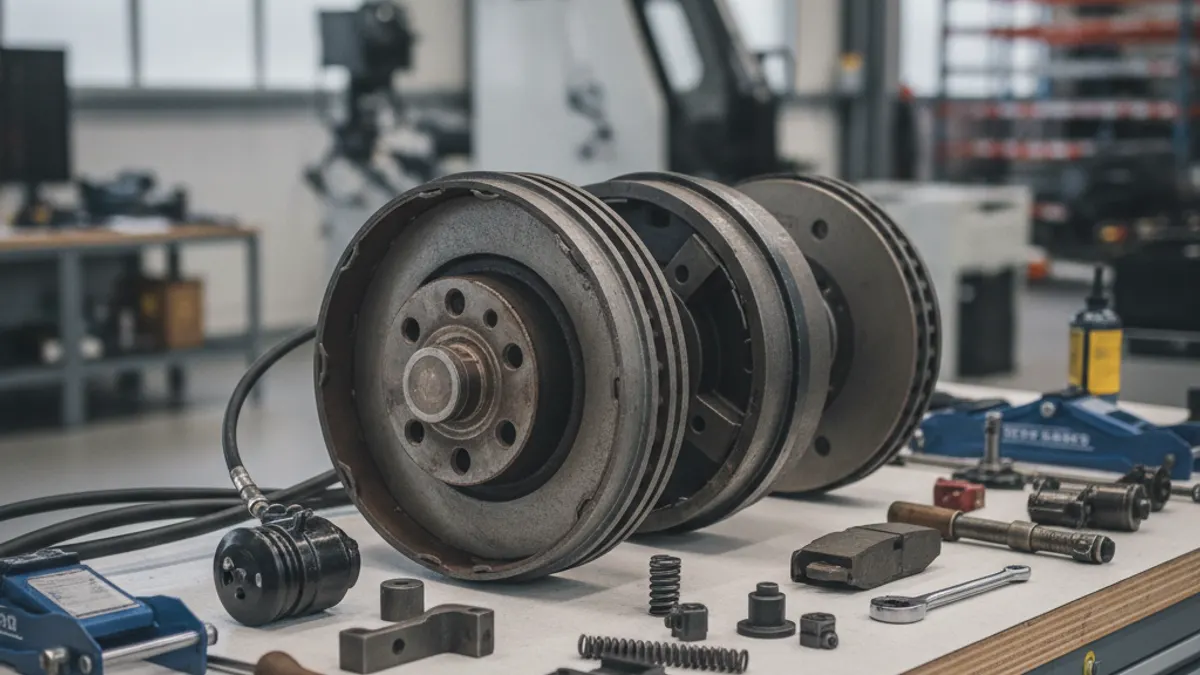
Air brakes are pneumatic, but the friction side of the system is the same foundation hardware you inspect at the roadside — S-cams, shoes, drums. Nothing about the air side makes a drum better at absorbing heat than it was on the flat. The whole discipline of downhill braking exists because a loaded combination coming off a long grade dumps an enormous amount of energy into a fixed amount of iron.
Set up before the crest, not on the way down
Every good descent is decided at the top. Once you are rolling and speed is climbing, your options collapse fast: a truck that is over-speeding may not go into a lower gear at all, and a missed shift leaves you in neutral with only the service brakes.
- Know your weight. Same grade, same truck: 80,000 lb behaves nothing like an empty tractor.
- Read the sign. Percent grade and length tell you what you are dealing with. A 6% grade that runs seven miles is a different problem than a short 6% pitch.
- Pick the gear at the top. The old rule of thumb is to descend in a gear at least as low as the one you would have needed to climb the same hill. Modern high-horsepower trucks climb in taller gears than they can safely descend in, so most drivers go a gear or two lower than that rule suggests.
- Set the retarder before you need it. Turn the engine brake to its highest setting on the flat approach, so it is already working as the nose drops.
- Confirm a full system. A fully charged system sits around 120 psi; governor cut-out typically falls in the 120–135 psi band and cut-in around 100–110 psi. Start the descent charged, not still building.
- Go slower than feels necessary. Safe speed is set by weight, grade, length, curves, surface and weather. It is always easier to give speed back than to take it away.
Snub braking, step by step
- Establish your target speed at the top of the grade, in the chosen gear, with the engine brake on high.
- Let speed build only slightly above target — a few mph, not fifteen.
- Apply the service brakes firmly enough that you feel real deceleration, and hold until you are roughly 5 mph below target.
- Release the pedal completely. Full release is the point of the whole exercise: the drums cool between applications, and the compressor rebuilds air.
- Let the retarder hold you until speed creeps back up, then repeat.
If you find you are snubbing every few seconds, or the intervals are getting shorter as you descend, you are in too high a gear or carrying too much speed. Fix it early — pull off at a turnout if there is one — because that pattern only ends one way.
What each method does to your brakes
| Method | What happens | Verdict |
|---|---|---|
| Snub braking (firm apply, full release) | Heat goes in during short bursts; drums shed heat between applications; air is replenished | Standard practice for long grades |
| Riding the pedal (light continuous pressure) | Continuous heat input with no cooling interval; linings glaze, drums expand, pedal effort rises | Causes fade — avoid |
| Stab braking (hard apply to lock, release, repeat) | An emergency stopping technique on vehicles without ABS, not a descent technique | Wrong tool for a grade |
| Engine brake or exhaust brake as primary | Retarding energy leaves through the engine and exhaust instead of the friction material | Do the majority of the work here |
Engine brakes, exhaust brakes and retarders
A compression-release engine brake turns the engine into an air pump that absorbs power instead of making it — the strongest of the common options, and loud enough to be restricted through some towns. An exhaust brake restricts the exhaust to create backpressure; it is quieter and weaker, but on a moderate grade it may be all you need. Driveline and transmission retarders are found on coaches and some vocational trucks and are excellent on sustained descents.
All of them share one caveat: on wet, icy or loose surfaces, a strong retarder brakes the drive axles only, which can start a jackknife. Back the setting down or switch it off when traction is poor. See how compression-release engine brakes work for the mechanical detail.
Recognizing brake fade before it bites
Fade is not sudden. The truck tells you first, and the cues are worth memorizing:
- The pedal needs more travel and more pressure for the same slowing.
- Speed comes back faster after each snub than it did earlier in the descent.
- A hot, sharp burning smell — glazing linings.
- Visible smoke or heat shimmer off a wheel end.
If any of that shows up, take the escape ramp if one is available. Ramps exist because drivers wait too long to use them. There is no procedure that recovers a genuinely faded system on a moving truck — the friction material is no longer gripping, and continuing only adds heat. More on the mechanism in brake overheating and fade.
The air side of a long descent
Repeated applications use air. On a properly maintained truck the compressor stays ahead of demand easily, but a worn compressor, a leaking chamber, or a system already bleeding air can lose the race. Watch the gauges as you descend: pressure should recover toward cut-out between snubs, not trend steadily downward. Low-air warning devices are required to activate by about 60 psi, and spring brakes begin to apply on their own somewhere in the 20–45 psi range — an uncontrolled, all-or-nothing application, and the last thing you want mid-grade.
Adjustment matters as much as air supply. An out-of-adjustment slack adjuster means that chamber contributes little braking, and the wheel ends still in spec absorb its share of the heat. Check pushrod stroke at your pre-trip, especially before mountain running, and know your S-cam foundation brake layout well enough to spot a wheel end doing no work.
A grade punishes deferred maintenance. Brakes that feel acceptable around town can be marginal on a seven-mile descent with 80,000 lb behind them.
Common mistakes
- Starting down in too high a gear. The most common cause of runaways.
- Shifting mid-descent. If you must, do it early and expect to lose the retarder while the clutch is in.
- Trusting an unloaded feel. Empty on the way up, loaded on the way back — the descent plan changes with the weight.
- Washing hot drums with cold water. Let the wheel ends cool on their own at the bottom.
- Skipping the brake check because the trip is short. The grade does not care how far you are going.
Gear first, retarder second, service brakes in short firm snubs with a full release between them. Pick the speed that feels slightly too slow at the top, and the rest of the descent stays uneventful — which is the only version worth having.
]]>That ordering collapses if the retarder is weak: a leaking butterfly or a tired actuator hands the entire descent back to the drums, which is why exhaust brake components deserve a look before grade season.
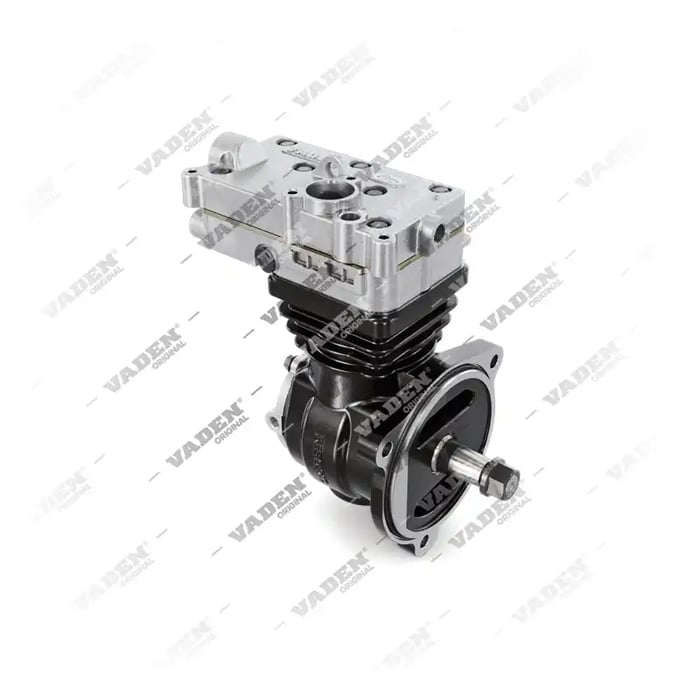
Need the part, not just the answer?
OE-grade air brake compressors and repair kits, manufactured and tested to commercial-vehicle standards.
Shop VADEN partsPublished by VADEN Original. Product links point to the manufacturer’s official catalogue. Specifications are general — always confirm figures against your vehicle’s service manual.