 airbrakecompressor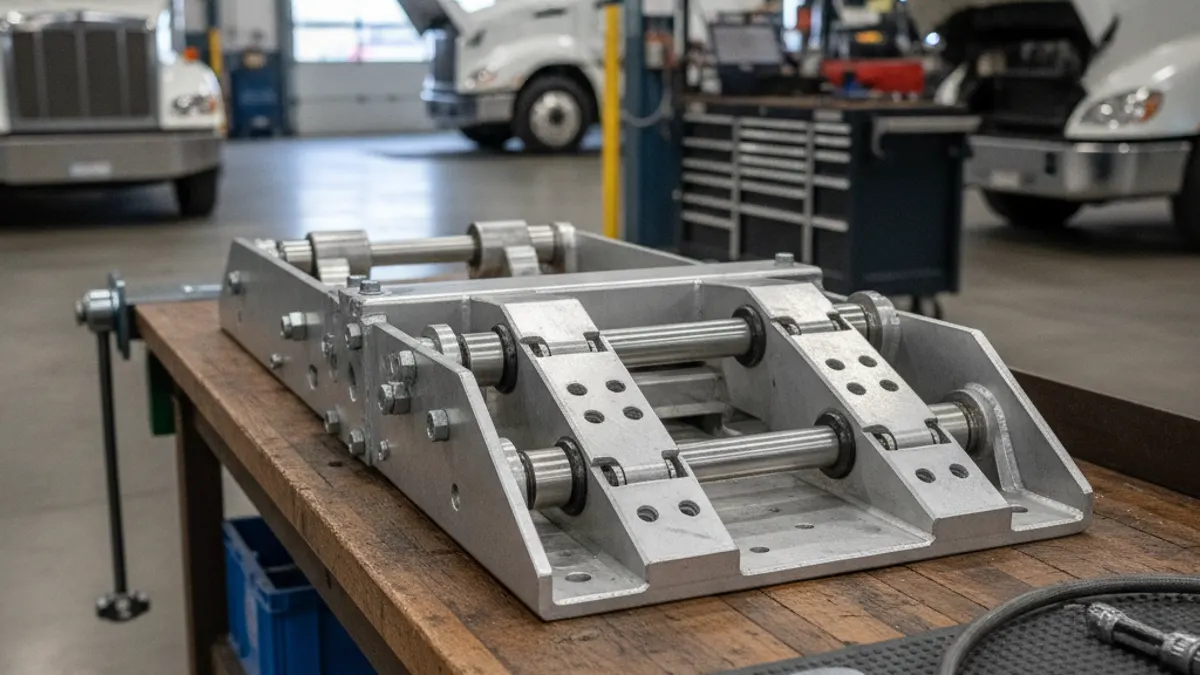
If a truck loses braking on a descent, the order of actions is: get off the throttle, make one firm service brake application (never fan the pedal), hold the lowest gear you can, apply the engine brake, and steer for a runaway truck ramp if one is available. A runaway truck ramp — also called an escape ramp or arrester bed — is a purpose-built gravel or sand lane beside a steep grade that stops a vehicle by rolling resistance instead of friction braking. Recovery costs money; the bottom of the hill costs more.
Most "brake failure" on an air-braked truck is not a broken component. It is brake fade from heat, or a slow loss of air pressure the driver did not act on early enough. Knowing which one you have decides what you can still do about it.
What actually fails on an air brake truck
Air brakes are pneumatic, not hydraulic. Air pushes a pushrod out of the brake chamber, the pushrod swings the slack adjuster, the slack adjuster rotates the S-cam, and the cam spreads the shoes against the drum. There is no fluid to lose or boil, so an air system does not fail the way a car's hydraulic brakes fail. Three failure paths are realistic.
1. Brake fade — the common one
Riding the service brakes down a long grade pours heat into the drums and linings. Hot linings lose friction and hot drums expand away from the shoes, so the same pedal effort produces less stopping force each time. The pedal still feels normal; the truck simply stops slowing down. This is the failure mode behind most runaway incidents, and it is largely a gear-selection problem — the mechanics are covered in air brake overheating and fade.
2. Air loss
A burst hose, a blown gladhand seal, a failed relay valve, or a compressor that has stopped charging will bleed the system down. This one warns you: the low-air buzzer and light come on at roughly 60 psi and the gauges fall. A healthy system sits fully charged around 120 psi, with the governor cutting out in the 120-135 psi band and cutting back in around 100-110 psi. If pressure keeps dropping, the spring brakes apply themselves — typically in the 20-45 psi range — and the truck stops whether you want it to or not. On a grade that is an emergency, but it is a fail-safe rather than a failure to stop.
3. Mechanical wear and adjustment
Out-of-adjustment slack adjusters, worn linings, cracked or heat-checked drums and a seized S-cam all reduce available braking long before anything dramatic happens — exactly what pre-trip inspections and stroke checks exist to catch.
Spring brakes: the built-in fail-safe
Every air-braked commercial vehicle carries a mechanical backup that does not depend on the driver. A spring brake chamber holds a heavy coil spring that wants to apply the brake at all times; air pressure is what keeps that spring compressed and the brake released. Lose the air, lose the hold, and the spring applies the brake. A trailer that breaks away dumps its supply line and stops itself the same way.
The limitation matters. Spring brakes are a parking and emergency system, not a controlled service brake: they apply hard, they are not modulated, and they act only on the axles fitted with spring chambers — normally the drive and trailer axles, not the steer axle. Stopping a loaded rig on a grade with spring brakes alone means locked wheels and a real jackknife risk, so treat an automatic application as something that happened to you, not as a technique.
Runaway truck ramps: what they are and how to use one
Escape ramps are engineered deceleration lanes placed on long, steep descents. The common designs:
| Type | How it stops the truck | Notes |
|---|---|---|
| Arrester bed (gravel bed) | Wheels sink into deep loose aggregate; rolling resistance absorbs the energy | Most common; usually graded uphill as well |
| Ascending grade ramp | Steep uphill slope converts speed into height | Often combined with a gravel surface |
| Sand pile | Successive mounds of loose sand | Short footprint; harsh on vehicle and driver |
Deciding to use it
Drivers hesitate over the recovery bill or the paperwork, and that hesitation turns a recoverable situation into a fatal one. If you are gaining speed and the service brakes no longer arrest that gain, the next ramp is the plan — faded brakes do not come back while you are on the hill.
Entering the ramp
- Signal and move into the ramp lane early so other traffic can clear.
- Enter square, centered and straight. Gravel grabs the wheels hard, and steering input at entry can put the vehicle on its side.
- Both hands on the wheel, belt on, stay seated; expect violent deceleration and a lot of noise.
- After stopping, set the parking brakes, shut down and stay put. Reversing out collapses the bed around the wheels.
- Call it in — many jurisdictions require ramp use to be reported so the bed can be regraded.
If there is no ramp
Not every grade has one, and some are closed for maintenance. Working order without an escape lane:
- Off the throttle immediately. Every second of power adds speed you cannot remove.
- Engine brake and lowest usable gear. A compression release engine brake or driveline retarder does work the service brakes cannot. If you are already too fast to downshift cleanly, do not force it — missing the gear entirely leaves you with nothing.
- One firm service brake application. If pressure remains, a hard steady application achieves more than repeated stabs. Fanning the pedal empties the reservoirs faster than the compressor can refill them.
- Use the terrain. An uphill side road, a shallow bank, brush or a guardrail rub-down all bleed speed — scrubbing along a barrier beats arriving at the bottom of the hill at speed.
- Horn and lights. Clear the traffic ahead of you.
- Do not drag the trailer hand valve alone. Braking the trailer alone invites a jackknife on a wet or loose surface.
Never shut the engine off while rolling: you lose the engine brake and power steering assist, and the compressor stops charging, so every application eats into the air left in the tanks.
Preventing it in the first place
The old rule holds: descend a grade in the same gear you would need to climb it, and let the engine brake or retarder do the work so the service brakes stay cool. Snub braking — a firm application to drop about 5 mph below your target speed, then fully off the pedal to let the drums cool — is far safer than a constant light drag, which cooks the linings continuously.
| Check | What good looks like |
|---|---|
| System pressure before the grade | Fully charged, around 120 psi |
| Governor operation | Cut-out typically 120-135 psi, cut-in typically 100-110 psi |
| Leak-down (engine off, brakes applied) | Drop within the manufacturer's stated limit for the vehicle type |
| Low-air warning | Buzzer and light activate around 60 psi as pressure is bled down |
| Pushrod stroke | Within the adjustment limit for the chamber size fitted |
| Lining and drum condition | No cracks, heat checking beyond limits or contamination |
| Gear selection | Chosen at the top of the grade, before speed builds |
Every figure above is a general range; the manufacturer's current service data takes precedence. A compressor that cannot keep the system charged turns each grade into a gamble, so if the gauges climb slowly, the governor cycles constantly, or you are chasing pressure on a long pull, fix the supply side before the next mountain.
After a runaway or a ramp entry
The truck does not go back into service on a driver's say-so. Expect heat damage to drums, linings, hubs and wheel bearings, gravel intrusion under the chassis, and a full inspection of air lines, chambers, valves and the compressor. Friction material that reached fade temperatures has been permanently altered and should be replaced, not measured and passed.
Friction material that has been through a fade event is scrap, so plan a reline across the axle group rather than one wheel end, and match new brake lining sets to the drum and shoe pattern you measured.
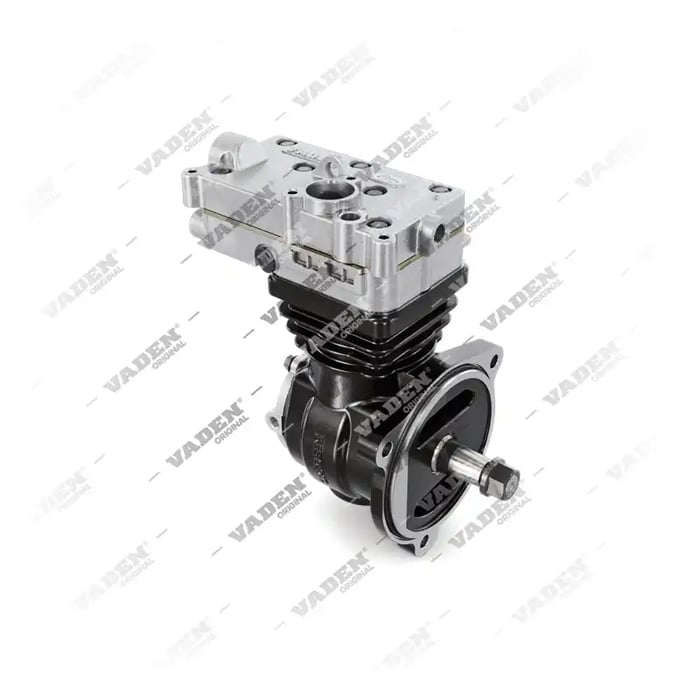
Need the part, not just the answer?
OE-grade air brake compressors and repair kits, manufactured and tested to commercial-vehicle standards.
Shop VADEN partsPublished by VADEN Original. Product links point to the manufacturer’s official catalogue. Specifications are general — always confirm figures against your vehicle’s service manual.