 airbrakecompressor
A commercial vehicle is placed out of service for brakes when 20 percent or more of its service brakes are defective — the core "20% rule" inspectors apply. On a five-axle tractor-trailer with 10 brakes, that means two or more defective brakes take the unit off the road until repaired. Individual defects like a broken spring brake, a severed air line, or a failed low-air warning can put a vehicle out of service on their own, regardless of the 20% count.
These criteria come from the Commercial Vehicle Safety Alliance (CVSA) North American Standard Out-of-Service Criteria, which DOT and state inspectors use during roadside inspections and the annual periodic (DOT) inspection. Below is how each brake defect is judged, in the order an inspector works the vehicle.
The 20 Percent Defective Brake Rule
Inspectors count how many brakes on the vehicle (or combination) meet a defect condition, then divide by the total number of brakes. If that fraction reaches 20 percent, the vehicle is declared out of service. This is why a single out-of-adjustment brake on a bobtail tractor with four brakes matters more proportionally than one on a long combination — one bad brake out of four is 25 percent.
| Total brakes | Defective brakes = out of service |
|---|---|
| 4 (bobtail tractor) | 1 |
| 6 (three-axle straight truck) | 2 |
| 10 (5-axle combination) | 2 |
| 18 (long combination) | 4 |
A "defective brake" is any brake that meets one of the conditions in the sections below — out of adjustment, worn out, cracked, contaminated, missing components, or non-functioning. Steering-axle brake defects carry extra weight and have their own tighter thresholds.
Pushrod Stroke (Brake Adjustment)
The most common out-of-service brake defect is excessive pushrod stroke — the brake is out of adjustment. When you apply full pressure (chocks in, then a firm 90 to 100 psi application), the pushrod travels out of the chamber to rotate the slack adjuster and turn the S-cam. If that travel exceeds the readjustment limit for the chamber, the brake is counted defective.
Stroke limits depend on chamber type and size, so an inspector identifies the chamber before measuring. Approximate readjustment limits for common clamp-type chambers:
| Chamber type / size | Approx. adjustment limit |
|---|---|
| Type 20 standard stroke | 1-3/4 in |
| Type 24 standard stroke | 1-3/4 in |
| Type 30 standard stroke | 2 in |
| Type 24 long stroke | 2 in |
| Type 30 long stroke | 2-1/2 in |
Because limits differ, confirm the exact figure against a current CVSA chamber chart rather than eyeballing it. Long-stroke chambers are stamped or tagged; mistaking one for a standard chamber gives a false reading. A brake at or beyond its limit needs adjustment, and if it uses an automatic slack adjuster, simply readjusting it without fixing the root cause means it will fail again. See how to adjust a slack adjuster for the procedure.
Lining and Pad Thickness
Worn friction material is an out-of-service defect once it drops below the minimum. General thresholds inspectors use:
- Drum brakes (S-cam): lining worn to less than about 1/4 inch at the thinnest point, measured at the shoe center, is out of service. A shoe worn to the rivet heads or with lining separating from the shoe table also qualifies.
- Air disc brakes: pad thickness below the manufacturer's stated minimum (commonly a few millimeters of friction material) is out of service.
Cracks matter too. A lining crack that extends to the shoe table edge, or a piece of lining missing large enough to expose the table, is counted as a defective brake. Contamination — oil, grease, or leaking hub-seal grease soaked into the lining over a significant portion of the friction surface — is also an out-of-service condition because it destroys braking force.
Air System Loss and Warning Devices
The air side of the system has its own out-of-service triggers, independent of the brake count. Inspectors check that the pneumatic system builds and holds pressure and that the driver is warned before it becomes dangerous.
| Air system check | Out-of-service condition |
|---|---|
| Low-air warning | Fails to activate at or before ~60 psi |
| Air leakage (static, brakes released) | Loss faster than allowed with engine off — roughly more than 2 psi/min single vehicle, 3 psi/min combination |
| Air leakage (applied, brakes on) | Faster than about 3 psi/min single, 4 psi/min combination |
| Governor / build-up | System that will not build to the normal cut-out band (~120–135 psi) |
A fully charged system should sit around 120 psi, with the governor cutting out in the 120 to 135 psi band and cutting back in near 100 to 110 psi. An audible or visual low-air warning that does not work by about 60 psi is an out-of-service item, because the driver loses the last warning before spring brakes begin to apply (around 20 to 45 psi).
Other Out-of-Service Brake Defects
- Broken or missing components: a cracked or broken brake drum, a missing or broken air chamber, a loose or missing slack adjuster, or a broken S-cam.
- Damaged air lines: a leaking or bulging hose, a line repaired with unapproved fittings, or a hose positioned so it could rub through.
- Inoperative parking / spring brake: a spring brake that will not hold or will not release properly.
- Mismatched or crossed lines: incorrectly connected supply and control lines that risk applying the wrong circuit.
- ABS: an inoperative ABS is a defect and a violation, but ABS alone is generally not an automatic out-of-service condition unless combined with other failures.
Steering-axle brakes are held to a stricter standard: a defect on a steering-axle brake, a mismatched chamber size or slack length side to side, or a contaminated steering-axle lining can be out of service on its own because it causes pull under braking.
Passing the Inspection: What to Check First
The fastest way to fail is on adjustment and air leaks, and both are easy to catch during a proper air brake pre-trip inspection. Before a trip, chock the wheels, run the engine to full pressure, shut it down, and time the pressure drop. Then pump the brakes to watch the warning device and note when the spring brakes apply. Under the vehicle, look for pushrod travel, thin or cracked lining, chafed hoses, and grease on the shoes.
Catching a marginal brake before a scale is the difference between a five-minute adjustment and being parked at the roadside with a violation on your record. Adjustment, lining, and air-loss defects account for the large majority of brake out-of-service orders — the same three things a technician can verify in a walk-around.
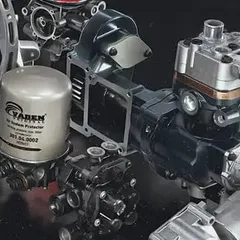
Two of those three defects end in a parts order rather than an adjustment, so stock the usual culprits — chambers, hoses, weeping valve bodies — from the air brake system parts before an inspector finds them.
Need the part, not just the answer?
OE-grade air brake compressors and repair kits, manufactured and tested to commercial-vehicle standards.
Shop VADEN partsPublished by VADEN Original. Product links point to the manufacturer’s official catalogue. Specifications are general — always confirm figures against your vehicle’s service manual.