 airbrakecompressor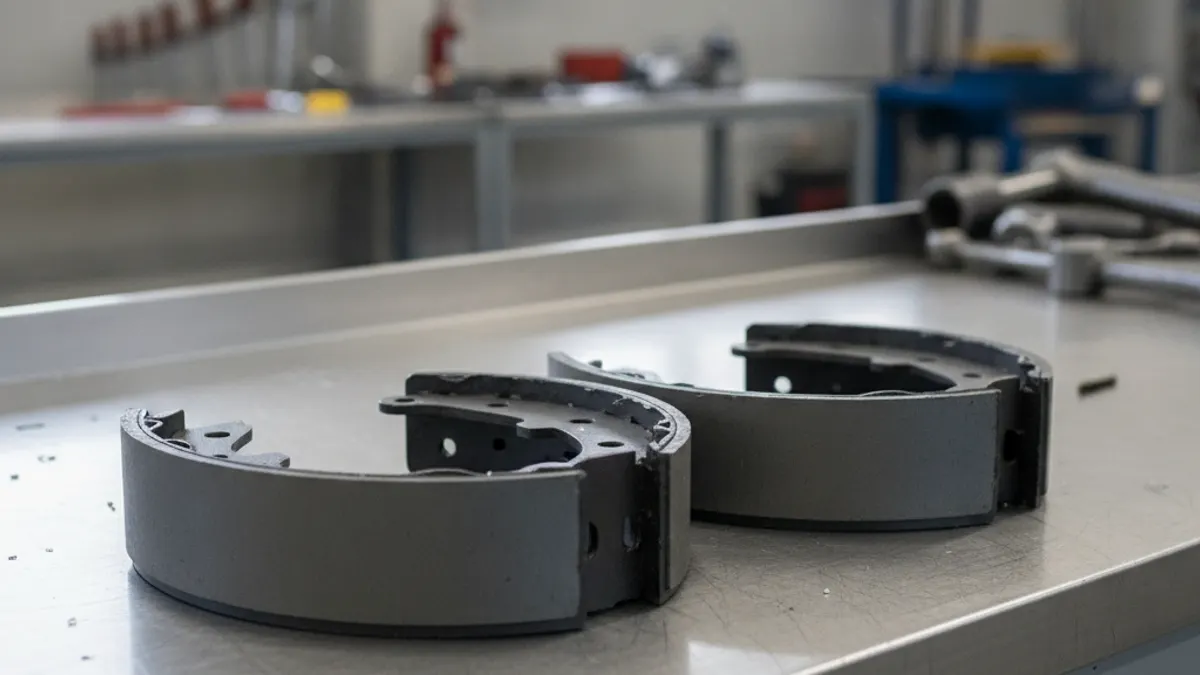
Truck brake shoes are the curved steel components inside a drum brake that carry the friction lining — the replaceable material that presses against the brake drum to slow the wheel. On a commercial air-brake vehicle, you replace the lining (or the whole shoe-and-lining assembly) when the friction material wears down to roughly 1/4 inch (about 6 mm) at its thinnest point, or to the minimum thickness stamped by the manufacturer, whichever comes first. Worn linings mean longer stopping distances, brake fade, and an out-of-service violation at roadside inspection.
Unlike a car's hydraulic disc pads, heavy-truck foundation brakes are pneumatic and built around the S-cam. Understanding how the shoe, lining, and drum work together is the difference between a brake job that lasts and one that comes back with a pull or a hot drum.
How brake shoes and linings work in an air-brake system
When the driver presses the pedal, air pressure enters the brake chamber and pushes the pushrod out. That rod turns the slack adjuster, which rotates the S-cam shaft. The S-cam spreads the two brake shoes apart, forcing the linings against the inside of the spinning drum. Friction converts the truck's momentum into heat, and the drum sheds that heat into the air. When pressure releases, the return springs pull the shoes back off the drum.
The lining is the wear item. It is either bonded (glued under heat and pressure to the steel shoe table) or riveted (mechanically fastened through drilled holes). The steel shoe itself is a reusable core — it should be straight, rust-free, and correctly arced to match the drum radius. For the bigger picture of how all the components tie together, see our overview of how air brake systems work and the details of the S-cam foundation brake.
Friction lining grades and what the codes mean
Brake linings are rated by a two-letter edge code that describes the coefficient of friction. The first letter is the "normal" friction rating and the second is the "hot" rating. Higher letters mean a more aggressive lining. The most common heavy-duty codes fall in this range:
| Edge code | Friction range | Typical use |
|---|---|---|
| EE | 0.25 – 0.35 | Milder, smoother, lower initial bite |
| FF | 0.35 – 0.45 | Most common OE-grade highway lining |
| FG / GF | Mixed hot/cold | Improved hot performance |
| GG | 0.45 – 0.55 | Aggressive, severe-service and vocational |
The critical rule: match linings across an axle and, ideally, from front axle to front axle. Installing an FF lining on one wheel end and a GG on the other creates a side-to-side imbalance — the truck pulls under braking and the aggressive side wears faster and runs hotter. Choose a lining grade that matches the vehicle's original specification and duty cycle. Read the edge code stamped on the lining before it goes on, and cross-reference the replacement by the axle or foundation-brake maker's number rather than by truck model, so the axle is rebuilt on the friction grade it was certified with rather than on a guess.
Bonded vs. riveted linings
Bonded linings use the full lining thickness before reaching the shoe table, so they can run slightly longer before the backing is exposed. Riveted linings can dissipate heat and debris through the rivet holes and are easier to inspect for even wear, but the rivet heads set the practical wear limit — once the lining wears down to the rivet heads, the rivets will score the drum. Neither is universally "better"; follow the shoe manufacturer's design.
Wear limits and when to replace
Do not wait for metal-to-metal contact. Replace linings when any of the following is true:
- Friction material is down to about 1/4 in (6 mm) at the thinnest point, or the stamped minimum — whichever is greater.
- On riveted linings, the material is approaching the rivet heads (commonly a minimum around 1/16 in / 1.6 mm over the rivet).
- Linings are cracked, glazed, contaminated with oil or grease, or show heat checking and a bluish tint on the drum.
- Wear is uneven — tapered, heel-to-toe, or side-to-side — which points to drum, cam, or slack-adjuster problems, not just worn friction material.
Federal out-of-service criteria treat a lining worn to the point that the shoe is nearly contacting the drum, or a lining thinner than roughly 1/4 in at the shoe center (for the common S-cam design), as a defect. Always confirm against your fleet's spec and the shoe maker's data — numbers vary with lining type and drum design.
Uneven or accelerated lining wear is a symptom, not a cause. If one wheel end eats linings, inspect the brake chamber, slack adjuster stroke, S-cam bushings, and drum before you simply reline.
Relining vs. new or remanufactured shoes
Once the lining is gone, you have three paths. Each has a place depending on core condition and shop capability.
| Option | What you get | Best when |
|---|---|---|
| Reline existing shoes | New lining riveted/bonded to your cleaned, inspected cores | Cores are straight, un-cracked, and correctly arced; cost matters |
| Remanufactured shoes | Reconditioned cores with new lining, ready to bolt on | You want a fresh assembly without waiting on relining |
| New shoes | New steel table, new lining, guaranteed arc and hardware | Cores are worn, corroded, or bent; severe-service or safety-critical |
Relining is economical only if the shoe cores are sound — a warped or corroded table will never hold the correct arc, and a poor arc means the lining touches the drum on the heel and toe only, cutting braking force and burning the lining. New or reman shoes remove that risk because the arc and hardware are known-good. Whichever route you choose, replace linings as a complete axle set and renew return springs, anchor pins, rollers, and retainers at the same time.
Don't forget the drums
New linings against a worn, out-of-round, or heat-cracked drum will not perform and will wear quickly. Measure drum diameter against the maximum machine and discard limits cast into the drum. Replace drums in axle sets as well. See truck brake drums for measurement and condemning limits.
Installation and break-in notes
After installing new linings and shoes, adjust the brakes so pushrod stroke is within spec — over-stroke is a leading out-of-service item. Verify the slack adjuster (manual or automatic) operates freely and that the S-cam rotates without excessive bushing play. New linings need a gentle burnish (bed-in) period of moderate stops to seat the friction material and reach full performance; avoid hard, prolonged braking on fresh linings. If you are diagnosing weak brakes rather than doing routine wear replacement, rule out air-supply problems first — a system losing pressure will feel like worn linings but is a different fault entirely.
Bottom line: brake shoes are reusable steel cores, linings are the wear item, and the job is done right only when you match friction grades, replace in full axle sets, service the drums and hardware, and burnish the new material in before the truck goes back to work.
Source (VADEN Original): What Is a Brake Shoe? Heavy-Duty Drum Brake Lining
Need the part, not just the answer?
OE-grade air brake compressors and repair kits, manufactured and tested to commercial-vehicle standards.
Shop VADEN partsPublished by VADEN Original. Product links point to the manufacturer’s official catalogue. Specifications are general — always confirm figures against your vehicle’s service manual.