 airbrakecompressor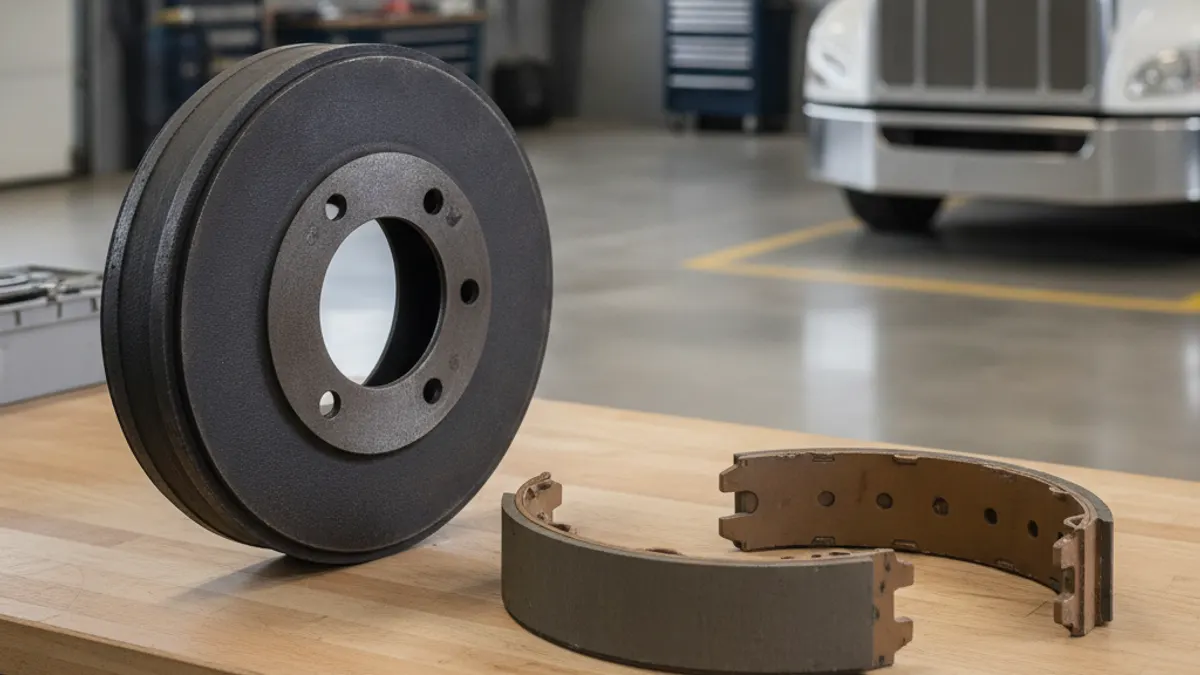
A truck brake drum is the heavy cast-iron ring that bolts to the wheel hub and gives the brake shoes a friction surface to clamp against. On an air brake system the shoes are pushed out by an S-cam and press outward on the inside of the drum, so drums wear from the inside out and grow in diameter over time. You replace a drum when it reaches its cast-in maximum diameter, cracks through, or overheats badly enough to develop hard spots — not simply because it has some scoring.
Everything else on this page is about telling the difference between a drum you can keep running, one you can machine, and one that belongs in the scrap bin. Getting that judgment right is a safety call: a drum that has grown past its limit or cracked through can fade, grab, or fail under a hard stop.
How truck brake drums wear
Drums live in a brutal environment. Every stop turns kinetic energy into heat, and the friction surface takes that heat directly. Over tens of thousands of miles the bore diameter grows, the surface glazes or scores, and the metal fatigues from repeated heating and cooling. Because the shoes expand outward against the inner wall, a worn drum is always a larger drum, never a smaller one.
The common wear patterns you'll find during a wheel-off inspection:
- Scoring: concentric grooves cut by debris, rivets, or worn linings. Light scoring is normal; deep grooves you can catch a fingernail in mean the surface is too far gone.
- Heat checking: a fine web of shallow surface cracks from repeated heat cycling. Shallow checks are acceptable and can often be machined out; cracks that run to the edge are not.
- Bell-mouthing: the open (outer) edge of the drum wears wider than the closed edge, so the bore becomes cone-shaped. This kills shoe contact and causes uneven, fading braking.
- Hard spots (heat spots): bluish, glassy patches where the iron got hot enough to change structure. They're harder than the surrounding metal, cause pulsation, and generally can't be machined away for good.
- Blue discoloration: a sign the drum has been severely overheated, which weakens the casting even where it still looks intact.
Maximum diameter: the number that matters
Every truck brake drum has a maximum diameter — also called the discard diameter or wear limit — cast or stamped into it. A common convention is a nominal bore (for example 16.5 inches) with a machine-to limit and a discard limit stamped nearby, often the nominal plus about 0.090–0.120 inch. Once measured wear reaches the discard number, the drum is scrap even if it still looks serviceable.
| Measurement | What it means | Action |
|---|---|---|
| Nominal diameter | The as-new bore size (e.g., 15", 16.5") | Reference point |
| Machine-to limit | Largest you may cut to and still leave metal for wear | OK to turn up to this size |
| Maximum / discard diameter | Absolute wear limit cast into the drum | Replace — do not machine, do not run |
Measure across the bore with a drum micrometer or inside gauge at several points, because a bell-mouthed or out-of-round drum reads differently depending on where you check. Take the largest reading. If that number meets or exceeds the discard limit, the drum is done. Never machine a drum up to the discard limit — that leaves no wear margin and it'll be back over the line almost immediately.
Cracks: which ones are scrap
Not all cracks are equal, and this is where technicians most often get it wrong.
- Heat checks — fine, shallow surface cracking spread across the friction face — are usually acceptable within limits and can be turned out if the drum is otherwise in size.
- Through-cracks — any crack that runs from the friction surface out to an edge, through the bolt-circle area, or all the way through the wall — condemn the drum immediately. There is no repair.
- Radial cracks at the open edge that extend more than a short distance toward the closed face are cause for replacement.
If you can see daylight through a crack, feel a step across it, or the crack reaches any edge or mounting hole, the drum is scrap. A cracked drum can let go under a panic stop.
Heat, glazing, and brake fade
Brake fade on a truck is a heat problem. On a long downgrade the drums and shoes soak up more heat than they can shed, the friction material glazes, and stopping power drops off even though the driver is pushing harder on the pedal. Air brakes don't fade from boiling fluid like a car's hydraulic system — there's no fluid in the foundation brake — but the drum-and-shoe interface absolutely fades when it overheats.
The right defense is engine braking and proper downhill gear selection so the engine brake carries the load instead of the service brakes. A drum that has been repeatedly cooked shows the blue discoloration and hard spots described above, and once those are present the drum won't recover — heat has permanently changed the metal. That's a replacement, not a machining job.
Weight and why drums are replaced in pairs
A standard 16.5-inch cast-iron truck brake drum typically weighs on the order of 100–130 lb, depending on size and wall thickness. That mass is what lets the drum absorb heat, but it also means a drum that's worn thin has lost some of its heat capacity along with its strength.
Because braking has to be balanced side to side, you replace drums in matched pairs across an axle, and you renew the shoes and linings at the same time so the new drum breaks in against fresh friction material. Mixing a new drum with worn shoes — or a new drum on one wheel and a worn drum on the other — causes pull, uneven wear, and inconsistent stopping.
When to replace a truck brake drum
Pull the drum and condemn it if any of the following are true:
- Measured bore diameter meets or exceeds the cast-in maximum/discard limit.
- Any crack reaches an edge, mounting hole, or passes through the wall.
- Blue hard spots or severe heat discoloration are present.
- Scoring or grooving is deeper than can be cleaned up while staying under the machine-to limit.
- The drum is bell-mouthed or out-of-round beyond spec, causing pulsation or fade.
Replacement is part of the larger foundation-brake job. A worn drum rarely comes alone — check the brake chamber, slack adjuster travel, S-cam bushings, and return springs while you're in there, since a dragging or over-stroking brake is often what cooked the drum in the first place. After reassembly, torque the wheel nuts to spec and re-torque after the first loaded miles.
Turn or replace?
Machining (turning) a drum trues the surface and removes light scoring or heat checks, but it only makes sense if the finished diameter stays comfortably under the machine-to limit with wear margin left. Given the low cost of many drums relative to shop time, and the fact that machining removes heat-absorbing metal, plenty of fleets simply replace rather than turn. If the drum is anywhere near its wear limit, replacement is the safer economic call.
Drum and friction work as a pair, so a new drum bedding against glazed or stepped shoes will never make full contact — plan fresh brake linings into the same wheel-off rather than a second one a month later.
Need the part, not just the answer?
OE-grade air brake compressors and repair kits, manufactured and tested to commercial-vehicle standards.
Shop VADEN partsPublished by VADEN Original. Product links point to the manufacturer’s official catalogue. Specifications are general — always confirm figures against your vehicle’s service manual.