 airbrakecompressor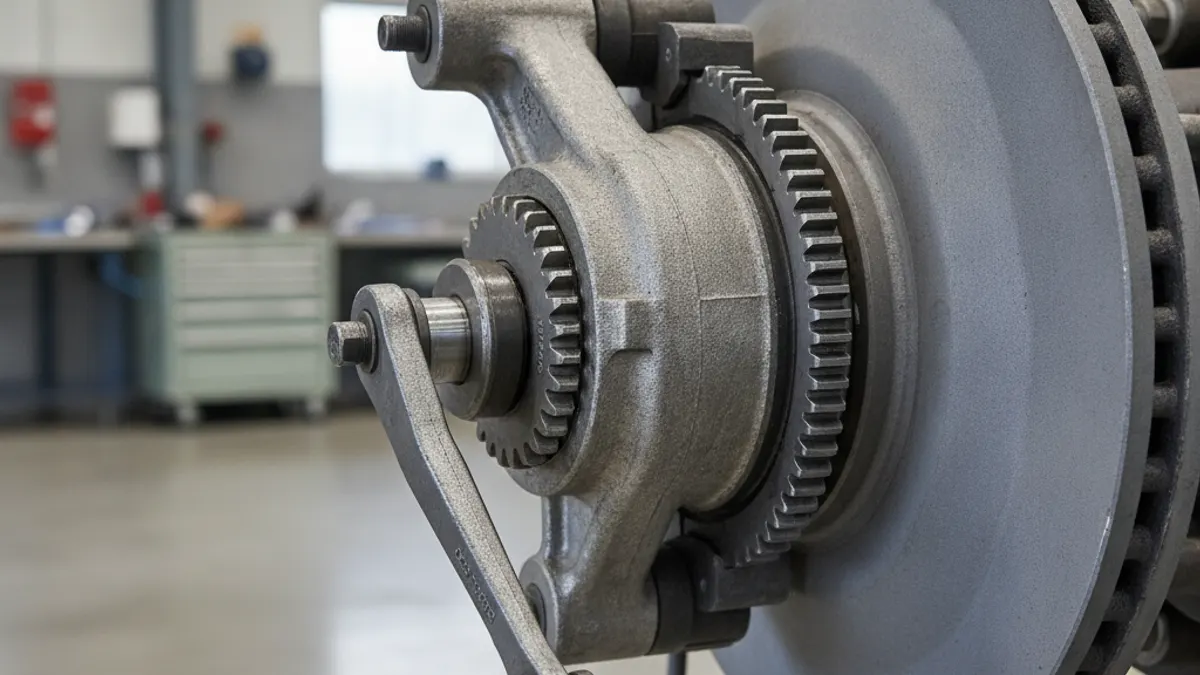
A slack adjuster is the adjustable lever arm on a truck, bus, or trailer air brake that connects the brake chamber pushrod to the S-cam shaft (or wedge mechanism) at each wheel. When you press the brake pedal, air pushes the chamber pushrod out; the slack adjuster converts that straight-line push into a twisting force that rotates the S-cam and spreads the brake shoes against the drum. It also sets and maintains the running clearance between lining and drum, which is why a slack that is out of adjustment quietly robs you of braking power.
In short: the slack adjuster is both a force multiplier (a lever that increases the mechanical advantage of chamber air pressure) and the adjustment point that keeps pushrod stroke within a safe range. Get the stroke wrong and the whole foundation brake underperforms, no matter how healthy your air compressor and supply system are.
What a slack adjuster actually does
Air brakes are pneumatic, not hydraulic. Compressed air (a fully charged system runs around 120 psi, with the governor cutting out near 120-135 psi and cutting in around 100-110 psi) is stored in reservoirs and delivered to each brake chamber when you apply the pedal. The chamber's diaphragm pushes the pushrod out. On its own, that pushrod does nothing useful; it needs a lever to turn linear motion into the rotation that actuates the brake.
That lever is the slack adjuster. One end clamps to the splined S-cam shaft; the other end is pinned to the chamber pushrod via a clevis. The distance from the shaft centerline to the clevis pin is the lever arm. A longer arm means more torque on the S-cam for a given air pressure, which is why slack adjuster length is a matched, engineered dimension, not something you swap arbitrarily.
Why stroke matters more than pedal feel
Here is the part that fools a lot of drivers: an air brake pedal feels the same whether your stroke is perfect or dangerously long, because you are metering air pressure, not fluid. In a hydraulic car brake, a worn brake gives you a low or spongy pedal. In an air brake, a long-stroke slack gives you a completely normal pedal right up until the chamber runs out of usable travel.
As the pushrod extends farther, the angle between the pushrod and the slack adjuster arm changes, and the effective leverage drops. Past a certain stroke, you lose braking torque fast, and if the pushrod bottoms out you may have almost no brake at that wheel. That is why federal inspection standards and CDL rules put hard limits on maximum pushrod stroke by chamber size, and why brakes out of adjustment are one of the most common out-of-service violations.
Related guides: Air Brake Chamber Size & Output Force Chart
Manual vs. automatic slack adjusters
There are two families of slack adjuster. Both do the same job of levering the S-cam; they differ in how clearance is maintained as the brake linings wear.
| Feature | Manual slack adjuster | Automatic slack adjuster (ASA) |
|---|---|---|
| Clearance control | Set by hand with a wrench on the adjusting bolt | Self-adjusts a small amount on each brake application as lining wears |
| Maintenance | Requires periodic manual adjustment to keep stroke in spec | Should not need routine manual adjustment; long stroke means something is wrong |
| Typical application | Older vehicles and some trailers | Standard on most North American trucks/buses built since the mid-1990s |
| Failure clue | Stroke slowly grows as linings wear if neglected | Stroke grows despite the auto function; indicates a worn or failed slack or foundation problem |
Critical rule for automatic slacks: if an ASA shows long stroke, do not just crank it back with a wrench and call it fixed. A properly working ASA holds stroke in spec on its own. If it is long, the slack is failing, the linings or S-cam bushings are worn, the clevis is loose, or a brake is dragging. Manually re-adjusting only hides the fault until it comes back, and it can mask a chamber or foundation problem that should be repaired. Manual adjustment on an ASA is for the initial install setup, not for chasing wear.
How adjustment sets clearance and stroke
Adjusting a slack (manual, or the initial set on an automatic) turns a worm gear that rotates the S-cam slightly, moving the shoes closer to the drum and reducing free travel. The technician's goal is a small, consistent lining-to-drum clearance so that a brake application takes up the slack quickly and leaves plenty of chamber stroke in reserve. Set it too tight and the brakes drag, overheat, and can fade; set it too loose and stroke runs long and braking force suffers.
Symptoms of a bad or out-of-adjustment slack adjuster
Because a bad slack does not announce itself through the pedal, you have to watch for these signs and check stroke physically.
- Long pushrod stroke. Measured travel exceeds the limit for that chamber size. This is the number-one indicator and the one inspectors check.
- Side-to-side imbalance. One wheel's stroke is noticeably longer than its partner on the same axle, causing pulling, uneven lining wear, and unequal braking.
- Brake drag and fade. An over-adjusted or seized slack holds the shoes against the drum, producing heat, smell, glazed linings, and loss of braking on long grades.
- Grabbing or clunking. A loose clevis, worn pins, or a slack with a stripped or failed internal gear can cause harsh, uneven application. Combined with air rushing sounds this can overlap with air noise when pressing the brake pedal, so inspect the whole foundation.
- Stiff or stuck manual adjustment. If the adjusting bolt will not turn or feels gritty, internal corrosion or a seized worm gear means the slack needs replacement.
- ASA that keeps going long. An automatic slack that will not hold adjustment has failed internally or is fighting a worn S-cam, bushing, or dragging brake.
How stroke is checked
The common method is the applied stroke check: with the system fully charged and the engine off, measure the pushrod at rest, then have someone make a full brake application (around 90-100 psi) and measure again. The difference is applied stroke, and it must fall under the maximum for that chamber type and size. Mark the pushrod with chalk and compare to the chamber's spec. Any wheel over the limit needs attention before the vehicle goes back in service. The full routine, including the free-play check by hand, is set out in how to check slack adjusters.
Where the slack fits in the foundation brake
The slack adjuster sits between two parts it depends on. Upstream is the brake chamber, which supplies the pushrod force; if the chamber diaphragm is torn or the spring brake is dragging, no amount of slack adjustment will fix the resulting stroke problem. Downstream is the S-cam, bushings, and brake shoes; worn foundation hardware makes even a good slack run long. That is why a long-stroke reading is a symptom to diagnose, not just a number to adjust away.
Keeping slack adjusters in spec is core preventive maintenance. Check stroke at every service interval, verify clevis pins and yokes are tight, lubricate per the manufacturer's schedule, and replace any slack that is worn, seized, or failing to hold adjustment. Balanced, in-spec slacks give you even braking, longer lining life, shorter stopping distances, and a truck that passes inspection.
Source (VADEN Original): How Does an Automatic Brake Slack Adjuster Work?
Need the part, not just the answer?
OE-grade air brake compressors and repair kits, manufactured and tested to commercial-vehicle standards.
Shop VADEN partsPublished by VADEN Original. Product links point to the manufacturer’s official catalogue. Specifications are general — always confirm figures against your vehicle’s service manual.