 airbrakecompressor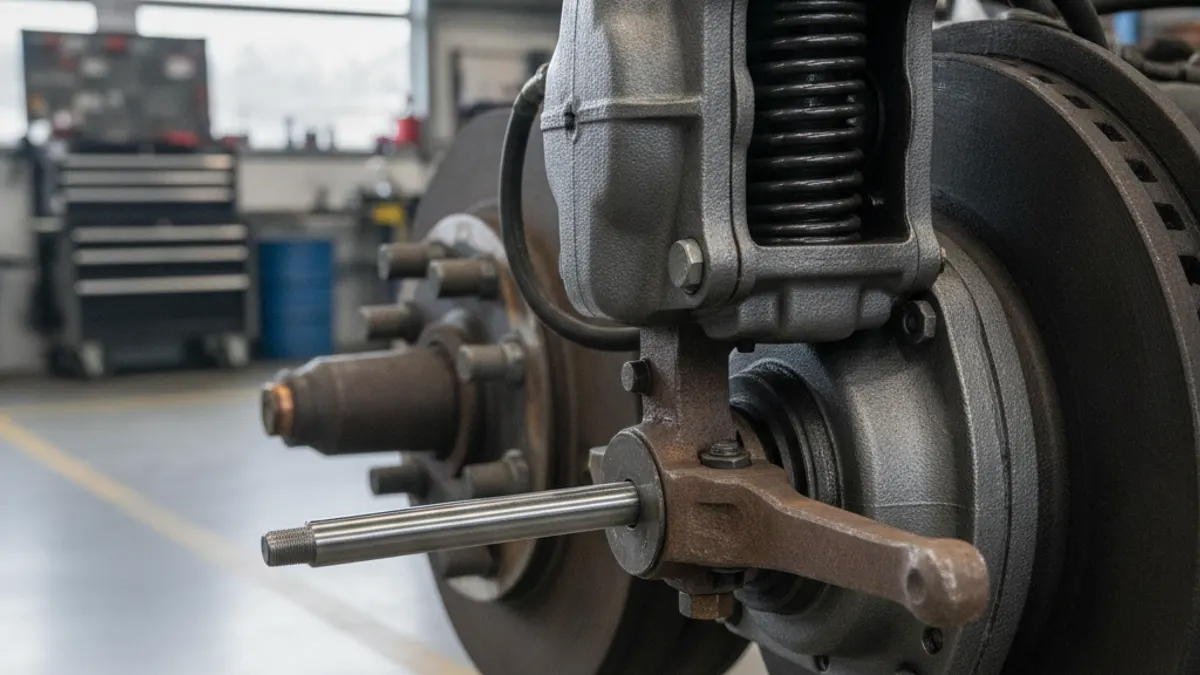
A brake chamber is the round, air-actuated device bolted to the axle at each braked wheel. Its job is simple but critical: it takes compressed air from the truck's air brake system and converts that pneumatic pressure into a straight mechanical push. That push travels through a rod to the slack adjuster, which rotates the camshaft (or actuates a disc caliper) and clamps the brake. When you press the treadle valve, air fills the chamber; when you release, a return spring pushes the diaphragm and rod back home.
Because heavy trucks use air rather than the hydraulic fluid found in cars, the brake chamber is the muscle that makes air braking work at every corner of the vehicle. Understanding the two sides of a chamber, the common types, and how they fail is core knowledge for any tech working on how air brake systems work.
How a Brake Chamber Works
Inside a service brake chamber is a flexible rubber diaphragm, a push rod, and a return spring. When you apply the brakes, air from the treadle valve enters the chamber behind the diaphragm. Air pressure acting across the diaphragm's surface area creates force — more pressure and more diaphragm area both mean more push. That force drives the push rod out, the rod moves the slack adjuster arm, and the slack adjuster rotates the S-cam to spread the brake shoes against the drum.
Two things determine how hard the brake applies: how much application air pressure the driver commands, and the effective area of the diaphragm (that is the number in the chamber size). When the driver releases the pedal, application air exhausts, and the internal return spring retracts the rod so the shoes back off the drum.
Chamber Size and What the Number Means
Chambers are rated by their effective diaphragm area in square inches, and that rating is what the "type" number refers to. A "Type 30" (T30) chamber has roughly 30 square inches of effective area. Larger numbers mean more output force for the same air pressure, which is why axle position and brake design dictate the size. Mixing chamber sizes across an axle throws off braking balance, so always match the size stamped on the housing when replacing one.
| Common size | Typical use | Notes |
|---|---|---|
| Type 20 (T20) | Steer / lighter axles | Smaller diaphragm, lower output force |
| Type 24 (T24) | Steer and some drive axles | Very common mid-size service chamber |
| Type 30 (T30) | Drive and trailer axles | Workhorse size; the "30" in T30/30 |
| Type 30/30 | Drive/trailer spring brakes | Service side plus a spring parking/emergency side |
Related guides: Air Brake Chamber Size & Output Force Chart
Service Chambers vs. Spring Brake Chambers
There are two broad families of brake chamber, and knowing which one you are looking at changes how you service it.
Service (Single-Diaphragm) Chambers
A plain service chamber — often a clamp-type T30 — has one diaphragm and one job: apply the brake with air when the driver presses the pedal. These are usually found on steer axles, which normally do not carry parking or emergency spring brakes. The housing is held together by a steel clamp band around its midsection, which is why techs call them "clamp type." When air is released, the return spring pulls the rod back and the brake fully releases.
Spring Brake Chambers (T30/30)
A spring brake chamber, such as a T30/30, is really two chambers stacked back to back. The forward "service" section works exactly like a plain chamber for normal driving. The rear "spring" or "emergency" section houses a large, heavily preloaded coil power spring. During normal operation, system air is held in that spring section to keep the power spring compressed and out of the way. When you set the parking brake — or when air pressure drops dangerously low — that holding air is exhausted, the power spring extends, and it mechanically pushes the rod out to apply the brake.
This fail-safe design is why a truck with a serious air leak will brake by itself: spring brakes typically begin to apply somewhere around 20 to 45 psi as the power spring overcomes the fading air pressure. It is also why you must never work on a spring chamber without caging it first. For the pressure thresholds that govern this behavior, see what happens when the system is losing air pressure.
Symptoms of a Failing Brake Chamber
Brake chambers live in a brutal environment — road spray, salt, heat, and constant flexing. Watch for these warning signs:
- Audible air leak at the wheel: A steady hiss from a chamber, especially when the brakes are applied, usually means a ruptured or cracked diaphragm.
- Slow brake application or release: A weak return spring or a leaking diaphragm can make a brake drag or lag.
- Excessive push rod stroke: If the rod travels farther than the adjustment limit, the chamber may be weak — though a maladjusted slack adjuster or worn lining is the more common cause.
- Corroded or deformed clamp band / housing: Rust-swollen bands and cracked non-pressure housings are frequent MOT/DOT rejection items.
- Broken power spring: A snapped spring can rattle inside the chamber, leave the parking brake unable to hold, or in some cases jam the service stroke.
- Brake won't release: If a spring brake stays applied, the spring section is not receiving hold-off air, or the power spring has failed.
A leaking chamber can mimic other faults, so confirm the source. If the whole truck is bleeding down and you cannot pin it to one wheel, the leak may be upstream at a valve, line, or the compressor circuit rather than a chamber, so trace it to the wheel before condemning parts.
Caging a Spring Brake (Safety First)
The single most important rule with any spring chamber: the power spring stores enough energy to seriously injure or kill you. Before you loosen the clamp band or remove a spring chamber, you must neutralize that spring by caging it.
- Chock the wheels and make sure the vehicle cannot roll.
- Locate the release (caging) bolt — usually stowed on the side of the chamber — and insert it into the center hole in the non-pressure (spring) end cap.
- Seat the release bolt so it engages the internal caging plate, then turn it to draw and hold the power spring back into its compressed position.
- Confirm the spring is fully caged (the rod retracts and the brake releases) before touching the clamp band.
Many spring chambers are sold as sealed, non-serviceable units precisely because the internal spring is so dangerous. If a spring section is cracked or its band is corroded, the correct fix is almost always to replace the whole chamber, not to open it up.
Replacement Basics
Replacing a brake chamber is straightforward once it is caged and depressurized, but a few points keep it safe and correct. Drain the air system or cage the spring, then disconnect the air line(s) and the push rod clevis from the slack adjuster. Note the chamber's clocking (the air-port orientation) and mounting stud pattern so the new one fits the bracket and hoses without kinks. After fitting, always set push rod length and re-check slack adjuster adjustment, then apply and release the brakes several times to verify free travel, full release, and a leak-free application.
Because the chamber is only one link in the actuation chain, inspect the neighbors while you are in there. A worn slack adjuster, a seized camshaft, or a tired return spring will undo the benefit of a fresh chamber. Fit OE-grade actuation parts and pneumatic components from a quality air brake system parts range so stroke, force, and durability match what the axle was engineered for. Chambers are relatively inexpensive and safety-critical, so when one fails, replace it rather than nursing it.
Source (VADEN Original): Brake Chamber Types and Sizes: Choosing T, DD and Spring Chambers · How to Read an Air Brake Diagram: Circuit Guide
Need the part, not just the answer?
OE-grade air brake compressors and repair kits, manufactured and tested to commercial-vehicle standards.
Shop VADEN partsPublished by VADEN Original. Product links point to the manufacturer’s official catalogue. Specifications are general — always confirm figures against your vehicle’s service manual.