 airbrakecompressor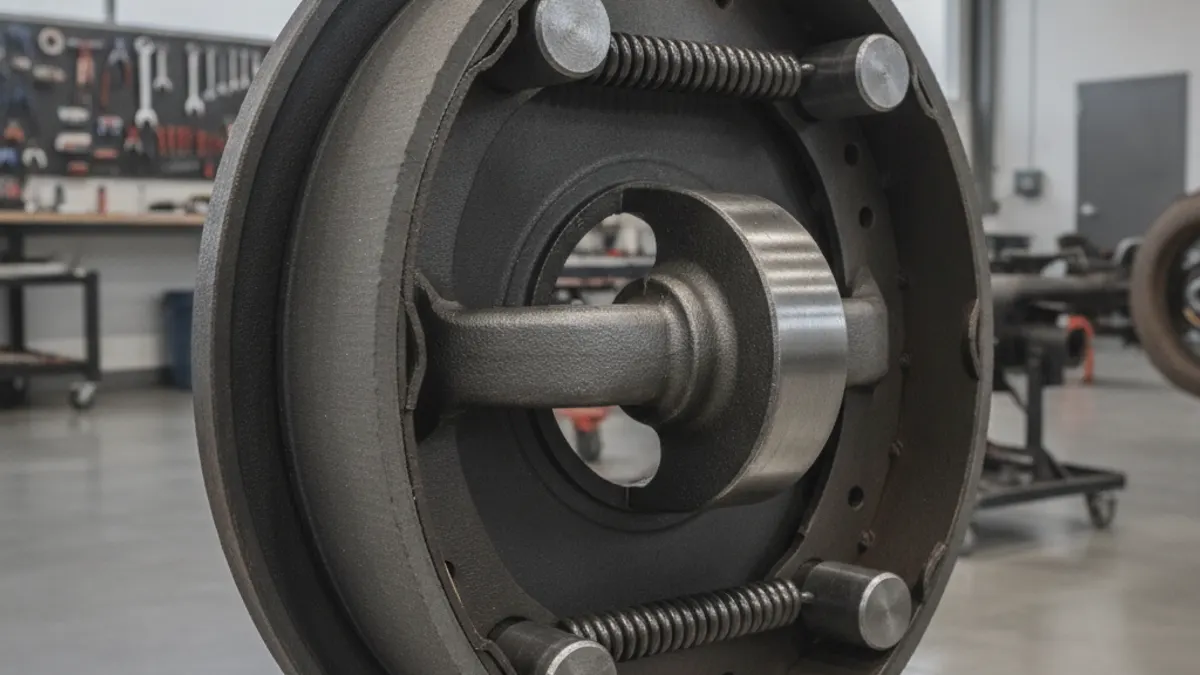
An S-cam foundation brake is the drum brake used on most heavy trucks, buses, and trailers, and it works by turning air pressure into mechanical spreading force. When you press the treadle, air fills the brake chamber, the chamber pushrod extends and rotates the slack adjuster, the slack adjuster twists the S-cam shaft, and the S-shaped head at the end pries the two brake shoes apart against the inside of the spinning drum. Friction between the shoe linings and the drum is what slows the wheel.
The name comes from the shape of the cam: the end of the camshaft is formed like the letter S. As it rotates, the widening profile of the S pushes rollers on the ends of the brake shoes outward. It is a simple, rugged, and cheap-to-service design, which is why it has dominated commercial vehicle braking for decades. Understanding it makes diagnosing brake drag, uneven wear, and adjustment problems far easier.
The parts of an S-cam foundation brake
Foundation brake is the term for everything at the wheel that actually creates stopping friction, downstream of the valves and plumbing. On an S-cam axle the assembly bolts to a fixed spider (backing plate) and includes the following core components.
| Component | Function |
|---|---|
| Brake chamber | Converts air pressure to linear pushrod force; on rear axles it houses the spring brake section for parking and emergency |
| Slack adjuster | Lever arm that converts pushrod travel into camshaft rotation and sets shoe-to-drum clearance |
| S-camshaft | Rotating shaft with the S-shaped head that forces the shoes apart |
| Camshaft bushings and tube | Support and locate the camshaft; worn bushings cause lash and uneven lining wear |
| Brake shoes and linings | Curved steel shoes carrying the friction material that contacts the drum |
| Cam rollers | Rollers on the shoe ends that ride on the S-cam profile to reduce friction and wear |
| Return springs | Pull the shoes back off the drum when air is released |
| Anchor pins | Pivot points at the opposite end of the shoes from the cam |
| Brake drum | Rotating cast surface the linings press against; wears from the inside out |
How the force gets from the pedal to the drum
Follow the chain of events one link at a time. It starts with a driver's foot and ends with heat at the drum.
- Air arrives at the chamber. Pressing the treadle valve sends air through the relay valve to the service side of the brake chamber. Fully charged system pressure is around 120 psi.
- The pushrod extends. Air pressure acts on the chamber diaphragm and pushes the pushrod out. The distance it travels is called pushrod stroke, and it is the single most important thing you measure on this brake.
- The slack adjuster rotates. The pushrod is clevis-pinned to the slack adjuster arm. As the rod extends, the arm swings and rotates the splined camshaft.
- The S-cam spreads the shoes. The rotating S head pushes the cam rollers apart, forcing both shoe linings outward against the drum.
- Friction slows the wheel. Lining pressed against drum converts motion into heat. When air is released, the return springs retract the shoes and the drum spins free again.
Because the brake is applied by air and released by spring, anything that reduces air pressure reduces braking force. That is the opposite of the parking function: spring brakes apply when air is lost, generally in the 20-45 psi range, which is what holds a rig safely if the system bleeds down. On the service side, if the system is losing pressure, stopping power suffers directly.
The slack adjuster: leverage and clearance
The slack adjuster does two jobs. First, it is a lever: a longer arm multiplies the chamber's force into more camshaft torque, so slack adjuster length is matched to the brake size and must never be swapped for a different length. Second, it sets running clearance. As linings wear, the shoes have to travel farther to reach the drum, which lengthens pushrod stroke. Left unchecked, stroke eventually exceeds the chamber's usable travel and the brake stops working effectively.
Manual versus automatic slack adjusters
Manual slack adjusters have an adjusting bolt a technician turns to take up clearance. They are simple but require scheduled adjustment, and a neglected manual slack is a classic cause of long stroke and brake imbalance. Automatic slack adjusters (ASAs) take up clearance on their own during normal brake applications. ASAs are standard on modern equipment, but they are not maintenance-free: a failed ASA that stops self-adjusting will still show long stroke, and you cannot fix an out-of-adjustment ASA by simply cranking the adjuster like a manual unit. Verify stroke; do not assume the automatic slack is doing its job.
Where S-cam brakes wear
Every friction and pivot point in the assembly wears, and they wear together. Knowing the wear map tells you what to inspect on every brake job.
| Wear point | What you see | Why it matters |
|---|---|---|
| Shoe linings | Thinning friction material, cracks, glazing, oil contamination | Thin or contaminated linings lose stopping power; minimum thickness is a hard limit |
| Brake drum | Scoring, heat checking, bluing, thin wall, out-of-round | Worn drums increase clearance and can crack; there is a maximum diameter cast into the drum |
| S-cam head | Flat spots and pitting on the S profile | A worn cam head reduces shoe travel and causes uneven lining wear |
| Cam bushings | Radial play in the camshaft | Slop lets the cam shift, causing lining taper and inconsistent application |
| Cam rollers | Flat spots, seizing | A frozen roller drags the cam profile and accelerates wear |
| Anchor pins | Wear and seizing at the pivot | Seized pins keep shoes from centering, causing uneven contact |
| Return springs | Stretched or broken springs | Weak springs let shoes drag on the drum, generating heat and premature wear |
Because these parts share the same duty cycle, good practice is to reline shoes, inspect or replace the drum, service the cam bushings and rollers, and fit new hardware as a set rather than replacing one worn item and leaving the rest. VADEN's OE-grade brake system components cover the wearing hardware in this assembly so a rebuild goes back together to original tolerances.
Inspecting and adjusting an S-cam brake
Pushrod stroke is the master check. With the brakes fully applied at normal pressure, measure how far the pushrod travels from released to applied. Excessive stroke on any wheel is one of the most common out-of-service items at roadside inspection, and even one brake over the limit can put the vehicle out of service. The specific stroke limit depends on the chamber type and size, so always work to the marked chamber specification rather than a single universal number.
A basic inspection sequence
- Check adjustment. Measure pushrod stroke on every wheel with a fully charged system, around 120 psi, and a hard application.
- Look for imbalance. Strokes should be similar side to side on an axle; a mismatch pulls the vehicle and overloads the tight brake.
- Inspect linings and drums. Confirm lining thickness above minimum, no contamination, and drums within diameter and free of cracks.
- Check the camshaft. Grab the cam and feel for radial play indicating worn bushings; look for a worn S profile.
- Verify hardware. Confirm return springs, rollers, and anchor pins are intact and not seized.
- Confirm chamber travel. Watch the pushrod and slack adjuster move freely with no binding.
If you want the full picture of how these wheel-end parts fit into the pneumatic system, from compressor to chamber, see the overview of how air brake systems work. The S-cam foundation brake is where all that stored air finally becomes stopping force, so its condition is the last and most important link in the chain.
Why the S-cam design endures
S-cam brakes are not the only foundation brake, but they remain the most common because they are inexpensive, easy to service at the roadside, and tolerant of dirt, water, and heavy heat. Their main weakness compared with air disc brakes is fade under repeated hard use and more moving parts to keep in adjustment. For most linehaul and vocational work, though, a properly maintained S-cam brake stops a loaded rig reliably, and the maintenance it needs is straightforward once you understand the force path from chamber to drum.
Need the part, not just the answer?
OE-grade air brake compressors and repair kits, manufactured and tested to commercial-vehicle standards.
Shop VADEN partsPublished by VADEN Original. Product links point to the manufacturer’s official catalogue. Specifications are general — always confirm figures against your vehicle’s service manual.