 airbrakecompressor
A CVSA Level I inspection is the full North American Standard Inspection: the inspector reviews the driver's credentials and then physically gets under the vehicle to examine the air brake system, including measuring pushrod stroke on every service brake chamber and spring brake chamber. Level V covers the same vehicle items without the driver present, and Level VI builds on Level I for radioactive shipments. Every other level either stays out from under the truck or looks at something other than the brakes.
That distinction matters because the brake defects that most often end in an out-of-service order are the ones you cannot see from the shoulder of the road: brakes past their adjustment limit, cracked drums, oil-soaked linings and air lines chafed through above the axle. If you want to predict what an inspector will find, start by knowing which level you are getting.
The eight CVSA inspection levels at a glance
The Commercial Vehicle Safety Alliance (CVSA) defines the inspection levels used by enforcement agencies across the United States, Canada and Mexico. CVSA-certified inspectors follow the same procedures and apply the same North American Standard Out-of-Service Criteria regardless of jurisdiction, so a Level I in Ontario examines the same brake items as a Level I in Texas.
| Level | Name | Driver credentials | Goes under the vehicle | Pushrod stroke measured |
|---|---|---|---|---|
| I | North American Standard Inspection | Yes | Yes | Yes |
| II | Walk-Around Driver/Vehicle Inspection | Yes | No | Generally no |
| III | Driver/Credential/Administrative Inspection | Yes | No | No |
| IV | Special Inspection | Depends on focus | Only if the focus item requires it | Only if brakes are the focus |
| V | Vehicle-Only Inspection | No (driver absent) | Yes | Yes |
| VI | Enhanced NAS Inspection for Radioactive Shipments | Yes | Yes | Yes |
| VII | Jurisdictional Mandated Inspection | Set by jurisdiction | Varies | Varies |
| VIII | Electronic Inspection | Electronic data only | No | No |
Level I: the inspection that goes under the truck
Level I is a structured procedure, published by CVSA as a 37-step sequence, that begins with the driver (license, medical certificate, hours of service, seat belt, driver vehicle inspection reports) and then moves through the vehicle: coupling devices, frame, suspension, steering, tires, wheels, lighting, cargo securement and the brake system. It is the most thorough roadside examination a commercial vehicle receives.
What the inspector checks on the air brake system
- Brake adjustment. Applied pushrod stroke at each wheel, compared with the adjustment limit for that chamber's type, size and stroke design.
- Foundation brake condition. Cracked or broken drums, missing or loose linings, linings contaminated with oil or grease, broken brake shoe return springs, and on air disc brakes, pad and rotor condition.
- Chambers. Audible leaks, broken or missing components, a broken power spring in a spring brake chamber, and mismatched chamber sizes or stroke types on the same axle.
- Air lines and hoses. Hoses chafed through the outer cover, kinked, bulging or leaking; damaged gladhand couplers and seals.
- System function. Audible air leaks, the rate of air loss with the engine off, operation of the low-air warning device, and the tractor protection system.
- ABS. Malfunction lamps on the tractor and trailer for vehicles required to have antilock braking.
How the brake adjustment check is performed
- The wheels are chocked, air pressure is built into roughly the 90-100 psi range, and the engine is shut off.
- With the spring brakes released, the inspector marks each pushrod at the chamber face.
- On command, the driver makes and holds a full service brake application.
- The inspector measures the applied stroke at each brake and records any that reach or exceed the limit.
Brakes fitted with automatic slack adjusters are measured exactly the same way and get no allowance. Defective brakes are tallied according to the out-of-service criteria, and once the count reaches the threshold the vehicle is parked until repaired. For how stroke is measured and marked in the shop, see our guide to pushrod stroke measurement; for how violations are counted, see DOT brake inspection out-of-service criteria.
Level II: walk-around only
A Level II inspection covers the same driver items and every vehicle item that can be examined without physically getting under the vehicle. On the brake system that means audible leaks, visible hoses and gladhand couplers, the low-air warning device, ABS malfunction lamps, the tractor protection system and any chamber damage visible from outside.
What Level II misses is significant. Pushrod stroke on most axles, the inside of the drums, lining condition and air lines routed above the frame rails are largely out of view. A clean Level II result does not mean your brakes are in adjustment; it means nothing obvious was visible from a walk-around.
Level III: paperwork, not parts
Level III is a driver and credential inspection: license and endorsements, medical certificate, hours-of-service records, seat belt use, hazardous materials documents where applicable, and driver vehicle inspection reports. There is no mechanical examination. The brake connection is indirect: if a previous inspection report lists a brake defect with no certification that it was repaired, that is a documentation violation on its own.
Levels IV and VII: depends on the program
A Level IV Special Inspection is a one-time examination of a particular item, typically to support a study or to verify or refute a suspected trend. If brakes are the item under study, the inspector may well go underneath; if the focus is something else, the brakes may not be touched.
Level VII covers inspections mandated by a jurisdiction that do not fit Levels I through VI, such as programs for school buses, limousines or shuttle vehicles. The scope, including whether brakes are examined from underneath, is set by the jurisdiction's own program.
Level V: Level I without the driver
Level V includes every vehicle item in a Level I inspection, under-vehicle brake examination included, performed without the driver present. It is common at carrier terminals during compliance investigations and can happen to parked equipment with no warning. For fleet shops, that means trailers sitting in the yard should be held to the same brake standard as units on the road.
Levels VI and VIII
Level VI is an enhanced inspection for highway route controlled quantities of radioactive material. It incorporates the Level I procedure plus additional radiological and enhanced vehicle requirements. Level VIII is an electronic inspection conducted wirelessly while the vehicle is in motion, with no direct interaction with an officer; it reviews credentials and electronic data, not brake hardware.
The CVSA decal and brake condition
A vehicle that passes a Level I or Level V inspection with no critical violations can receive a CVSA decal, valid for up to three months. Decaled vehicles are generally not selected for another inspection during that period unless an inspector sees an obvious defect. Because both qualifying levels include the under-vehicle brake check, the decal is a useful signal that the brakes were in adjustment and the air system was sound on that date.
Preparing your air brakes for a Level I examination
Assume every inspection could be a Level I and check the items an inspector will find from underneath:
- Measure applied pushrod stroke yourself. An automatic slack adjuster that keeps drifting past the limit points to worn foundation brake parts or a faulty adjuster; repeatedly backing it off by hand only hides the problem.
- With a full brake application held, walk the vehicle and listen for leaks at chambers, valves, fittings and gladhand couplers.
- Pump the system down and confirm the low-air warning comes on around 60 psi and the spring brakes apply somewhere in the 20-45 psi range; on rebuild, the governor should cut out roughly between 120 and 135 psi.
- Inspect linings and drums through inspection ports or from behind the wheel, and trace air lines where they cross frame rails and near the fifth wheel.
- Drain the air tanks and confirm the ABS lamps cycle off after startup.
A disciplined air brake pre-trip inspection catches most of these before an inspector does. When it turns up a leaking chamber, a worn slack adjuster or damaged lines, replacing them with OE-grade brake system components keeps the repair consistent with the original chamber sizes and stroke types an inspector will compare against.
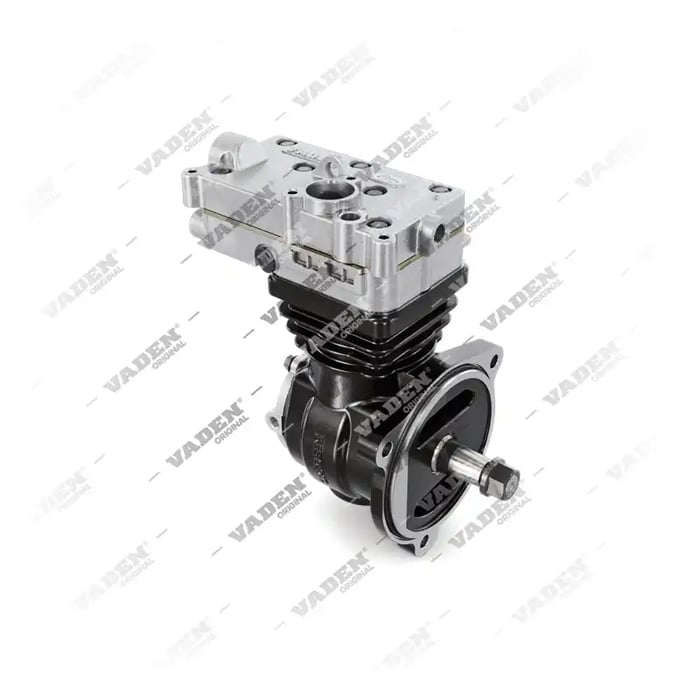
Need the part, not just the answer?
OE-grade air brake compressors and repair kits, manufactured and tested to commercial-vehicle standards.
Shop VADEN partsPublished by VADEN Original. Product links point to the manufacturer’s official catalogue. Specifications are general — always confirm figures against your vehicle’s service manual.