 airbrakecompressor
The air brake endorsement in Canada — usually called the Z endorsement — is a provincial add-on to your driver's licence that allows you to operate a vehicle equipped with air brakes. It is not a separate licence class and it is not issued federally: each province and territory runs its own course, knowledge test and, in most cases, a hands-on practical test on a real air-braked vehicle. The letter "Z" is used in Ontario and most of Atlantic Canada; Alberta uses "Q", British Columbia uses code 15, and other jurisdictions use their own designation. The endorsement travels with your licence, but the rules behind it are written locally.
What the Z endorsement actually covers
The endorsement certifies that you understand a pneumatic braking system — compressor, governor, reservoirs, air dryer, foot valve, relay valves, chambers and spring brakes — and that you can verify it is safe before you move. That is a different animal from a car's hydraulic brakes: pressure is stored rather than generated on demand, and the parking and emergency function comes from a spring that applies when air is lost. Almost every test question flows from that one idea.
Nearly every provincial curriculum is built on the same backbone:
- How air is produced, cleaned, stored and distributed
- Governor cut-out and cut-in, and what a fully charged system reads
- Low-air warning devices and what to do when one activates
- Spring brake (parking and emergency) operation and the danger of caging
- Dual-circuit design and what braking you retain when one circuit fails
- Slack adjusters, pushrod stroke and readjustment limits
- Daily draining, moisture control and cold-weather behaviour
Where "Z" applies — and where it does not
Codes and course requirements change. Treat the table below as orientation only, and confirm with the issuing authority before you book anything.
| Jurisdiction | Common designation | Typical requirement |
|---|---|---|
| Ontario | Z | Approved course, written knowledge test, practical (hands-on) test |
| Alberta | Q | Air brake course from an approved provider, knowledge plus practical |
| British Columbia | Code 15 | Knowledge test plus a practical air brake exam |
| Saskatchewan / Manitoba | Provincial air brake code | Course plus knowledge and practical assessment |
| Nova Scotia, New Brunswick, PEI, N.L. | Z | Course and/or knowledge test, practical component in most cases |
| Quebec | No separate "Z" code | Air brake knowledge handled within the licence class — confirm with SAAQ |
Endorsements are generally recognized across provinces once your licence is issued, but if you move and exchange your licence, the receiving jurisdiction decides whether it carries over or whether you retest. If you also drive in the United States, see the air brake endorsement overview — the American system removes a restriction rather than adding a code.
The practical test: what the examiner is watching
The written portion is memorization. The practical portion is where candidates fail, and it comes down to three things: can you measure pushrod stroke, can you run a leakage test cleanly, and can you narrate what you are doing while you do it. Examiners want to hear the numbers, not just watch the motions. The sequence is essentially the Canadian version of the seven-step air brake check.
Pressure and leakage figures you will be asked to state
A fully charged system normally sits around 120 psi (about 830 kPa) with the compressor unloaded. Everything else is measured against that baseline.
| Check | Expected value | Metric |
|---|---|---|
| Governor cut-out (fully charged) | About 120–135 psi | ~830–930 kPa |
| Governor cut-in | About 100–110 psi, and normally not more than roughly 25 psi below cut-out | ~690–760 kPa |
| Build-up time | 85 to 100 psi within about 2 minutes at fast idle | ~585 to 690 kPa |
| Low-air warning | Activates around 60 psi; provincial manuals cite a minimum near 55 psi | ~380–415 kPa |
| Spring brakes apply | Automatically, generally between 20 and 45 psi | ~140–310 kPa |
| Static leakage, engine off, brakes released | Roughly 2 psi/min single vehicle, 3 psi/min combination | ~14 / 21 kPa/min |
| Applied leakage, full application held | Roughly 3 psi/min single vehicle, 4 psi/min combination | ~21 / 28 kPa/min |
Use the ranges as ranges. The vehicle in front of you is governed by its manufacturer's specification and by the current provincial standard, and those are what an inspector will hold you to.
Adjustment limits
Canada applies National Safety Code criteria that mirror the North American out-of-service limits, so the readjustment numbers are the ones already printed on a chamber tag. Measure stroke with the system at normal operating pressure and a full brake application held.
| Chamber | Standard stroke limit | Long-stroke limit |
|---|---|---|
| Type 16 | 1-3/4 in | 2 in |
| Type 20 | 1-3/4 in | 2 in |
| Type 24 | 1-3/4 in | 2 in |
| Type 30 | 2 in | 2-1/2 in |
| Type 36 | 2-1/4 in | — |
Two rules follow from that table. First, a long-stroke chamber is identified by markings on the body and a square-cornered air port — do not assume from the size. Second, a vehicle or combination is placed out of service when roughly 20 percent of its brakes are defective or out of adjustment, which on a five-axle unit is fewer brakes than most drivers expect. Full figures are on the brake adjustment limits chart.
How the Canadian test differs from the US approach
Three practical differences matter. Canada leans harder on mandatory classroom or shop instruction before you are allowed to test, where the American system is largely self-study. Most provinces include a hands-on component — you will be under a unit with a ruler. And Canadian material is taught in metric alongside imperial, so expect kPa on the page even though most gauges in the yard still read psi.
If you remember one thing for the practical: reservoir pressure must be at normal operating level and the service brakes fully applied before you measure stroke. A slack adjuster measured at partial pressure can read within spec and still be badly out on the road.
Common reasons candidates fail
- Starting the leakage test before pressure has stabilized, then reporting a false loss rate
- Fanning the pedal instead of holding a steady full application
- Not stating the governor cut-out and cut-in figures out loud
- Missing the low-air warning because the engine was left running
- Failing to chock the wheels and treating the spring brakes as the only safeguard
- Guessing chamber type and applying the wrong stroke limit
One last piece of practical advice: a unit that will not build 85 to 100 psi inside the two-minute window, or that fails the static leakage check, is pointing at the compressor, the air dryer or a leaking chamber diaphragm. Chase that down before you book an examiner's time — those faults do not fix themselves on test day.
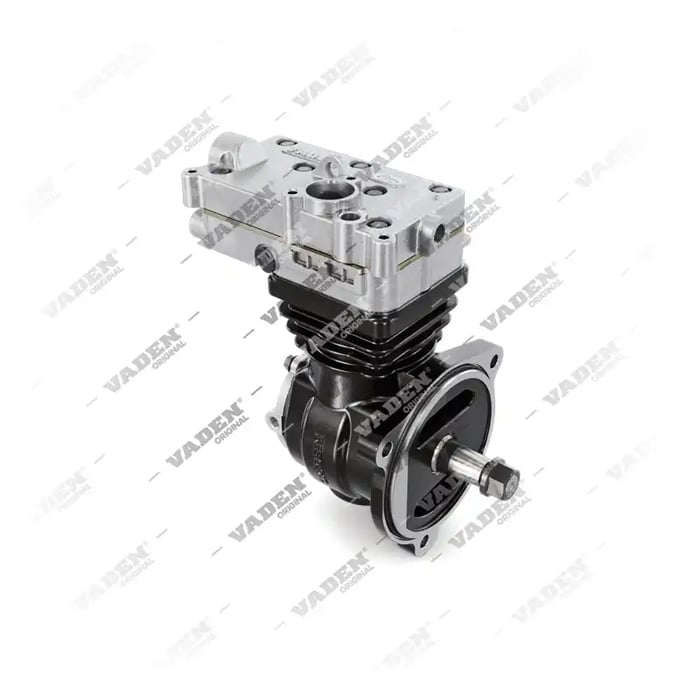
Need the part, not just the answer?
OE-grade air brake compressors and repair kits, manufactured and tested to commercial-vehicle standards.
Shop VADEN partsPublished by VADEN Original. Product links point to the manufacturer’s official catalogue. Specifications are general — always confirm figures against your vehicle’s service manual.