 airbrakecompressor
CVSA Brake Safety Week is an annual, publicly announced enforcement campaign in which certified inspectors across the United States, Canada and Mexico pull commercial vehicles in for brake-focused inspections and place any unit with a critical brake violation out of service on the spot. It is organized by the Commercial Vehicle Safety Alliance under its Operation Airbrake program, normally falls in late summer, and each year carries one announced focus item that inspectors collect data on. The campaign does not change the rules — the out-of-service criteria are identical every other week of the year — it concentrates inspection effort into a few days and publishes the results afterwards.
Who runs it and why it exists
CVSA is the alliance of state, provincial and federal commercial vehicle enforcement agencies that writes the North American Standard Inspection Program and the out-of-service criteria that inspectors work from. Operation Airbrake is its long-running brake program, conducted in partnership with the federal motor carrier agencies in the United States and Canada. Brake Safety Week is the visible, scheduled end of that program: inspectors run their normal inspections, but brake systems get the attention, and the aggregate data — vehicles inspected, brake-related out-of-service rate, and the counts on the announced focus item — is published once the numbers are compiled.
The reason for the emphasis is straightforward. Brake defects and brake adjustment problems are consistently among the most-cited vehicle violations in roadside inspections, and a pneumatic brake system degrades quietly — a chafed hose, a stroke that has crept past its limit, or a slow leak on a gladhand seal will not announce itself to the driver until it matters.
Timing and the annual focus item
Brake Safety Week is announced ahead of time, usually several weeks out, with the exact dates published by CVSA. In recent years it has landed in August. CVSA also runs an unannounced, single-day Brake Safety Day at another point in the year, so a fleet that treats the announced week as the only date to be ready is preparing for the wrong thing.
The focus item is the part fleets should actually watch for. Each campaign names one area where inspectors record extra data — past campaigns have concentrated on items such as brake hoses and tubing, and on brake lining and pad condition. The focus item does not narrow the inspection; a unit is still examined against the full criteria, and it can still be placed out of service for something entirely unrelated to that year's theme. Read the announcement when it goes out, then make that item the first thing your technicians check on every unit in the yard.
What inspectors actually check
Most Brake Safety Week inspections are North American Standard Level I inspections, which cover the driver and the full vehicle, including an under-vehicle examination. Some jurisdictions supplement this with a performance-based brake tester that measures total braking force against vehicle weight on a roller bed. The table below covers the brake-system items that generate the bulk of violations.
| System area | What the inspector looks at | Common violation |
|---|---|---|
| Air supply | Compressor build-up time, governor cut-out and cut-in, ability to hold a fully charged system | System will not reach a normal fully charged pressure of roughly 120 psi, or governor cut-out falls outside the usual 120-135 psi band |
| Warning devices | Low-air warning light and audible alarm, dash gauge function | Warning device inoperative or not activating at the required threshold of about 60 psi |
| Air loss | Static and applied leakage rates, audible leaks with the system charged | Leakage above the limits — commonly 2 psi per minute released and 3 psi per minute applied for a single vehicle, 3 and 4 psi per minute for a combination |
| Foundation brakes | Lining and pad thickness, cracks, contamination, drum or rotor condition, S-cam and bushing wear | Lining below the thickness limit, cracked or scored drum, oil or grease contamination |
| Adjustment | Pushrod stroke measured against the readjustment limit for the chamber type and size | Brake out of adjustment, counted toward the 20 percent defective brake criterion |
| Chambers | Service brake chamber and spring brake chamber condition, clamp band, mounting, diaphragm integrity | Audible leak at the chamber, non-manufactured hole, loose or missing mounting hardware |
| Plumbing | Hoses, tubing, fittings, routing and chafing points | Hose chafed into the reinforcement, kinked tubing, improper splice or repair |
| Combination items | Gladhand couplers and seals, tractor protection valve, trailer supply function, ABS lamps on tractor and trailer | Leaking gladhand seal, ABS lamp remaining lit, tractor protection not functioning correctly |
Adjustment is worth singling out, because it is measurable and it is where preventable failures cluster. Chalk the pushrod, apply a full application, measure the travel, and compare it against the published limit for that chamber type and size using a brake adjustment limits chart rather than a rule of thumb. Long-stroke and standard chambers have different limits, and mixing them on the same axle is a violation in its own right.
What puts a unit out of service
The criterion most often decided at the roadside is the defective brake rule: when 20 percent or more of the service brakes on a vehicle or combination have a defect, the unit goes out of service. On a five-axle tractor-trailer with ten brakes, that is two. A single cracked drum, a chamber with a hole in it, or an inoperative low-air warning device can also stand alone as a violation. The detail belongs on the out-of-service criteria page; for planning purposes, treat every individual defect as one-tenth of a shutdown.
How a fleet prepares
- Thirty days out. Pull the last twelve months of roadside inspection reports and repair orders and look for repeat offenders — the same trailer, the same axle position, the same chafe point. Order the fast-moving parts before the campaign, not during it: chamber diaphragm kits, gladhand seals, air dryer cartridges, governor and unloader components, slack adjusters, and lining sets. Sourcing these as OE-grade air brake system components avoids the fitment surprises that turn a one-hour job into a downed unit.
- Two weeks out. Put every unit through a full brake check on the rack. Measure stroke on every wheel end and record the numbers, gauge lining thickness rather than eyeballing it, inspect drums for cracks and heat checking, and walk the air lines end to end with the system charged, feeling for chafe against frame rails and crossmembers.
- One week out. Verify the air supply side. Confirm the compressor builds to a fully charged system in a reasonable time, that governor cut-out sits in the normal 120-135 psi range and cut-in around 100-110 psi, and that the low-air warning activates near 60 psi. With the tractor protection tested, confirm the spring brakes apply as pressure falls into the 20-45 psi range. Drain every reservoir and check for water and oil carryover, which points at a saturated air dryer or a compressor passing oil.
- Every day of the campaign. Brief drivers to slow down and do the walkaround properly. A disciplined air brake pre-trip inspection catches the leaking gladhand seal, the cracked slack adjuster clevis and the lit ABS lamp before an inspector does, and the driver's own knowledge of the air brake check is itself part of a Level I inspection.
After the campaign
CVSA publishes summary results once the data is compiled, including how many vehicles were inspected and the brake-related out-of-service rate. Compare that against your own numbers. If your units were cited during the week, the useful question is not whether the violation was fair but whether your preventive maintenance interval would ever have caught it — a brake found out of adjustment at the roadside was already out of adjustment the last time it went through the shop.
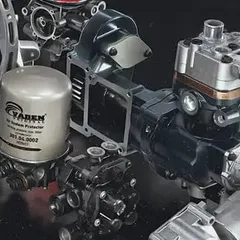
Need the part, not just the answer?
OE-grade air brake compressors and repair kits, manufactured and tested to commercial-vehicle standards.
Shop VADEN partsPublished by VADEN Original. Product links point to the manufacturer’s official catalogue. Specifications are general — always confirm figures against your vehicle’s service manual.