 airbrakecompressor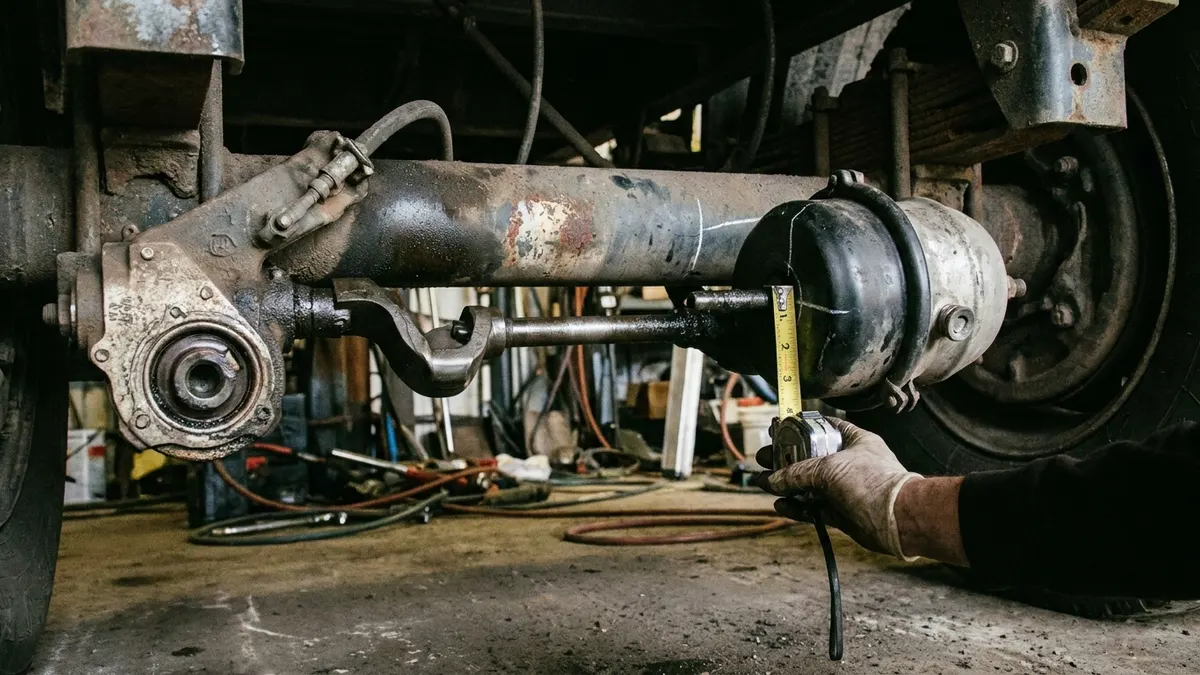
To measure brake pushrod stroke, chock the wheels, charge the system to a normal fully charged reading of about 120 psi, shut the engine off, release the spring brakes, and mark the pushrod where it leaves the brake chamber. With reservoir pressure bled down to somewhere between 90 and 100 psi, have a helper make a full, steady service brake application and measure how far the mark moved. That distance is the applied stroke, and it has to stay inside the readjustment limit for that chamber — commonly 1-3/4 in (44 mm) on a standard Type 24 and 2 in (51 mm) on a standard Type 30.
It is a two-minute measurement with a tape and a piece of chalk, and it is the single most informative check you can make on an S-cam brake. Everything upstream and downstream of the chamber shows up in it: lining thickness, drum wear, cam and bushing condition, clevis and pin slop, and whether the slack adjuster is doing its job.
What pushrod stroke actually measures
Air brakes are pneumatic. Air pressure in the chamber pushes a diaphragm and pushrod, the pushrod swings the slack adjuster, the slack adjuster twists the S-cam, and the cam spreads the shoes against the drum. The pushrod only has a finite amount of travel before the diaphragm bottoms out in the chamber, and force falls off badly toward the end of that travel. A brake sitting near its stroke limit still stops the truck on a flat lot — it simply has no reserve left for a long grade, a hot drum, or a panic stop, and it is the brake that fades first.
That is why enforcement measures stroke rather than lining thickness. Stroke is the one number that reflects the whole assembly at once.
Applied stroke: the measurement that counts
Do this on a level surface with the brakes cool. A hot drum has grown, and it will hand you a falsely long reading.
- Chock the wheels front and rear. You are about to release the parking brakes.
- Build to a fully charged system, roughly 120 psi, then shut the engine off.
- Push in the dash valves to release the spring brakes so the pushrods sit fully retracted.
- Fan the pedal until reservoir pressure sits between 90 and 100 psi. Stay above the low-air warning point near 60 psi and well above the 20-45 psi range where spring brakes start to apply on their own.
- Mark the pushrod with chalk or paint right where it exits the chamber, or pick a fixed reference such as the center of the clevis pin.
- Have a helper make a full brake application and hold it. Measure from the chamber face to the mark, or measure how far the mark travelled, keeping the rule parallel to the pushrod.
- Record each wheel end. Repeat on every brake — one wheel tells you nothing about the axle.
Never crawl under a vehicle with the spring brakes released and no chocks in place, and keep clear of the slack adjuster arc while a helper is on the pedal.
Two details spoil more measurements than anything else. First, the pushrod should be close to 90 degrees to the slack adjuster arm at the applied position; a bad installation angle wastes travel and reads long. Second, a side-to-side difference of more than about 1/4 in (6 mm) on the same axle is a defect in its own right, even if both readings pass — that axle will pull under braking.
Free stroke: the fast check
Free stroke measures only the slop before the shoes touch the drum, and it needs no air and no helper. With the spring brakes released and the wheels chocked, hook a pry bar on the slack adjuster and lever the pushrod out of the chamber until you feel the shoes contact the drum. Measure how far the pushrod moved.
Most cam brakes with a manual slack adjuster want roughly 1/2 to 5/8 in (13-16 mm) of free stroke, but the axle or brake manufacturer's figure governs. Almost nothing means the brake is dragging or over-adjusted; a lot means the clearance has run away.
Reading the two together
| Free stroke | Applied stroke | What it points to |
|---|---|---|
| In spec | In spec | Brake is adjusted and the foundation is sound |
| In spec | Long | Foundation problem: worn linings or drum, flared drum, worn cam bushings or rollers, weak or damaged diaphragm |
| Long | Long | Adjustment problem: automatic slack adjuster not taking up clearance, worn clevis and pins, stripped internal splines |
| Short or none | Short | Over-adjusted or dragging brake, seized cam, chamber not returning, restricted exhaust at the relay valve |
Adjustment limits by chamber size
Limits depend on chamber type and rated stroke, so identify the chamber before you judge the number. Long-stroke clamp chambers are marked — square air inlet ports, a trapezoidal or tagged identification, and the rated stroke stamped on the body. Treating a long-stroke chamber as a standard one, or the reverse, is the most common way to fail a good brake or pass a bad one.
| Chamber type | Rated stroke | Limit |
|---|---|---|
| Type 9 | Standard | 1-3/8 in (35 mm) |
| Type 12 | Standard | 1-3/8 in (35 mm) |
| Type 16 | Standard | 1-3/4 in (44 mm) |
| Type 20 | Standard | 1-3/4 in (44 mm) |
| Type 24 | Standard | 1-3/4 in (44 mm) |
| Type 30 | Standard | 2 in (51 mm) |
| Type 36 | Standard | 2-1/4 in (57 mm) |
| Type 20, 24 | Long stroke, 2-1/2 in | 2 in (51 mm) |
| Type 30 | Long stroke, 2-1/2 in | 2-1/2 in (64 mm) |
| Type 24 | Long stroke, 3 in | 2-1/2 in (64 mm) |
Bolt-type chambers and air disc brakes use their own figures, and the vehicle manufacturer's current service manual is the authority for your specific axle. See the full brake adjustment limits chart for bolt-type and less common sizes.
What to do with a long reading
These are enforcement thresholds, not targets. A brake measured at the limit is already a defect waiting to happen, and 20 percent or more of the service brakes on a vehicle being defective is what puts the unit out of service at a roadside inspection. On a combination with ten brakes, two bad wheel ends is enough.
If the brake uses a manual slack adjuster, set it back to spec and recheck by measuring again — see adjusting a slack adjuster. If it uses an automatic slack adjuster, do not simply crank it in. An ASA that has let stroke run long has a cause: a seized or dry adjuster, a worn clevis or anchor bracket, a failed internal clutch, worn cam bushings, or linings at the end of their life. Manual adjustment resets the symptom for a few hundred miles and hides the fault from the next inspection.
Mistakes that produce false readings
- Measuring hot brakes right after a descent — expanded drums read long.
- Applying the pedal with pressure well below 90 psi, which under-reports stroke.
- Using a partial or pumped application instead of one full, held application.
- Leaving the engine running so the governor keeps cycling between cut-in near 100-110 psi and cut-out near 120-135 psi during the measurement.
- Measuring at an angle to the pushrod, or from a reference point that moves.
- Forgetting to release the spring brakes, so the rod never starts from its true retracted position.
Write the numbers down. Stroke recorded at every service interval turns a pass/fail check into a wear trend, and a wheel end that grows 1/8 in between services is telling you something long before it becomes a violation.
Need the part, not just the answer?
OE-grade air brake compressors and repair kits, manufactured and tested to commercial-vehicle standards.
Shop VADEN partsPublished by VADEN Original. Product links point to the manufacturer’s official catalogue. Specifications are general — always confirm figures against your vehicle’s service manual.