 airbrakecompressor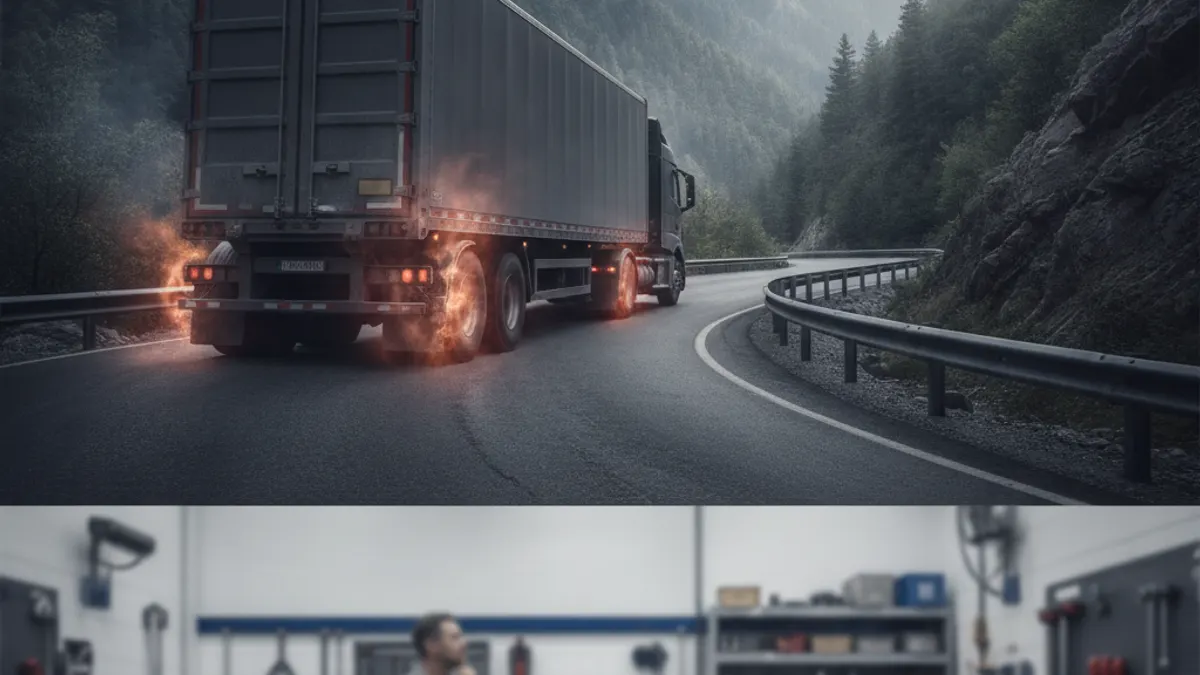
Air brake fade is a loss of braking power caused by heat in the drums and linings, not by anything wrong with the air supply. The compressor, governor, and tanks can be holding a normal ~120 psi while the truck refuses to slow down, because the friction material has been cooked past the temperature it can work at. Almost every case traces to one of two things: a brake that drags and heats up with no driver input, or a driver riding the service brakes down a long grade instead of letting the engine brake carry the load.
Because the air system stays healthy throughout, the gauge tells you nothing. Fade only appears when the brakes are hot and returns once they cool; an air fault shows up cold or hot and never improves with cooling.
The types of brake fade on an air-braked truck
Friction (lining) fade
The resin binders in the friction material break down and gas off at high temperature. The lining is still pressed hard against the drum, but its coefficient of friction drops. This is the classic long-downgrade fade, and it arrives with a hot resin smell.
Mechanical fade (drum expansion)
The drum heats faster than the shoes and grows outward, so the shoes have farther to travel and push-rod stroke lengthens. Stroke that measured legal cold can run past the readjustment limit once hot, at which point the chamber can no longer generate enough force at the S-cam.
This is the one that surprises drivers, because it compounds: longer stroke means less force at the shoe, less force makes the driver push harder, harder pushing makes more heat, and more heat means more expansion.
Lining contamination
Grease or oil on the lining glazes the friction surface and produces the same symptom. The usual sources are a failed wheel seal dumping hub oil into the drum, or an over-greased S-cam bushing throwing grease onto the shoes. Strictly this is contamination rather than heat fade, but it presents identically.
One failure you will never see here is vapor lock, which needs brake fluid boiling in a hydraulic line. A truck air brake system is pneumatic, so heat attacks the foundation brake and nothing else.
Root cause 1: dragging brakes
A brake that never fully releases generates heat every mile, whether or not the driver touches the pedal, so by the time that wheel end is asked to do real work it has no thermal headroom left. Common causes:
- Seized or dry S-cam bushings, so the cam will not rotate back
- Weak or broken shoe return springs
- Over-adjusted brakes: manual slacks cranked too tight, or an automatic slack adjuster failed in the take-up direction
- A relay or quick-release valve holding residual pressure at the chamber instead of venting it
- A kinked or collapsed hose acting as a one-way restriction
- A spring brake that will not fully release: corroded chamber, tired power spring, or restricted supply line
The tell is a hot wheel end after a run with no heavy braking. Walk the trailer at the next stop and hold a hand near — not on — each drum. One drum noticeably hotter than its mates is a dragging brake until proven otherwise; full diagnosis is on our dragging brakes page.
Root cause 2: riding the service brakes downhill
A loaded combination descending a long grade converts an enormous amount of potential energy into heat, and the drums are the only place it can go. Service brakes are sized to stop a truck from speed a handful of times, not to hold it at a constant speed for six miles.
Fade does not announce itself gradually. Everything feels fine for the first few minutes: the pedal stays firm, the gauge sits in its normal ~100-120 psi band, and then the truck stops responding to the same pedal effort. Nothing on the pneumatic side warns you, because nothing on the pneumatic side is wrong.
Fade or an air fault? How to tell them apart
Because the symptom is "the truck will not slow down", fade gets confused with a genuine supply problem. Sort the two apart before you pull a drum.
| Symptom | Points to heat / fade | Points to an air fault |
|---|---|---|
| Gauge pressure while braking | Holds in the normal ~100-120 psi band | Sags and will not recover; low-air warning at ~60 psi |
| Pedal feel | Firm, full travel, no result | Soft, or falls away under your foot |
| When it happens | Only when hot, after a grade or a drag | Any time, cold or hot |
| Recovery | Braking returns once the drums cool | No improvement with cooling |
| Smell | Hot resin, burnt lining | Nothing unusual |
| Likely fix | Linings, drums, adjustment, driving technique | Compressor, governor, leaks |
The two overlap in one place. A compressor that cannot keep up never lets pressure climb to the governor's cut-out point of ~120-135 psi, so the driver watches the needle sag and starts fanning the brakes to compensate, and fanning builds heat. If the gauge is misbehaving as well as the braking, chase the air side first.
Why the engine brake is the real answer
A Jake brake or engine brake turns the truck's momentum into heat inside the engine, where the cooling system is built to shed it continuously. The service brakes turn that same momentum into heat inside the drums, where there is no cooling system at all, only air passing over cast iron. That is the whole argument for engine braking on grades.
The right downhill procedure
- Pick the gear before the crest. Once you are rolling and heavy you may not get another gear. Descend in the gear you would need to climb the same grade, or one lower.
- Set the engine brake to its highest useful stage and let it carry the descent, so speed is controlled by gear and engine brake.
- Use snub braking for the rest. Apply firmly enough to feel a definite slowdown, take roughly 5 mph off your safe speed, then release fully and let the drums cool in moving air.
- Never ride the pedal. Light continuous pressure puts enough heat into the linings to cook them and never lets the drums shed it.
Heat rejection depends on the temperature gap between drum and air, and on time spent not adding heat. A firm, short application followed by a full release gives you both; a light constant drag gives you neither.
What decides how much heat you can take
| Factor | Effect on fade resistance |
|---|---|
| Drum mass and condition | More iron means more heat sink. Turned-thin or cracked drums fade sooner. |
| Lining spec | Friction material is rated for a temperature range. A lining that fades early on grades is a false economy. |
| Brake adjustment | Out-of-stroke brakes push the in-adjustment ones into extra work, and those overload and fade first. |
| Load and brake balance | An overloaded axle, or mismatched timing that makes one axle grab first, cooks that wheel end. |
| Air disc vs drum | Discs are open to airflow and resist fade markedly better than an enclosed drum. See air disc vs drum brakes. |
If fade happens on the road
- Get the engine brake to maximum and downshift if the engine will accept it.
- Look for an escape ramp and use it. Taking one is never the wrong call. With no ramp, look for anything that adds rolling resistance: an uphill shoulder, soft gravel, a runout.
- Do not pump the pedal hoping to find grip. You will only add heat, and repeated heavy applications draw the tanks down toward the ~60 psi low-air warning.
- Once stopped safely, do not set the parking brakes hard on glowing drums. A hot drum clamped by a spring brake can distort or crack as it cools. Chock the wheels, let the wheel ends cool in still air, and do not hose them down.
Preventing fade
Check push-rod stroke at every inspection and treat anything at the readjustment limit as a defect. Keep S-cam bushings and slack adjusters greased so the brakes release, without overdoing it and contaminating the linings. Replace drums at the discard dimension cast into the drum rather than guessing, replace linings in matched sets with a friction spec rated for the work, and verify the engine brake on every pre-trip before a route with grades.
Above all, treat a hot wheel end as a repair order. The drum running hotter than the others is the one that will fade first, and it tells you exactly where to start.
Friction material that has been through a fade event is heat-glazed and does not recover, so plan on brake lining sets in axle pairs whenever a drum has run hot enough to blue.
Need the part, not just the answer?
OE-grade air brake compressors and repair kits, manufactured and tested to commercial-vehicle standards.
Shop VADEN partsPublished by VADEN Original. Product links point to the manufacturer’s official catalogue. Specifications are general — always confirm figures against your vehicle’s service manual.