 airbrakecompressor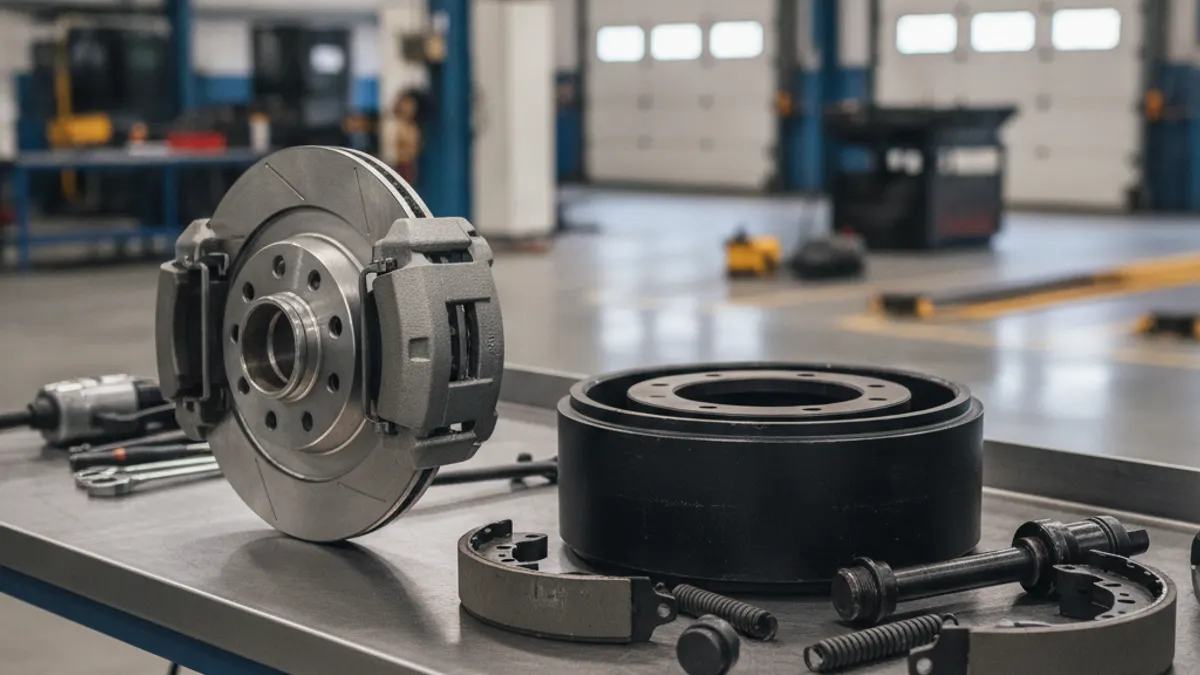
Air disc brakes (ADB) stop a truck in a shorter distance, shrug off brake fade on long downgrades, and cut brake-service time dramatically — but they cost more up front than the S-cam drum brakes that still dominate the fleet. Both designs run on the same pneumatic air brake system and the same brake chambers; the only thing that changes is the foundation brake at the wheel end. On a disc setup, air pressure drives a caliper that squeezes a rotor. On a drum setup, that same pressure rotates an S-cam that forces two shoes outward against a spinning drum. Which one belongs on your truck depends on the axle, the duty cycle, and how you value downtime against purchase price.
Same Air System, Different Foundation Brake
It's worth clearing up a common point of confusion before comparing the two. Air disc and air drum brakes are both air brakes — the word "air" describes how the force is delivered, not the foundation design. In both cases, pushing the pedal sends air from the reservoirs through the relay valve to the brake chambers, and the diaphragm pushes a pushrod. What happens after that pushrod moves is where they split.
- Drum (S-cam): The pushrod swings a slack adjuster, which rotates the S-cam shaft. The cam spreads two brake shoes outward against the inside of a cast drum. This is the classic S-cam foundation brake that has been on North American trucks for decades.
- Disc (ADB): The pushrod acts directly on an internal lever and adjuster inside the caliper, which drives a pad against each face of a ventilated rotor — the same clamping principle a car uses, scaled up and fed by air instead of hydraulic fluid.
Because the air supply, governor, dryer, and tanks are identical, you don't re-engineer the whole truck to run discs. You change the wheel-end hardware and, in most cases, the chambers stay compatible.
Head-to-Head Comparison
| Factor | Air Disc Brake (ADB) | S-Cam Drum Brake |
|---|---|---|
| Stopping distance | Shorter, more consistent; strong initial bite | Longer; adequate when well maintained |
| Fade resistance | Excellent — open rotor sheds heat fast | Prone to fade; drum traps heat and expands |
| Wet/recovery performance | Recovers quickly; pads wipe the rotor | Slower to recover after water or heavy heat |
| Adjustment | Self-adjusting inside caliper; no slack adjuster | Automatic slack adjuster that can fall out of stroke |
| Routine service time | Fast pad swap, minutes per wheel | Longer reline; shoes, drums, hardware |
| Up-front cost | Higher parts and initial purchase price | Lower; cheapest to buy and repair |
| Repairability in the field | Specialized parts; fewer roadside fixes | Parts everywhere; almost any shop can do it |
| Weight | Comparable, sometimes slightly heavier per corner | Comparable; drums are heavy but familiar |
Where Air Disc Brakes Win
Stopping power and fade
The biggest real-world advantage is heat management. A rotor is open to airflow, so it dumps heat quickly and keeps its clamping force steady through repeated hard stops. A drum, by contrast, is a closed casting that traps heat; as it gets hot it expands away from the shoes, and the friction drops off — that's brake fade. On a long mountain descent or in stop-and-go city delivery, ADB holds its performance where drums can start to lose theirs. That consistency also translates to shorter, straighter stops, which is why disc-equipped steer axles have become popular for safety and reduced stopping distance.
Maintenance and uptime
For a fleet, the labor story is often more persuasive than the stopping story. Swapping pads on a caliper is a quick job compared to pulling drums, replacing shoes, and resetting hardware. There is no slack adjuster to inspect for pushrod stroke and no S-cam bushing to seize — two of the most common items that put drum brakes out of adjustment and flag a roadside inspection. Fewer wear components in the stroke path means fewer chances to be out of adjustment at exactly the wrong moment.
Where Drum Brakes Still Make Sense
Drums are far from obsolete. They remain the default on a huge share of trailers and on cost-sensitive vocational trucks for good reasons:
- Purchase price: Drum foundation brakes are cheaper to buy, and a reline uses inexpensive, widely stocked shoes and drums.
- Field serviceability: Almost any shop in any town can reline a drum brake. ADB parts and know-how are more specialized, which matters for an owner-operator far from a dealer.
- Proven durability: In lighter-duty or lower-speed work where fade isn't the enemy, a well-maintained S-cam brake gives long, predictable service life.
Many fleets run a mixed strategy: air disc on the tractor's steer and drive axles for stopping performance, and drum brakes on trailers to hold down cost across a large trailer pool. The trailer side of that decision has its own weight, heat and lifecycle-cost math, set out in trailer disc versus drum brakes. When you do move to disc, matching the caliper to the axle and duty cycle matters, and OE-grade hardware is worth it on a safety-critical part — VADEN's air disc brake caliper range is built to that standard for common commercial axles.
Cost of Ownership, Not Just Sticker Price
The honest way to compare the two is total cost of ownership. ADB costs more to buy, but the reduced labor per service event, longer typical friction life, and fewer out-of-adjustment write-ups can close the gap over a truck's life — especially on high-mileage tractors that stop hard and often. Drums win the up-front math and stay ahead on light-duty or low-annual-mileage equipment where the labor savings never fully accumulate. Run the numbers on your duty cycle: annual miles, terrain, brake-service labor rate, and how much a roadside out-of-service event actually costs you.
Do Both Wear Out the Same Way?
No. On drums, you watch shoe lining thickness, drum wear and cracking, and pushrod stroke on the slack adjuster. On discs, you watch pad thickness and rotor condition (cracking, scoring, thickness). Discs give you a more visible, quicker read on wear at inspection. Either way, the rest of the air brake system — governor, dryer, valves, and chambers — is inspected and maintained identically, so upgrading your foundation brake doesn't change how you service the air side. If you're new to how the whole pneumatic circuit charges and delivers pressure, start with how air brake systems work before you dive into foundation-brake choices.
The Bottom Line
Choose air disc brakes when stopping performance, fade resistance on grades, and reduced brake-service downtime are your priorities — steer axles and severe-service tractors are the obvious candidates. Choose S-cam drum brakes when up-front cost and universal field repairability matter most, which keeps them the sensible default on trailers and many vocational units. Neither is "obsolete"; they're two answers to different priorities, and plenty of well-run fleets deliberately use both on the same rig.
Source (VADEN Original): Disc Brakes vs. Drum Brakes: A Heavy-Duty Vehicle Comparison · Air Brake Caliper: Air Disc Brake Systems Explained
Need the part, not just the answer?
OE-grade air brake compressors and repair kits, manufactured and tested to commercial-vehicle standards.
Shop VADEN partsPublished by VADEN Original. Product links point to the manufacturer’s official catalogue. Specifications are general — always confirm figures against your vehicle’s service manual.