 airbrakecompressor
On a line-haul truck with a low duty cycle, clean intake air and a serviced air dryer, an air brake compressor commonly lasts several hundred thousand miles, and some reach the engine's first major overhaul. On transit, refuse, dump, mixer and other high-air-use trucks the same compressor can wear out in a fraction of that distance, because loaded pumping time and heat wear it out, not the odometer. Replace it when build-up time, oil carryover or head condition show real wear, or preemptively when major engine work already has it off the engine.
Why miles are the wrong yardstick
On most trucks the compressor turns whenever the engine runs, but it only works hard while it is loaded. The governor unloads it at cut-out, typically 120-135 psi, and loads it again at cut-in, around 100-110 psi, holding a fully charged system near 120 psi. The share of engine running time spent loaded is the duty cycle. Bendix troubleshooting guidance states that compressors are designed to run loaded up to about 25 percent of the time; beyond that, head temperature climbs, more oil passes into the discharge air and carbon builds in the head and discharge line.
That is why two trucks with the same part number age so differently. A highway tractor at cruise spends long stretches unloaded as it covers hundreds of miles a day; a refuse truck on its route can stay loaded for much of the shift at low road speed. On vocational equipment, judge the compressor by engine hours and by measured duty cycle and accessory air demand.
Realistic service life by application
OE guidance ties compressor life to duty cycle, not mileage, and warranty terms show how much duty matters. Bendix's published limited warranty covers its compressors for 24 months, 200,000 miles or 7,200 hours in normal service, but only 12 months, 100,000 miles or 3,600 hours in high-duty applications such as transit buses, refuse haulers, dump trucks, cement mixers, bulk unloaders and off-highway equipment. A warranty is a floor, not a life expectancy. The groupings below follow Bendix's low- and high-air-use classes.
| Application | Air demand | What works the compressor | Realistic expectation | Track it by |
|---|---|---|---|---|
| Line-haul tractor with a single trailer | Low | Few brake applications per mile, long unloaded stretches | Longest: several hundred thousand miles; some reach the first major engine overhaul | Miles and a build-up time trend |
| Doubles and triples, highway coach, most pick-up and delivery, yard tractors | High | More chambers and trailer reservoirs to fill, air suspension, frequent stops | Shorter; wear follows duty cycle more than distance | Miles and engine hours |
| Dump, mixer, logging, construction and off-highway | High, with long charge times | Body, PTO and shift air, dust, idling on site | Noticeably shorter; plan around engine hours | Engine hours |
| City transit, refuse, bulk unloading, central tire inflation | Very high | Doors and kneeling suspension, a brake application at every stop, unloading air | Shortest, unless the compressor and air dryer are sized for the duty | Engine hours and measured duty cycle |
What shortens compressor life
- Sustained high duty cycle. Leaks, accessory air, a leaking air dryer purge valve or an undersized unit keep the compressor loaded and hot.
- Heat. A carboned discharge line, restricted coolant lines to the head or an engine running hot raises compressor temperature, distorting bores and cooking oil into carbon.
- Unfiltered intake air. A torn filter element or a leaking induction pipe wears out the upper rings and bores quickly, and a compressor damaged that way has to be replaced.
- Oil supply and drain faults. High engine oil pressure, a restricted oil return or excessive crankcase pressure pushes oil past the rings.
- Cold-weather idling. Bendix service literature links a significant number of compressor failures each year to discharge line freeze-ups, which long winter idling encourages.
How to judge how much life is left
Condition beats mileage. Trend these checks over time:
- Build-up time against a baseline. As Bendix recommends, time the same pressure build at the same engine speed when the compressor is new, file the result and repeat it at each preventive maintenance service; a lengthening time is lost output. The CDL check of 85 to 100 psi within about 45 seconds at operating rpm on a dual air system is only a pass or fail floor that a worn compressor can still meet.
- Oil carryover. Some oil at the dryer purge is normal. Oil collecting in the supply reservoir, or a dryer cartridge that fouls well ahead of schedule, points to wear once external causes are ruled out.
- Carbon and heat marks. Heavy carbon in the discharge line, discolored cylinders or head, a weeping head gasket or coolant in the air system all say the unit has run hot or is near the end.
- Noise. Knocking under load is late-stage wear.
Rule out leaks, the governor, the unloader and intake or discharge restrictions before condemning the unit; Bendix warns that skipping those checks tends to produce a string of replacement compressors without a fix. More warning signs are in our guide to failing air brake compressor symptoms.
When to replace it preemptively during engine work
On a gear-driven compressor, most of the labor goes into reaching it and disconnecting the oil feed, coolant lines and discharge line. When another job already pays for that access, a new or remanufactured unit on a high-hours truck is cheap insurance against a second teardown and against a roadside failure, where falling pressure trips the low-air warning around 60 psi and the spring brakes apply in the 20-45 psi range. Replacement usually makes sense when the compressor is original or high-hours, and:
- The engine is coming out for an out-of-frame overhaul or replacement. The compressor comes off anyway, and a worn unit refitted to a freshly overhauled engine becomes its weak link.
- Gear train or flywheel housing work disturbs the compressor drive. On many engines the compressor or its drive gear has to come off to reach the job.
- A pump driven off the back of the compressor is being replaced. On the Cummins ISX the power steering pump typically mounts to the rear of the compressor, and on the Detroit Series 60 the fuel pump can be driven the same way.
- The engine suffered something the compressor shared. Dirt ingestion, a serious overheat or bearing debris in the oil also reaches a compressor that shares the engine's intake air, coolant and oil.
Leave the compressor in place when it has a known recent history, its build-up time still matches baseline, oil carryover is normal and the job does not disturb it, or when the truck leaves the fleet before it would wear out. If duty cycle, heat or dirt killed the last compressor, fix that first or the new one will go the same way. For the cost side, see rebuilding versus replacing an air compressor.
Plan the part before the teardown
Once the engine job is booked, read the OE part number stamped on the existing compressor and confirm drive type, rotation, cooling and port layout so the replacement is on the shelf before teardown. VADEN's OE-grade replacement air brake compressors are cross-referenced by OE number for this. At installation, fit a new dryer cartridge, clean or replace the discharge line, confirm cut-out and cut-in, and record a fresh build-up time as the new baseline.
Service life ranges here are field expectations, not manufacturer ratings; current vehicle and compressor service literature governs build-up time, pressure settings and replacement criteria.
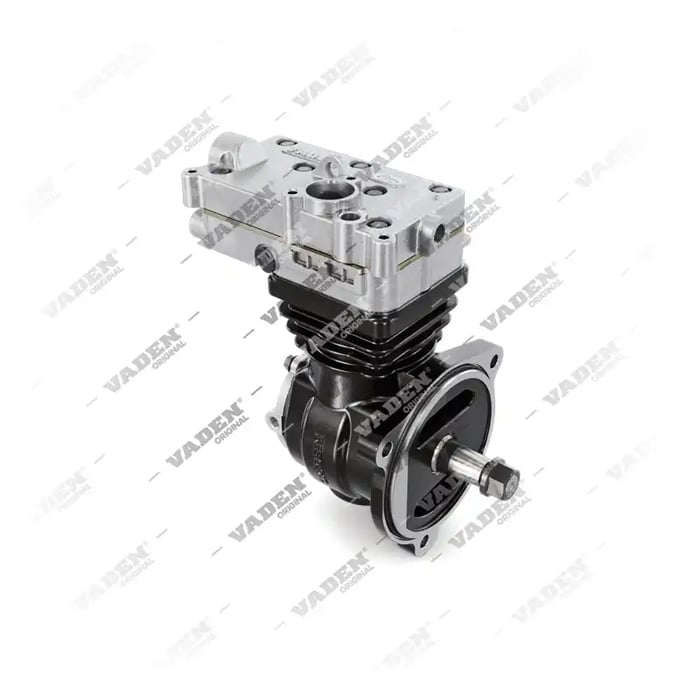
Need the part, not just the answer?
OE-grade air brake compressors and repair kits, manufactured and tested to commercial-vehicle standards.
Shop VADEN partsPublished by VADEN Original. Product links point to the manufacturer’s official catalogue. Specifications are general — always confirm figures against your vehicle’s service manual.