 airbrakecompressor
Compressor duty cycle is the percentage of engine running time the compressor spends loaded - actually pumping air into the system - and OE compressor manufacturers generally want that number at or below about 25 percent. Accessory air stacks directly on top of brake demand: air suspension, air-ride seats, PTO and shift cylinders, dump and tarp controls, packer bodies and tire inflation systems all pull from the same supply, so every cubic foot they use is another cubic foot the compressor has to make. When sustained duty cycle climbs well past that quarter-of-the-time mark, discharge temperatures rise, oil carries over into the discharge line and air dryer, and the compressor fails long before its normal service life.
What duty cycle actually measures
On a truck the compressor is gear- or belt-driven, so it turns whenever the engine turns. What changes is whether it is compressing. The governor watches reservoir pressure and, at cut-out (typically 120-135 psi depending on the vehicle), sends air to the compressor unloader so the intake stays open and the compressor free-wheels. When pressure falls to cut-in (typically 100-110 psi), the governor vents that signal and the compressor loads again. A healthy system sits around 120 psi fully charged.
Duty cycle is therefore loaded minutes divided by total engine running minutes, measured over a representative shift rather than a single trip. Two trucks with identical compressors can be worlds apart: a linehaul tractor at highway speed may load for a few seconds every several minutes, while a refuse or dump chassis working a route can be loaded almost continuously. Same part number, completely different service life.
Where accessory air demand comes from
Brake applications are only part of the picture. The chart below covers the loads that most often push a vocational or bus chassis into trouble.
| Accessory system | Draw pattern | Effect on duty cycle |
|---|---|---|
| Chassis and cab air suspension, leveling valves | Small, near-continuous corrections; worse on rough roads and at loading docks | Steady background load that never lets the compressor rest |
| Air-ride seat | Small, continuous with road input | Minor alone, meaningful when combined with a worn system |
| PTO engagement, air shift and air clutch cylinders | Short high-volume bursts, many per hour on vocational work | Sharp draw-downs that trigger repeated cut-in |
| Dump body, tailgate latch, tarp system | Large actuations every load cycle | High on short-haul and aggregate work |
| Refuse packer, tanker blow-down, air-operated tools | Heavy and sustained | Often the single largest consumer on the vehicle |
| Bus doors, kneeling suspension, wheelchair lift | Frequent cycles at every stop | Urban duty can double compressor loaded time |
| Trailer tire inflation systems | Small and continuous | Masks slow tire and line leaks, so demand creeps up unnoticed |
| Air horns, air guns used for cleaning | Operator-controlled | A leak by choice; easy to underestimate over a shift |
Why a high duty cycle destroys compressors
Unloaded time is cooling time. Take it away and the head and discharge port run hot; above roughly 400 F at the discharge port, lubricating oil begins to coke rather than drain. That carbon collects in the discharge line and unloader passages, restricts flow, raises temperature further and feeds itself.
Hot, thin oil also gets past the rings more easily, which is why the first symptom on a high-demand chassis is usually oil at the air dryer purge or in the wet tank rather than a loss of pressure. If you are chasing that, work through a compressor that is passing oil before condemning the unit - the cause is often duty cycle, not a defective compressor. Downstream, oil-fouled desiccant loses its ability to hold water, so you get moisture in the tanks, sluggish valves and frozen lines in winter. Contaminated air then swells rubber valve seats, which creates more leaks, which raises duty cycle again.
Treat every pressure and temperature figure here as a working range. Cut-out, cut-in, discharge temperature limits and dryer service intervals vary by chassis and body builder, and the vehicle manufacturer's current service literature is the authority.
How to measure duty cycle in the shop
- Run the standard leakage checks first. A compressor that never seems to unload is far more often a leak or a governor fault than an undersized unit.
- Verify governor operation at the dash gauge: cut-out in the 120-135 psi band, cut-in in the 100-110 psi band, with a clean audible dryer purge at cut-out.
- Time the build-up from 85 to 100 psi; roughly 45 seconds or less at operating rpm is the usual in-service benchmark.
- Count air dryer purges over a measured hour of normal operation. One purge equals one cut-out, so purge frequency is a free duty-cycle proxy.
- For a real number, record supply reservoir pressure or the governor unloader signal over a full shift and total the loaded time.
- Repeat the test with the accessory circuit shut off. The difference between the two runs is what the body is costing you.
| Check | Typical reference value |
|---|---|
| Governor cut-out | 120-135 psi |
| Governor cut-in | 100-110 psi |
| Fully charged system | About 120 psi |
| Build-up, 85 to 100 psi | About 45 seconds or less |
| Static leakage, single vehicle / combination | 2 psi/min / 3 psi/min maximum |
| Applied leakage, single vehicle / combination | 3 psi/min / 4 psi/min maximum |
| Low-air warning | Active by about 60 psi |
| Spring brakes apply | Roughly 20-45 psi |
| Target loaded duty cycle | About 25 percent or less |
Sizing and protecting the system for accessory air
Fix demand before you buy displacement
Leaks, a stuck unloader, a leaking dryer purge valve or a body cylinder that seeps all raise duty cycle around the clock. Repair those first, then re-measure. Many "undersized compressor" complaints disappear at this step.
Match displacement to the real load
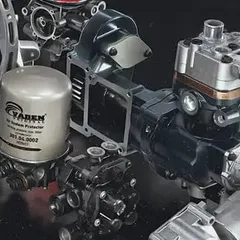
If demand is genuine, the answer is more displacement per engine revolution - typically a twin-cylinder unit or a higher-capacity single, chosen against its rated output at a stated rpm and the actual drive ratio. Confirm mounting, drive, and head cooling and lubrication connections before ordering, and spec a unit built to OE tolerances such as these heavy-duty air brake compressors, since a marginal casting will not survive vocational duty. Our displacement and output buying guide walks through the comparison.
Understand what more tank volume does
Adding reservoir capacity lengthens the time between cut-in and cut-out and softens peak draw-downs, but it does not reduce the total air the vehicle consumes. Volume buys you fewer, longer cycles - useful for valve and dryer life, but not a substitute for capacity.
Isolate the accessory circuit
Accessories must be fed through a pressure protection valve so a burst body line cannot drain the brake supply; these valves generally close in the 70-80 psi region, giving service and parking brakes first claim on stored air.
Give the air time to cool and dry
Route the discharge line to the OE minimum length, sloping and free of low spots where oil and condensate collect, and keep it clear of carbon. On high-demand chassis, size the dryer for the duty, consider an oil-coalescing type, and shorten the cartridge interval rather than following the highway-truck schedule.
Bottom line
Accessory air is not free. Measure the duty cycle, fix the leaks, then size the compressor, dryer and protection valves to the work the truck actually does. Get that right and the compressor lasts; get it wrong and you will keep replacing the same part.
Source (VADEN Original): Air Brake Compressor Duty Cycle & Efficiency Guide
Need the part, not just the answer?
OE-grade air brake compressors and repair kits, manufactured and tested to commercial-vehicle standards.
Shop VADEN partsPublished by VADEN Original. Product links point to the manufacturer’s official catalogue. Specifications are general — always confirm figures against your vehicle’s service manual.