 airbrakecompressor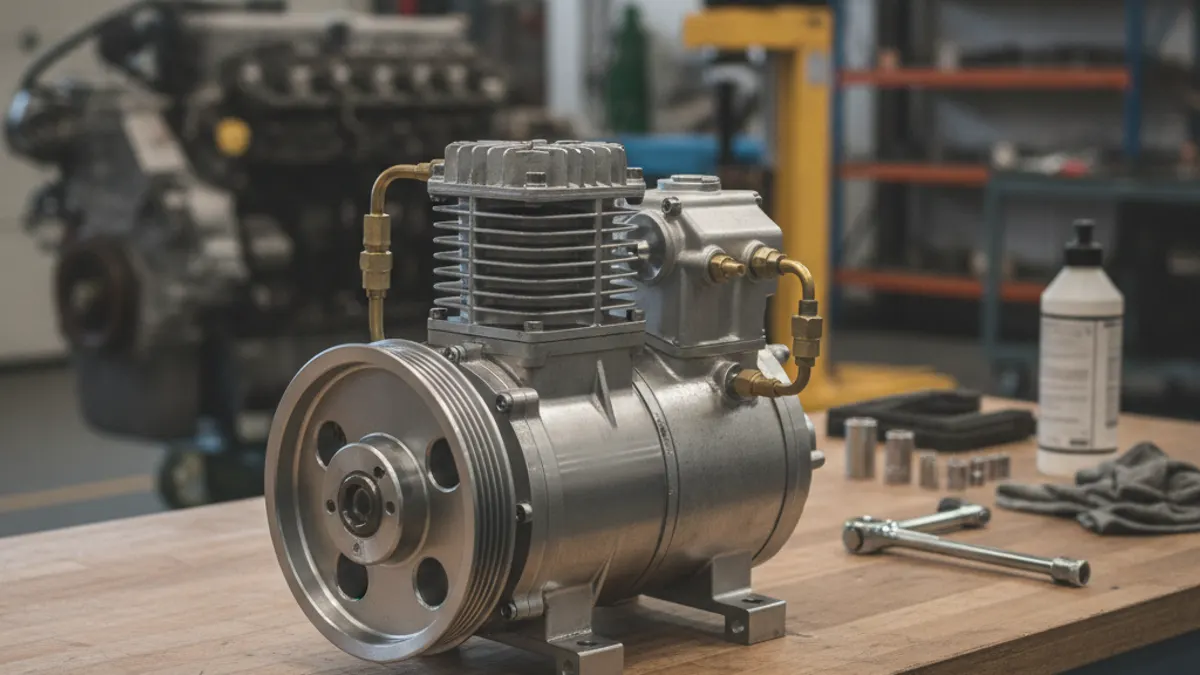
Rebuilding a truck air brake compressor with a repair kit is worth doing when the failure is confined to wear items — valves, gaskets, piston rings, unloader seals — and the castings, bore and crankshaft still measure inside the manufacturer's limits. Replace the unit when the bore is scored or worn past its taper limit, the head is cracked or the valve seats are eroded, the crank journals or bearings are damaged, or the compressor has been passing oil long enough to glaze the cylinder. The deciding factor is rarely the price of the kit — it is the labor of pulling and refitting the compressor, which you pay either way.
The short decision rule
You cannot make this call with the compressor still on the engine. Pull it, strip the head, and measure. If everything that failed is in the kit, rebuild. If anything outside the kit is out of spec, the rebuild is a bandage — you will be doing the same job again, and paying the same labor a second time.
Air brake compressors are engine-lubricated and gear- or belt-driven, so an in-frame repair is rarely practical. Budget the removal and refit as a fixed cost, then decide what goes back in the hole. For the full R&R procedure, see the air brake compressor replacement guide.
What a compressor repair kit actually covers
Kit contents vary by make and model, but a typical overhaul kit for a truck air brake compressor includes:
- Inlet and discharge valve assemblies (reed or disc type), valve springs and seats, or a complete valve plate
- Head, base and cover gaskets, plus O-rings for the coolant and oil passages
- Piston rings, and in fuller kits the piston and wrist pin
- Unloader plungers, seals and springs
- Connecting rod bearing shells and main bearings or seals, depending on the design
Kits are sold as minor (gaskets, valves, unloader seals) or major (adds rings, pistons, bearings). Buying the right level matters: fitting a minor kit to a unit with worn rings is the classic way to have the same oil-passing complaint back within weeks. OE-grade parts earn their price here — VADEN air brake compressor repair kits are matched to specific compressor families, so valve lift, seat height and ring dimensions are correct rather than approximate.
What kits do not fix: the wear limits
Everything below has to be inspected and, where the manual gives a figure, measured. Always work to the compressor manufacturer's current service literature for the actual limits — the guidance below is the decision logic, not the numbers.
| Component | Check | Rebuild is viable | Replace the compressor |
|---|---|---|---|
| Inlet/discharge valves and seats | Carbon build-up, pitting, leak-down test | Carbon only; seats clean or serviceable | Seats eroded or grooved, valve plate cracked |
| Cylinder bore | Bore gauge for taper and out-of-round; visual for scoring and glaze | Light glaze, within taper limit — hone and fit new rings | Vertical scoring you can feel with a fingernail, or wear past the service limit |
| Piston and rings | Ring gap, groove wear, skirt condition | Rings worn, piston sound | Skirt scuffed, collapsed or seizure-marked |
| Crankshaft and bearings | Journal condition, end float, big-end play | Journals clean and to size | Scored or undersize journals, spun shell, damaged keyway |
| Head and crankcase casting | Crack test, straightedge for warp, coolant passage corrosion | Flat, sound, passages clear | Any crack, warp past limit, badly corroded water jacket |
| Unloader bores | Scoring, sticking plungers, bore wear | Bores clean — seals come in the kit | Bores worn oval or pitted |
| Drive gear or coupling | Tooth wear, backlash, rear seal leak | Gear good — reseal | Chipped or worn teeth, damaged drive flange |
Cost and downtime compared
Prices vary by compressor family and market, so work with ratios rather than figures. A repair kit is typically a small fraction of a new unit; a quality remanufactured unit sits between the two. Where the arithmetic turns is bench time and risk.
| Factor | Rebuild with kit | Remanufactured unit | New unit |
|---|---|---|---|
| Parts outlay | Lowest | Medium (often plus a core charge) | Highest |
| Labor | R&R plus several hours on the bench | R&R only | R&R only |
| Vehicle downtime | Longest — the truck waits on the bench work | Shortest | Shortest |
| Tooling needed | Bore gauge, hone, torque wrench, clean bench | Basic hand tools | Basic hand tools |
| Warranty | Kit parts only | Unit warranty | Full unit warranty |
| Repeat-failure risk | Higher if anything outside the kit is worn | Low | Lowest |
For a shop with a spare compressor on the shelf, rebuilding the removed unit as a bench job costs nothing in downtime. For an owner-operator with one truck earning, a day on the bench can easily outweigh the price difference — see what an air brake compressor replacement costs before committing.
When a rebuild is false economy
- The unit was pumping oil. Oil carryover means worn rings, a glazed bore or a failed rear seal, and by then the bore is usually past honing. See air brake compressor pumping oil.
- Second rebuild on the same casting. Once the bore has been honed and the seats lapped, there is little material left to give.
- High-hour unit on a high-mileage engine. A kit restores the valves; it does not reset a worn crank or a fatigued casting.
- No measuring equipment. Rebuilding by eye without a bore gauge is guesswork, and a compressor that fails again on the road is a safety problem, not just a warranty argument.
- Unmatched generic kits. If the only kit available is unbranded and not listed for the model, valve lift and ring specification are a lottery.
Rebuild makes sense when
- The complaint was slow build-up traced to carboned discharge valves, with a clean bore behind them
- The unit is low-hour and failed on a gasket, unloader seal or head leak
- You run a fleet with float units, so bench time is off the critical path
- The compressor is on an older or low-volume engine where new units are scarce or long-lead
Whichever way you go, clean the system
A compressor that passed oil or ran hot has already pushed contamination downstream into the air dryer, wet tank, valves and lines. Fitting a perfect compressor into a dirty system is the fastest way to ruin it. Change the dryer cartridge, drain and inspect the tanks, and clear or replace the discharge line and any oil-soaked hoses before the truck goes back out.
Finish by checking governor and unloader operation. A healthy pneumatic system cuts out somewhere around 120–135 psi, cuts back in near 100–110 psi, and sits fully charged at roughly 120 psi, with the low-air warning light and buzzer clearing as pressure climbs above about 60 psi. Where the vehicle manufacturer's service data gives different figures, those govern.
If build-up time is still slow after the repair, the compressor was probably never the whole problem. Leaks, a restricted air dryer or a failing governor produce the same complaint.
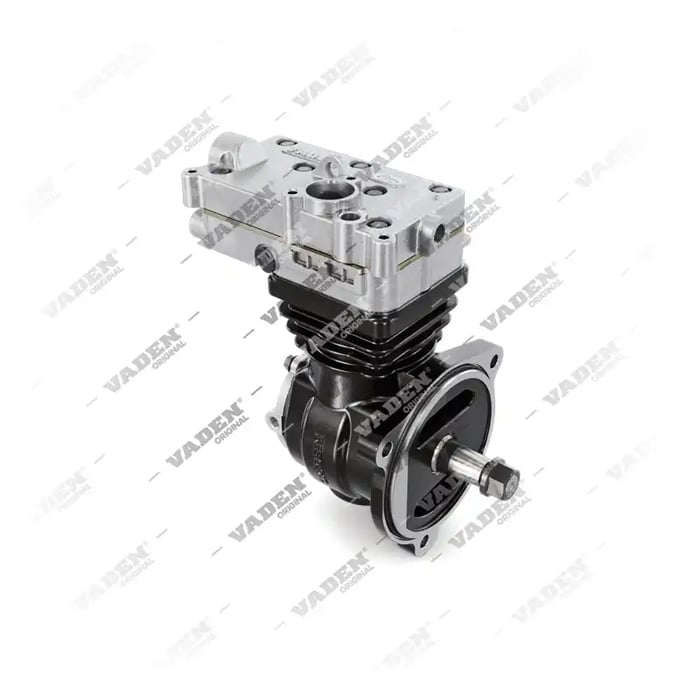
Need the part, not just the answer?
OE-grade air brake compressors and repair kits, manufactured and tested to commercial-vehicle standards.
Shop VADEN partsPublished by VADEN Original. Product links point to the manufacturer’s official catalogue. Specifications are general — always confirm figures against your vehicle’s service manual.