 airbrakecompressor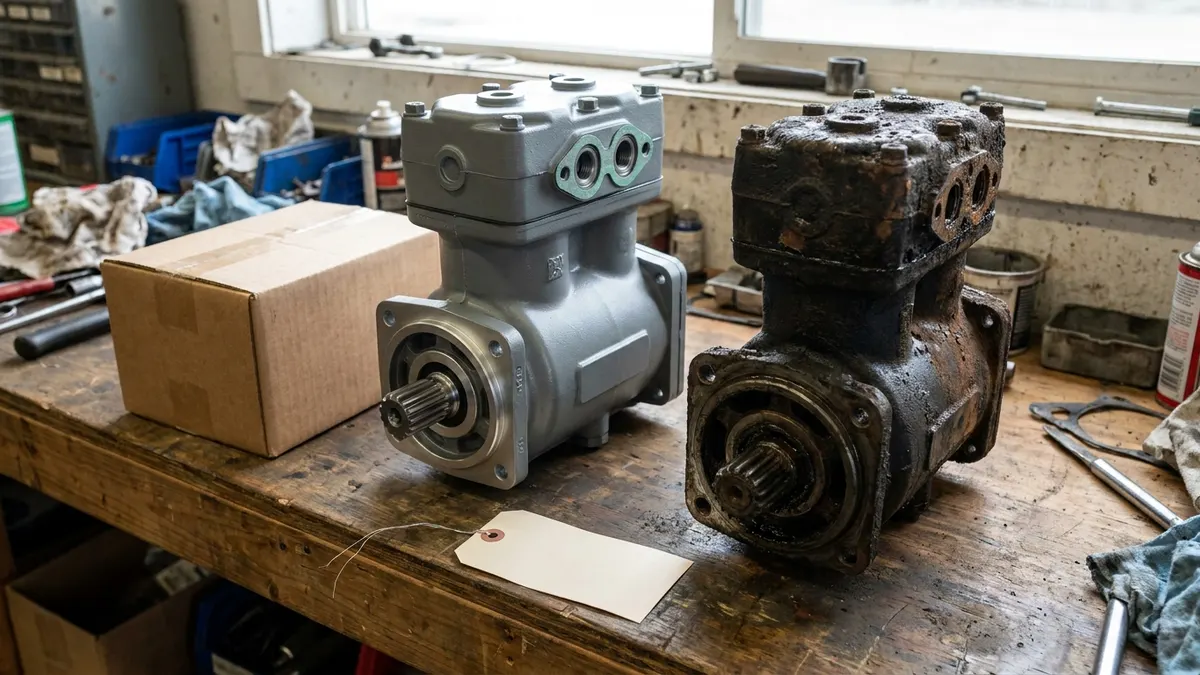
For most fleets running common heavy-truck compressor designs, a properly remanufactured exchange unit is the better value: it typically costs well under a new unit, comes with a warranty and a refundable core credit, and — if the rebuilder actually replaces wear parts instead of cleaning and re-gasketing — it will build air to the same spec as new. Buy new when the compressor is a late-model or low-volume design with no proven core supply, when downtime cost swamps the price gap, or when you cannot verify what the rebuilder replaced. The decision comes down to four things: what the reman spec covers, warranty terms, the core charge process, and whether the failure that killed the old compressor left contamination behind in the rest of the air system.
What "remanufactured" actually means
The words on the box are not regulated the way most techs assume, and three very different products get sold under similar names.
- Remanufactured: the compressor is fully disassembled, the housing and crank are inspected against OE dimensional specs, bores are honed or sleeved, and all wear items — pistons, rings, bearings, valve plate assembly, unloader components, gaskets and seals — are replaced. The finished unit is run on a test stand for pumping rate and leak-down.
- Rebuilt: looser term. Often means the unit was opened, the obvious failed part was replaced, and it was reassembled with a gasket set. The crank and bores may be original and out of spec.
- Repaired or "serviced": a head gasket and unloader kit on an otherwise untouched core. Cheap, and usually short-lived if the bottom end was already tired.
Ask the seller for the reman spec sheet. If they cannot tell you whether the crankshaft bearings and piston rings are new every time, you are buying a rebuilt unit at reman prices.
Your four options, side by side
| Option | What you get | Relative cost | Best for |
|---|---|---|---|
| New OE-grade compressor | All-new castings, crank, bearings, rings, valves. Longest warranty, no core hassle. | Highest | Trucks kept long term, late-model designs, downtime-critical units |
| Remanufactured exchange | OE-spec rebuild with new wear parts, bench tested. Core charge applies. | Roughly half to three-quarters of new, depending on model | Common Bendix, Wabco/ZF, Knorr-Bremse and Cummins-mounted designs with good core supply |
| In-house rebuild with a repair kit | You reuse the housing and crank; kit supplies rings, gaskets, valve and unloader parts. | Lowest parts cost, highest labor | Shops with tooling, when bore and crank measure in spec |
| Used or salvage unit | Unknown history, no test data, little or no warranty. | Cheapest up front | Emergency get-home only |
Labor is the same in every row. On most chassis, pulling and refitting the compressor, discharge line and coolant lines dominates the job, which is why the cheapest part is rarely the cheapest repair. Run the numbers on the full job, not the box price — our air compressor replacement cost breakdown walks through parts plus labor plus the collateral items you should not skip.
How core charges work
A core charge is a refundable deposit that funds the reman supply chain. You pay it with the new-to-you unit and get it back when the old compressor comes home to the supplier as a rebuildable core. Three things routinely cost technicians that refund:
- Missing the return window. Most suppliers allow a limited period, commonly a month or two. A core sitting on the shop floor past that date is a write-off.
- Sending an incomplete unit. The head, unloader housing and mounting flange usually have to be on it. Robbing the old compressor for a governor bracket can void the core.
- Sending an unrebuildable core. Cracked housings, a seized crank that scored the bores through, or a unit that came apart internally will be rejected or credited at a reduced rate.
Drain the oil, cap the ports, and ship the core in the crate the replacement arrived in. That crate is designed to protect the machined surfaces the rebuilder needs.
Warranty: where the real difference shows up
New units generally carry a longer term than reman units, but the exclusions matter more than the length. Almost every compressor warranty — new or reman — is written to exclude failures caused by conditions outside the compressor itself:
- An air dryer that was never serviced, so the desiccant stopped catching oil and water
- A carboned or restricted discharge line raising head pressure and cooking the valve plate
- A restricted or missing intake filter feeding the compressor dirt
- Engine oil supply problems, or an engine already passing oil into the intake
Consequential damage is also usually excluded. If a failing compressor pushes oil downstream, the dryer cartridge, purge valve and sometimes relay and control valves are on your dime regardless of who made the compressor.
When new is the right call
Buy new when the previous unit failed catastrophically and you want zero variables left in the repair, when the truck is under a service contract that keeps it in the fleet for years, or when the model is new enough that cores in circulation are scarce and reman stock is really first-time rebuilds of low-mileage returns. New also wins on any truck where a second failure means a second tow bill. VADEN's range of new OE-grade air brake compressors covers the common single- and twin-cylinder applications if you prefer to start from a clean sheet.
When reman is the smart money
Reman makes sense on mature, high-volume designs where cores are plentiful and the rebuild process is well established, on second- or third-life trucks where you are managing cost per remaining mile, and any time you need a unit off the shelf today. If you are weighing an exchange unit against opening the one you have, the tradeoffs are laid out in our guide to rebuilding versus replacing an air compressor.
Do these regardless of which one you buy
A compressor is a pneumatic pump feeding a system that has to hold pressure, and a fresh unit installed into a dirty system fails the same way the old one did.
- Replace or thoroughly clean the discharge line; carbon buildup is the single most common repeat-failure cause.
- Change the air dryer cartridge and inspect the purge valve.
- Check governor operation: cut-out should land in the 120-135 psi band and cut-in around 100-110 psi, with the system sitting fully charged near 120 psi.
- Confirm the unloader releases cleanly at cut-out and that the compressor stops pumping.
- Verify the low-air warning still activates around 60 psi and that spring brakes apply in the 20-45 psi range on a full bleed-down.
- Confirm the part number and mounting before the old unit comes off — see how to verify compressor fitment.
Always follow the vehicle manufacturer's current service literature for build-time, torque and pressure specifications on your specific chassis.
Source (VADEN Original): Air Brake Compressor Duty Cycle & Efficiency Guide
Need the part, not just the answer?
OE-grade air brake compressors and repair kits, manufactured and tested to commercial-vehicle standards.
Shop VADEN partsPublished by VADEN Original. Product links point to the manufacturer’s official catalogue. Specifications are general — always confirm figures against your vehicle’s service manual.