 airbrakecompressor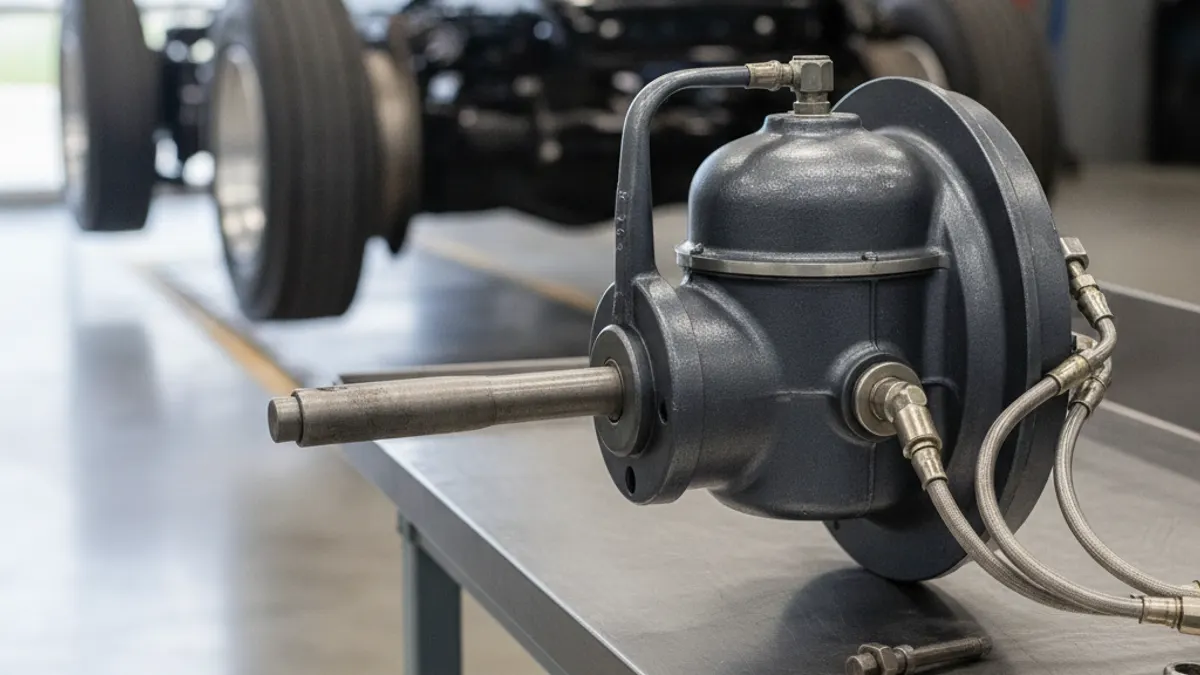
Bendix air brake parts are the components of a standard commercial-vehicle pneumatic brake system supplied under the Bendix name: air compressors, governors, air dryers, relay and foot valves, spring brake and service brake chambers, and the protection valves that keep circuits isolated. They are not a proprietary braking design. A Bendix-equipped truck works on the same physics as any other air brake system, so a Bendix compressor, a Bendix governor and another maker's dryer will run together as long as the specifications match. That is exactly why cross-referencing to OE-grade equivalents is routine work in most shops.
This page covers what each major component family does, how to identify what is actually fitted to your truck, and what has to line up before you swap in a replacement.
Where Bendix parts sit in the air brake system
If you understand the air path, you understand the parts. The compressor pumps air; the governor tells it when to pump; the dryer removes moisture and oil aerosol; the wet tank catches whatever gets through; protection valves split the supply into primary and secondary circuits; the foot valve meters driver demand; relay valves put that demand into the chambers quickly out at the axle. Bendix builds a part for every one of those jobs, which is why a single truck can carry a dozen components with the same nameplate. A typical system runs fully charged at roughly 120 psi, with the dash low-air warning set to alert at about 60 psi. For a walkthrough of the air path itself, see how air brake systems work.
Bendix compressors
The compressor is engine-driven, by gear, belt or direct coupling, and turns continuously, pumping only when the governor loads it. The families you will run into most:
- Tu-Flo 550 / 750 / 1000 - the long-running twin-cylinder line, still common on older and mid-life trucks. The number indicates a displacement class, so a 550 and a 750 are not interchangeable even though the heads look alike.
- BA-921 - a twin-cylinder unit widely used across Detroit, Cummins and Mack applications.
- BX-2150 and later high-output designs - used where duty cycle and accessory air demand climbed.
- Single-cylinder units - lower displacement, used on lighter applications and some vocational specs.
All of them share the same failure signatures: long build times, oil carryover into the dryer and tanks, knocking under load, and a discharge line packed with carbon. If your unit shows those symptoms, work through the symptoms of a failing air brake compressor before condemning it, because a leaking system or a stuck governor mimics a dead compressor convincingly.
Governors, unloaders and dryers
The D-2 governor is the near-universal Bendix pressure control. It senses reservoir pressure and pilots the compressor's unloader mechanism. Typical settings put cut-out somewhere in the 120-135 psi range and cut-in around 100-110 psi, with roughly 20-25 psi of differential; always use the value specified for your application rather than a generic figure. A governor that has drifted, or an unloader that is not seating, is the single most common cause of a system that either runs constantly or never reaches full pressure. More detail on both: air brake governor.
On the dryer side, the AD-9 is the classic desiccant cartridge unit, with AD-IP, AD-HF and AD-IS covering integrated purge volume, higher flow and oil-coalescing duty. Whatever the badge, the maintenance logic is identical: replace the cartridge on a service interval, check the purge valve and heater, and treat oil in the desiccant as a compressor symptom rather than a dryer fault.
Common Bendix valves and chambers
| Component | Typical designation | Function |
|---|---|---|
| Air compressor | Tu-Flo 550/750, BA-921, BX-2150 | Generates system air, engine driven |
| Governor | D-2 | Sets cut-in and cut-out, pilots the unloader |
| Air dryer | AD-9, AD-IP, AD-HF, AD-IS | Removes moisture and oil aerosol ahead of the wet tank |
| Foot brake valve | E-type treadle | Meters driver demand into both circuits |
| Relay valve | R-12, R-14 | Speeds delivery to rear and trailer chambers from a local reservoir |
| Pressure protection valve | PR-4 and PP-type | Isolates accessories so the brakes keep priority air |
| Tractor protection valve | TP-3, TP-5 | Seals the tractor circuit if the trailer breaks away |
| Spring brake chamber | Piggyback service/parking types | Service braking plus mechanical parking and emergency force |
Chamber sizing follows the same industry numbering (24, 30, 3030 and so on) regardless of brand, and spring brakes on any of them apply automatically if system pressure falls into roughly the 20-45 psi band. That commonality is precisely what makes cross-referencing practical.
How to identify the part you actually have
Do not order from a photograph. Every one of these components carries a stamped or tagged part number, and that number is the only reliable starting point.
- Find the nameplate or casting number. Compressors carry it on the crankcase or head; dryers on the body; valves on the housing.
- Record engine and chassis data. Engine family, model year and build date matter more than the truck badge, because the same chassis model can carry two different compressor mountings across a production run.
- Photograph the mounting and ports. Flange pattern, drive type (gear, spline, belt pulley), discharge port size and thread, coolant and oil feed arrangement.
- Read what the old part is telling you. A cartridge soaked in oil, or a discharge line full of carbon, means the compressor is the real job, and replacing the dryer alone will just repeat the failure.
Cross-referencing to OE-grade aftermarket parts
A cross-reference number is a starting point, not proof of fit. Before you commit, confirm all of the following match the unit coming off:
- Displacement and duty rating - an undersized compressor on a truck with air suspension, air seats and heavy accessory draw will run near-continuously and cook itself.
- Drive arrangement - gear tooth count and shaft or spline type, or pulley and belt geometry.
- Mounting flange - bolt pattern, pilot diameter, and whether it is flange or base mounted.
- Ports - inlet, discharge, governor signal, unloader, coolant in and out, oil feed and drain, plus thread standard.
- Head configuration - air-cooled and water-cooled heads are not interchangeable in service.
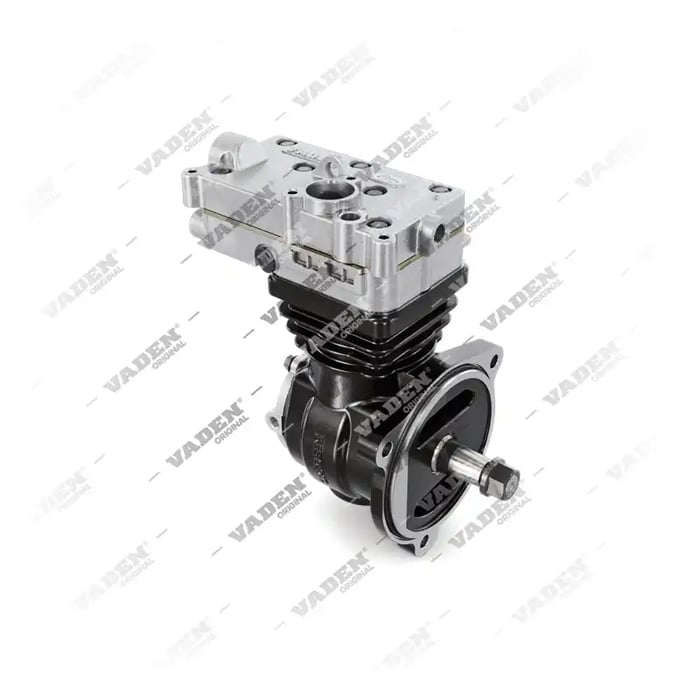
Where those specs line up, an OE-grade aftermarket unit is a legitimate route, and many are built to the same duty-cycle and pressure requirements as the original. VADEN's range of heavy-duty air brake compressors for trucks and buses is one example of a catalogue organised by OE reference, so you can match on number, application and mounting rather than guesswork. The point is to match specification, not brand: if displacement, drive, mounting and porting all agree and the part is built to OE-grade tolerances, it will do the job the original did.
Verify after you fit
Any compressor, governor or dryer replacement needs a post-fit check before the truck goes back into service. Bleed the system down, then time the build from around 85 psi to full charge with the engine at governed rpm and confirm it meets the manufacturer's spec. Watch that the governor cuts out in the correct band and cuts back in on demand, listen for a clean dryer purge at cut-out, then run a leak-down test with the engine off and the brakes applied. Finish by confirming that the low-air warning comes on at about 60 psi and that the parking brakes set as pressure continues to fall.
If the system still will not build, the fault is rarely the new part. Check the governor signal line, the unloader, discharge restriction and leaks, in that order.
A note on maintenance intervals
Most premature failures on these components trace back to contamination rather than wear. Water and oil in the tanks attack valve seats, freeze in winter and destroy desiccant. Drain the tanks on the interval your fleet sets, replace the dryer cartridge on schedule, and if you find heavy oil carryover, treat the compressor as suspect. Routine servicing costs far less than a roadside charge-time failure.
Need the part, not just the answer?
OE-grade air brake compressors and repair kits, manufactured and tested to commercial-vehicle standards.
Shop VADEN partsPublished by VADEN Original. Product links point to the manufacturer’s official catalogue. Specifications are general — always confirm figures against your vehicle’s service manual.