 airbrakecompressor
When a compression-release engine brake (widely known as a Jake Brake) stops working, the brake assembly itself is usually not the problem. In most cases the engine control module (ECM) is refusing to enable it because one input is out of range: the clutch or throttle switch, cruise control, an ABS event or fault, or a cold engine. Rule out those enable conditions first, then check solenoid voltage and engine oil supply before suspecting internal hardware.
The engine brake is separate from the pneumatic service brakes, but when it fails the driver leans harder on the foundation brakes on every grade. That raises drum and lining temperature and the risk of brake fade, so treat a dead engine brake as a priority repair rather than a comfort item. For how the system turns the engine into a power-absorbing air compressor, see our overview of the compression-release engine brake.
What has to be true before the engine brake will engage
Electronic engines treat the engine brake as a request, not a direct command. The ECM checks a list of enable conditions continuously; if any one fails, the solenoids are never energized. Typical requirements are:
- Dash master switch on and a braking level selected (low, medium or high, depending on the system).
- Foot completely off the accelerator pedal, with the accelerator position sensor reporting idle.
- Clutch pedal fully released on manual transmissions, or an automated transmission in gear and not mid-shift.
- Engine speed above a minimum set in the calibration; the brake drops out as rpm falls toward idle.
- Cruise control not active, unless the calibration allows engine braking in cruise.
- No ABS wheel-slip event in progress and, on many vehicles, no active ABS fault.
- Engine at or above a minimum temperature, where a cold lockout is programmed.
Some fleets also program a service-brake mode, in which the engine brake only applies once the driver presses the foot brake valve. In that configuration the ECM uses the stop-lamp signal from the air brake pressure switch, so a failed switch or a leaking air line to it can look exactly like an engine brake failure.
Switch inputs: clutch and throttle
The clutch switch is the most common single cause. It sits near the pedal, takes dirt and vibration, and loses adjustment as the clutch wears. If the switch reports the pedal as depressed, even slightly, the ECM keeps the engine brake off. Symptoms range from no engine braking at all to braking that cuts in and out over rough pavement.
The throttle side works the same way. A worn accelerator position sensor, a floor mat holding the pedal slightly down, or a sticky pedal return that leaves the signal above the idle threshold will all block engagement. With a diagnostic tool, watch the live clutch switch state, idle validation status and pedal percentage while you operate each pedal. Every value should change cleanly and return fully when released.
Cruise control and ABS interlocks
On many calibrations the engine brake is disabled while cruise is set, or it is only allowed to act when road speed exceeds the set speed by a programmed margin. A driver who expects full retarding on a downgrade with cruise engaged may report a fault that is really a parameter setting. Read the ECM programming before replacing anything.
The ABS system sends a disable request to the engine as soon as it detects drive-wheel slip, because retarding torque on a slippery surface can lock the drive axle. Brief dropouts on ice or wet pavement are normal and correct. If the engine brake stays off on dry pavement and the ABS lamp is lit, a wheel speed sensor or modulator fault may be holding the inhibit active. Diagnose the ABS warning light first; the engine brake normally returns once that fault is cleared.
Solenoid, wiring and oil supply
If every enable condition is met and the brake still does nothing, move to the hardware. On a housing-type brake, each solenoid valve admits pressurized engine oil to the control valve and the master and slave pistons. Integrated designs work on the same principle, with oil pressure acting on the exhaust valve mechanism.
- With the engine running and all conditions met, confirm on the scan tool that the ECM is commanding the brake on.
- Check for supply voltage at the solenoid connector. No voltage points to a fuse, relay, chafed harness or corroded connector under the valve cover.
- Measure solenoid coil resistance and compare it to the engine manufacturer's specification. Replace any open or shorted coil.
- Verify engine oil level and pressure. Low pressure, aerated oil or the wrong viscosity slows or prevents piston travel.
- Inspect solenoid seal rings and inlet screens. A torn seal bleeds off pressure; a blocked screen starves the circuit.
A brake that works on low but is weak or dead on high usually has one solenoid, harness branch or housing out of service. Slave piston lash outside specification produces weak braking or valve train noise and must be set with the engine cold, following the engine service manual.
Cold-engine lockout
Many engines inhibit engine braking until coolant or oil reaches a calibrated temperature. Cold oil is thick, the hydraulic circuit responds slowly, and firing the brake on a cold engine loads the valve train. If the complaint is no engine brake for the first few miles on winter mornings, compare the temperature sensor reading with actual engine temperature and confirm the lockout parameter before condemning parts. A temperature sensor that reads low can extend the lockout indefinitely. Some calibrations also limit engine or exhaust braking during an active diesel particulate filter regeneration.
Air-actuated exhaust brakes
Exhaust brakes that close a butterfly valve in the exhaust pipe are often operated by a small air cylinder fed from the vehicle air system through an electric air solenoid. Here the failure list is pneumatic: a leaking actuator cylinder, a stuck air solenoid, a cracked supply line, or a valve seized by carbon. Accessory circuits are normally supplied through a pressure protection valve, so the exhaust brake may not operate until the system has built pressure. Replacement butterfly valves, actuators and related components are listed in the VADEN exhaust brake parts range.
Quick diagnosis table
| Symptom | Likely cause | First check |
|---|---|---|
| No engine braking at any level | Clutch or throttle input not validated; master switch; fuse or relay | Live switch data on scan tool; supply voltage at solenoids |
| Cuts in and out over bumps | Clutch switch adjustment; loose connector | Adjust or replace switch; wiggle-test the harness |
| Drops out on wet or icy roads | Normal ABS inhibit | No repair needed if it returns on dry pavement |
| Stays off with ABS lamp lit | Active ABS fault holding the inhibit | Repair ABS fault, clear codes, road test |
| Inactive until engine warms up | Programmed cold lockout; faulty temperature sensor | Compare sensor reading with actual temperature |
| Works on low, weak or dead on high | One solenoid, harness branch or housing | Voltage and coil resistance at each solenoid |
| Weak braking with valve train noise | Slave piston lash out of specification; low oil pressure | Set lash cold; verify oil pressure |
| Exhaust brake valve not closing | Air solenoid, actuator cylinder leak, carbon-seized valve | Listen for air leaks; check valve movement with engine off |
Before replacing parts
Pull active and inactive fault codes from both the engine and ABS modules, record the enable-condition data during a road test, and confirm oil level and pressure. Most engine brake complaints are resolved at the switch, parameter or harness level. Replacing solenoids or housings without that data usually leaves the real cause in place, and the driver keeps relying on the service brakes on every descent.
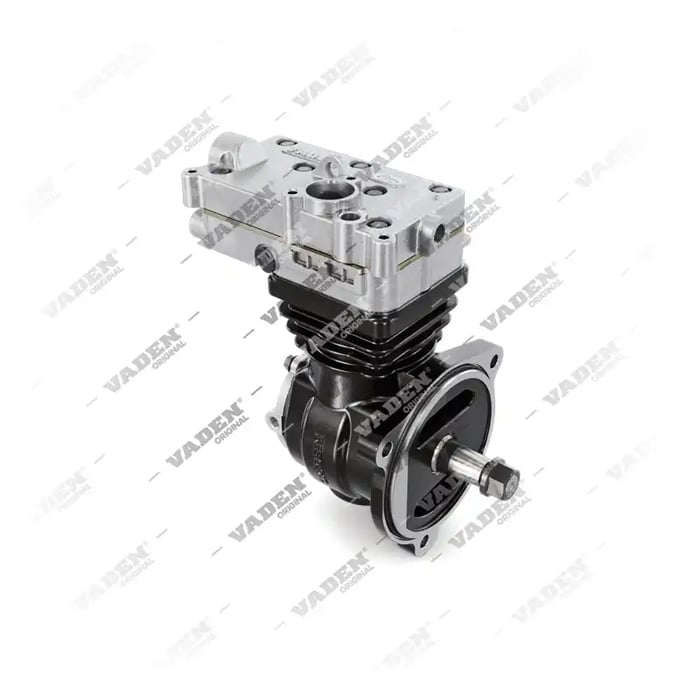
Need the part, not just the answer?
OE-grade air brake compressors and repair kits, manufactured and tested to commercial-vehicle standards.
Shop VADEN partsPublished by VADEN Original. Product links point to the manufacturer’s official catalogue. Specifications are general — always confirm figures against your vehicle’s service manual.