 airbrakecompressor
A truck that will not shift into high range is almost always an air problem in the range change circuit rather than a worn transmission. The auxiliary section is moved by an air cylinder fed from a vehicle reservoir through a pressure protection valve, a filter and regulator, and the range valve; lose pressure or lose flow at any one of those and the range yoke never completes its travel. Work the circuit in that order — pressure at the transmission feed, then the range valve, then the filter and regulator, then the cylinder seals — and stop at the first fault you can prove.
How the range change circuit is fed
The range change on a heavy manual or automated manual transmission is pneumatic, and it borrows its air from the brake supply. Air leaves a reservoir through a pressure protection valve, which closes if reservoir pressure falls so that a transmission leak cannot empty the brake reservoirs. From there it passes a small filter and regulator that drops the feed to the transmission's working pressure, then reaches the range valve, which routes air to one side of the range cylinder and exhausts the other. On a manual box with a preselector, the change is executed as the lever passes through neutral; on an automated transmission the same pneumatics are commanded by a solenoid block.
That layout is the reason the fault is diagnosed from the supply end forward. Every component in the chain can produce the same complaint at the driver's seat.
Step 1: Confirm pressure and flow at the transmission feed
Chock the wheels, charge the system and watch a full governor cycle before touching the transmission. If the system is not reaching and holding normal working pressure, the range fault is a symptom and the brake side is the job — start with a system that is losing pressure.
| Checkpoint | Typical figure | What it means for the range circuit |
|---|---|---|
| Governor cut-out | 120-135 psi | System is charging normally; the range circuit has full supply behind it |
| Governor cut-in | 100-110 psi | Compressor restarts here; in normal work pressure should not fall much below this |
| Pressure protection valve opening | commonly 65-75 psi, check the vehicle spec | Below this the accessory feed, including the range circuit, is shut off by design |
| Regulated feed at the transmission | commonly 55-65 psi, check the transmission manual | Working pressure for the range valve and cylinder |
| Low-air warning | about 60 psi | Stop and repair the brake system; this is not a transmission fault |
Then tee a gauge into the feed line at the transmission and read it while the range change is demanded, not only at rest. Static pressure proves supply; pressure that collapses during the shift proves restriction. A truck that ranges cleanly in the yard and refuses after a long grade of repeated brake applications is telling you the reservoir is being pulled down toward the pressure protection valve's closing point.
Step 2: Test the range valve
With the system charged and the wheels chocked, operate the range selector and listen at the valve and at the transmission. A healthy valve gives a crisp change of state and vents the opposite side of the cylinder through its exhaust port. Three failures are common:
- Blocked exhaust. Dirt or a swollen seal traps pressure on one side, so the cylinder cannot return. This is the classic transmission that is stuck in one range and will not come back.
- Internal seal failure. Heat and oil carryover harden the seals; the valve then leaks continuously in either position and never builds enough pressure to complete the stroke.
- Incomplete travel. Worn preselector linkage or a bent actuating lever stops the valve short, so it cross-feeds instead of switching cleanly.
Soap the valve body, the ports and the exhaust. A valve that leaks in both positions, or that will not hold with the selector set, is condemned — these are serviced with a seal kit or replaced as a unit, and the correct part is chosen by the transmission maker's number rather than by appearance. VADEN lists OE-standard range change valves for heavy commercial transmissions against the original references.
Step 3: The air filter and regulator ahead of the valve
This small canister on the transmission or frame rail is the most frequently ignored item in the circuit, and it explains the most confusing symptom. A plugged element still passes enough air to show correct pressure on a gauge at rest, but it cannot supply flow when the cylinder demands it, so the shift is slow, late, or will not complete under load while it works perfectly at idle.
The root cause is usually upstream. Water and oil that get past a tired air dryer cartridge travel down the accessory line, blind the filter element, and swell the elastomer seals in both the valve and the cylinder. If the tanks are wet or the discharge line shows heavy carbon, deal with a compressor that is pumping oil before fitting new transmission parts.
Replace the element, drain the reservoirs, and verify regulated output against the transmission manual with the shift demanded. Do not turn the regulator up above specification to make a marginal circuit work; overpressure shortens cylinder seal life and hammers the synchronizer.
Step 4: Range cylinder and seals
If supply, valve and regulated flow all check out, air is reaching the cylinder and is not producing full travel. Apply air with the selector in high range and listen at the transmission breather and around the shift bar housing. Air escaping from the breather means an internal piston seal is passing into the case; air at the cover means the cover gasket or shaft seal has gone. Both bleed off the pressure the piston needs, and both can leak badly enough to drag the whole air system down.
If the circuit is tight and the cylinder still will not move the yoke, the fault is mechanical: a seized piston in a corroded bore, a worn range yoke or slide, a sheared pin, or a worn synchronizer that blocks engagement. That work opens the case.
Stuck in low range versus a change that will not complete
These are different faults and they point at different parts. Ask the driver exactly what the transmission did, because the answer usually halves the diagnosis before a tool comes out.
| What the driver reports | What it usually means | First test |
|---|---|---|
| Stays in low range; high-range gears will not engage at all | No air reaching the cylinder, or the piston is seized | Gauge at the transmission feed, then check the range valve exhaust |
| Change starts, hangs in neutral, then blocks out | Weak or restricted flow, or a worn synchronizer or yoke | Regulated pressure measured during the shift; filter element condition |
| Ranges at idle or stationary, refuses under load | Marginal supply: pressure protection valve closing, or a plugged filter | Reservoir pressure while working; brake system leak test |
| Stuck in high range, will not return to low | Blocked exhaust at the range valve, or the return side is not venting | Range valve exhaust port and return line |
| Constant leak at the transmission and slow air build | Range cylinder or valve seal leaking to atmosphere | Soap test at the cylinder cover, shaft seal and valve body |
Before you condemn a part
- Technique. On a manual box the range must be preselected and the lever passed through neutral. Forcing the lever will not complete the change, and repeated attempts under load damage the synchronizer.
- Clutch drag. A failing air-assisted clutch servo leaves the clutch partly engaged, so the range gears never stop turning and the change grinds or blocks. Check clutch release travel before blaming the range circuit.
- Oil. Low level, the wrong grade, or a very cold transmission slows the synchronizer and mimics an air fault.
- Plumbing. Chafed nylon line behind the cab, a pulled push-in fitting, or a line crushed against a crossmember gives full static pressure and no flow.
- Automated transmissions. Read fault codes first, but the physical checks above are unchanged — the solenoid block still needs clean, dry, regulated air.
Never plug, bypass or remove the pressure protection valve to get the range circuit working again. It is there so that a split seal in the range cylinder cannot drain the brake reservoirs; without it the same leak can take the low-air warning at about 60 psi and eventually apply the spring brakes at 20-45 psi while the vehicle is moving.
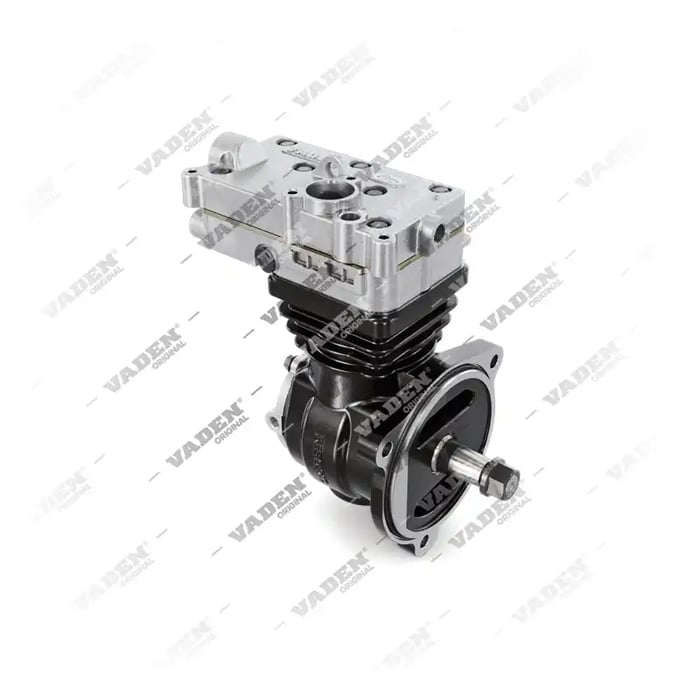
Need the part, not just the answer?
OE-grade air brake compressors and repair kits, manufactured and tested to commercial-vehicle standards.
Shop VADEN partsPublished by VADEN Original. Product links point to the manufacturer’s official catalogue. Specifications are general — always confirm figures against your vehicle’s service manual.