 airbrakecompressor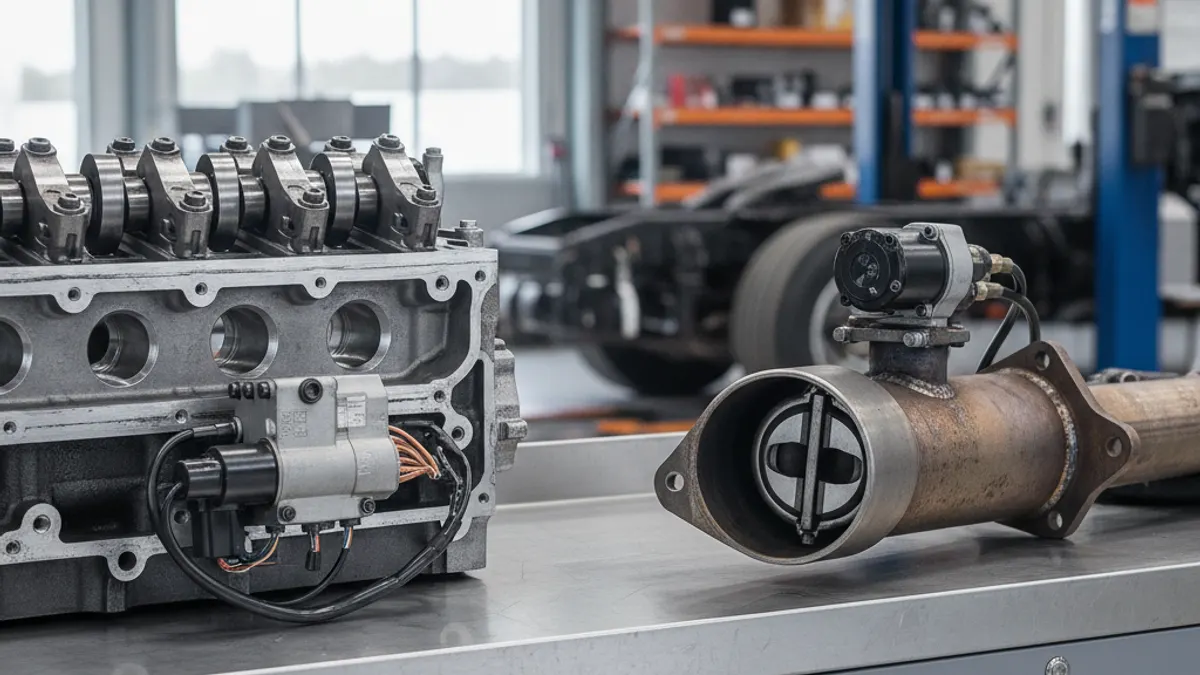
A Jake brake, an exhaust brake, and a retarder all do the same job from the driver's seat: they slow the truck without touching the air (service) brakes, so your shoes and drums stay cool on a long grade. The difference is where the energy goes. A Jake brake (compression release engine brake) opens the exhaust valves near top-dead-center to bleed off the compressed air the piston just built, turning the engine into an air pump that eats momentum. An exhaust brake instead throttles the exhaust flow to create back-pressure that resists the pistons. A retarder is a separate device — hydraulic or electromagnetic — mounted in the driveline that absorbs energy through fluid or magnetic drag, independent of the engine's valvetrain.
If you only remember one thing: the engine brake is the strongest and loudest, the exhaust brake is the quietest and mildest, and the retarder is the smoothest and works even when the engine is idling or the clutch is in. All three exist to keep you off the foot valve on downgrades, protecting the foundation brakes from overheating and fade.
How each one actually slows the truck
Compression release engine brake (the "Jake")
"Jake brake" is genericized from Jacobs, the company that popularized the compression release brake. On the compression stroke the piston squeezes the air charge; normally that energy is returned to the piston on the way back down, so no net braking happens. The Jake brake defeats that by mechanically opening the exhaust valve right at the top of the compression stroke, releasing the compressed charge to the exhaust with a sharp bark. The energy the engine spent compressing air is gone, and that loss is felt as strong retarding force at the drive wheels. It is the most powerful of the three, which is why it is standard on heavy line-haul tractors.
Exhaust brake
An exhaust brake is far simpler: a butterfly valve in the exhaust pipe (often just after the turbo) closes to restrict flow. The pistons then have to push against trapped, pressurized exhaust gas, and that resistance slows the engine and the truck. Because it works with the standard valvetrain and adds no violent valve events, it is much quieter and gentler than a Jake — but it also produces noticeably less braking, and its effectiveness drops off at lower rpm. Exhaust brakes are common on medium-duty trucks, buses, and vocational rigs where a full engine brake would be overkill or too loud. The butterfly and its actuator live in the exhaust brake valve assembly, a wear item worth inspecting when braking feels weak.
Retarder (driveline / hydraulic / electromagnetic)
A retarder is a stand-alone braking device, not an engine feature. A hydraulic retarder uses a rotor spinning in fluid inside the transmission or driveline; engaging it fills the housing with oil, and the fluid drag (converted to heat, then shed through a cooler) slows the rotor and the driveshaft. An electromagnetic (eddy-current) retarder uses magnets around a driveline disc to create drag. The key advantage: a retarder does not load the engine's valvetrain and keeps braking with the throttle fully closed or even the clutch depressed. Retarders are the workhorse of transit buses, coaches, and heavy mountain-service trucks, often stacked with an engine brake for extreme grades.
Side-by-side comparison
| Feature | Compression brake (Jake) | Exhaust brake | Retarder |
|---|---|---|---|
| How it works | Opens exhaust valve at compression TDC to dump compressed air | Butterfly restricts exhaust to build back-pressure | Separate fluid or magnetic drag device on the driveline |
| Braking strength | Highest | Lowest of the three | High, very consistent |
| Noise | Loud bark (often restricted in towns) | Quiet | Nearly silent |
| Best rpm range | Strong at high rpm | Best at higher rpm, weak down low | Effective across a wide range |
| Works at idle / clutch in | No (needs engine turning under load) | Limited | Yes |
| Added hardware | Modified rocker/valve hardware in the head | Valve in exhaust pipe | Bulky, heavy separate unit + cooling |
| Typical use | Heavy line-haul tractors | Medium-duty, urban, vocational | Transit buses, coaches, severe grades |
Trade-offs that matter in the real world
Noise and local ordinances
The Jake's bark is the reason for all those "No Engine Braking" signs near towns. On a truck with a properly maintained muffler the noise is legal on the highway, but drivers still need to respect posted restrictions. Exhaust brakes and retarders are quiet enough that this is rarely an issue.
Weight, cost, and complexity
Exhaust brakes are the cheapest and lightest — essentially one valve and an actuator. Engine brakes add cost inside the cylinder head but no bulk. Retarders are the heaviest and most expensive, and a hydraulic unit needs its own cooling capacity, which is why they show up mostly where the duty cycle justifies them.
Drivetrain wear
Because a retarder acts on the driveline rather than firing the valvetrain, it spares the engine internals and produces very smooth, controllable braking. Engine and exhaust brakes put cyclic load on valves, springs, and the turbo plumbing, though both are engineered for it and reliable when maintained.
What none of them do
All three are auxiliary or "secondary" brakes. They slow a moving truck; they do not stop it and they do not hold it parked. When you need to come to a full halt you still use the foot valve and the service brakes, and when you park you set the spring parking brakes. On a wet or icy road an aggressive engine brake acting on the drive axle only can also break traction, so many trucks tie the engine brake into the ABS so it releases if a drive wheel starts to lock. Use auxiliary braking to manage speed on the grade and save the service brakes for the moments you truly need them.
Which one should you rely on?
Match the tool to the work. If you run heavy over real mountains, an engine (Jake) brake — ideally paired with a retarder on the worst grades — gives you the most control and the coolest service brakes at the bottom. If you run lighter loads, do a lot of city and suburban driving, or work where noise matters, an exhaust brake covers most of the need at a fraction of the cost and racket. Transit and coach operators lean on retarders for their smoothness and their ability to hold speed at low rpm. Whatever you have, the discipline is the same: select the auxiliary brake early, let it carry the grade, and keep the foot valve in reserve so your air brakes never overheat.
Source (VADEN Original): Truck Retarder: Faults, Replacement & Maintenance Guide
Need the part, not just the answer?
OE-grade air brake compressors and repair kits, manufactured and tested to commercial-vehicle standards.
Shop VADEN partsPublished by VADEN Original. Product links point to the manufacturer’s official catalogue. Specifications are general — always confirm figures against your vehicle’s service manual.