 airbrakecompressor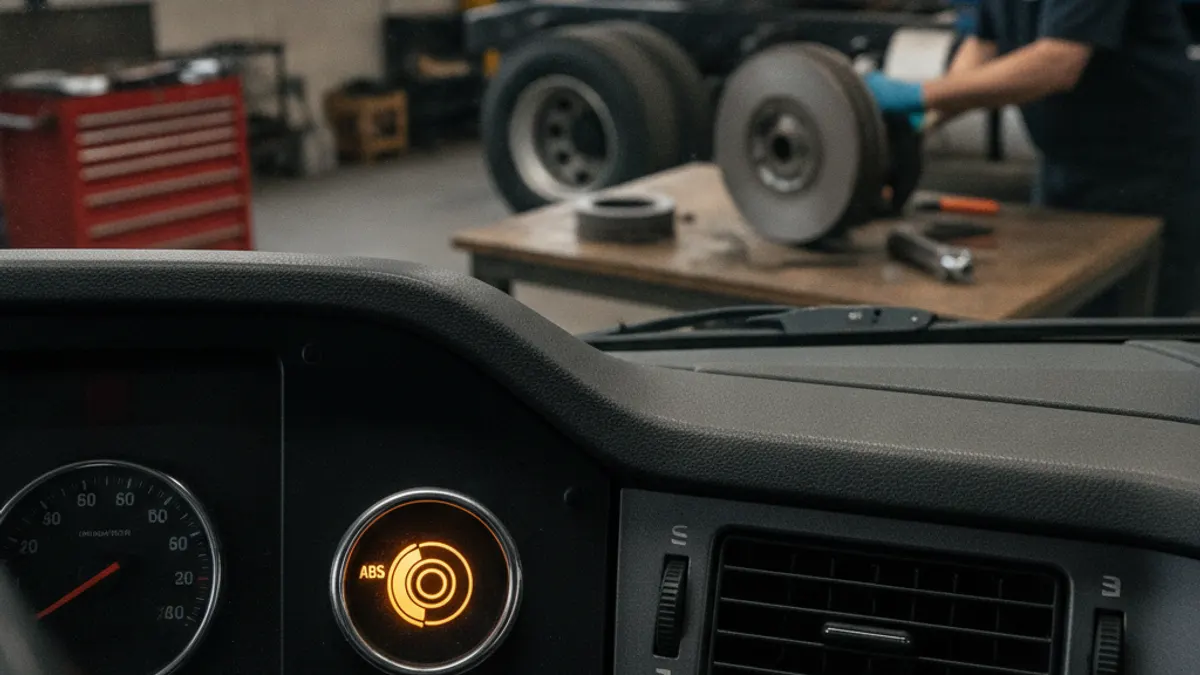
An illuminated ABS lamp means the anti-lock system has found a fault and shut itself off, partially or completely. Your air brakes still stop the truck exactly as they did before; what you lose is electronic wheel-lock control, and often traction or stability control along with it. The most common cause on a tractor or trailer is a wheel-speed sensor problem: a sensor backed away from the tone ring, a corroded tip, a chafed lead, or a damaged exciter ring.
What the ABS lamp is actually telling you
Two separate lamps exist, and knowing which is lit narrows the job in seconds.
- Dash ABS lamp — the tractor's own ABS system.
- Trailer ABS lamp — mounted on the trailer's left side where you can see it in the mirror, and mirrored on most tractors by a separate dash telltale. It reports faults from the trailer ECU.
Both lamps bulb-check at key-on: a couple of seconds lit, then out. On many older trailers the lamp stays lit until road speed passes roughly 5 mph, going out once the ECU has seen valid signals from every sensor. A lamp that stays on past that point is reporting an active fault. A lamp that never lights is also a defect: you cannot know the system's status, and an inspector will write it up.
The ABS lamp is not the low-air warning. That warning, buzzer and red light together, comes on around 60 psi and means you are losing supply. A healthy pneumatic system builds to a governor cut-out in the 120 to 135 psi range and cuts back in around 100 to 110 psi, sitting near 120 psi fully charged. The ABS lamp is indifferent to all of it, so an ABS fault and a low-air fault are two different problems.
Is it safe to drive with the ABS light on?
You still have full service braking, spring brakes and a normal governor cycle. The risk is that under hard braking or on a slick surface the wheels on the affected channel can lock, costing you steering control and inviting a jackknife. Many tractors also disable traction control and roll stability when ABS drops out, costing you safety nets you will not miss until you need them.
An ABS malfunction lamp is a recordable violation that must be repaired, but an ABS fault on its own is generally not an automatic out-of-service condition the way defective foundation brakes are. Finish the trip if the foundation brakes and air system are sound, then get it diagnosed. If the lamp appeared alongside pulling, grabbing or a dragging wheel, stop and inspect before you keep rolling.
Most common causes, ranked
| Cause | Typical symptom | First check |
|---|---|---|
| Wheel-speed sensor pushed out of the tone ring | Lamp on at low speed, sometimes clears at highway speed | Push the sensor in until it touches the ring |
| Damaged, packed or missing tone-ring teeth | Repeat fault at the same wheel end after sensor replacement | Inspect through the sensor bore; clean off rust scale |
| Chafed or pulled sensor lead | Intermittent, worse over rough road | Follow the lead to its frame clips; look for rub-through |
| Corroded trailer power circuit (blue auxiliary wire) | Trailer lamp on with one tractor, off with another | Voltage-drop test at the nose box under load |
| Modulator valve solenoid open or shorted | Fault names a specific modulator channel | Resistance check at the valve connector |
| Low system voltage | Lamp on at idle, clears when charging | Battery and alternator output under load |
| Excessive wheel bearing endplay | Air gap opens and closes as the hub turns | Dial-indicate endplay at the affected hub |
| ECU internal failure | All channels faulted, no output at any sensor | Confirm power and ground first; it is rarely the ECU |
Wheel-speed sensors and tone rings
Speed sensors sit in a spring-clip holder and are pushed in until they contact the exciter ring, which then knocks them back to a working clearance of a few thousandths of an inch. Nothing is shimmed or adjusted. Over time, vibration and bearing movement walk the sensor back out, the signal weakens, and the ECU faults the channel.
Two checks tell you most of it. Spin the hub by hand, roughly half a turn per second, with a meter on AC volts at the sensor connector; a healthy passive sensor typically produces on the order of 0.2 volts AC or more. On ohms, most read somewhere in the 500 to 2,500 ohm range at room temperature. Confirm exact figures against the manufacturer's spec sheet; ranges differ by part number. If output is weak but resistance is normal, the sensor is too far from the ring, or the ring is rusted, packed with grease, or missing teeth.
Wiring, connectors and the blue auxiliary circuit
On trailers built to the standard seven-way pinout, ABS power comes down the blue auxiliary circuit, with the stop-lamp circuit acting as a secondary supply on many units. A green, crusty or spread terminal in the receptacle, nose box, or tractor plug will brown out the trailer ECU under load even though a test light still glows brightly. Do a voltage-drop test with the system energized rather than trusting an open-circuit reading. The same applies to grounds: a poor chassis ground produces the same unrepeatable faults as a weak feed.
Modulator valves
Modulators are solenoid-operated dump valves plumbed between the relay valve and the chambers. When one faults, the ECU disables that channel and lights the lamp. Resistance checks at the connector separate a failed coil from a wiring problem. A modulator that has been leaking or cycling oddly also warrants a look at air quality upstream: oil and water carryover from a tired compressor or spent dryer cartridge fouls valve internals.
How to work the fault
- Note which lamp is on, and whether it lights at key-on only, at low speed, or continuously.
- Pull codes. A hand-held or laptop tool is fastest; most ECUs will also flash blink codes on the lamp per the manufacturer's diagnostic sequence.
- Separate active from stored codes. A stored code from a one-time low-voltage event is not the same as a live sensor fault.
- Go to the wheel end or component the code names. Inspect the sensor lead, connector, tone ring and bearing endplay before you buy parts.
- Clean and reseat the sensor, repair the wiring, then clear codes and road test above about 5 mph so the ECU can re-validate every channel.
- If the lamp returns with the same code, measure rather than guess: voltage drop on power and ground, AC output at the sensor, resistance at the modulator.
Odd lamp behavior and what it usually means
A trailer lamp that lights only with one particular tractor points at that tractor's auxiliary feed or plug, not the trailer. A lamp that comes on only after a hard stop suggests an intermittent connection that vibration is opening. A lamp that appears at highway speed with no other symptom is often a tone ring losing teeth. If the dash also shows a separate trailer-brake message, work through the service trailer brake warning first, since the two often share a cause. On vehicles with electronically controlled braking, an ABS fault can cascade into stability and brake-blending functions, covered under electronic braking systems; the control logic itself is explained in how ABS works on air brakes.
Keeping it from coming back
Most repeat ABS faults are maintenance faults. Reseat sensors any time a hub comes off. Secure sensor leads away from tires, driveline and slack adjusters. Keep the seven-way and nose box clean and dielectric-greased. Drain tanks and change the dryer cartridge on schedule so valve bodies stay dry. And make the lamp check part of the daily walk-around, not something you discover at a scale house.
Sensor faults account for most of these lamps, and a chewed lead or a corroded tip cannot be repaired, so have ABS wheel-speed sensors and their clamping sleeves on hand before the hub comes off.
Need the part, not just the answer?
OE-grade air brake compressors and repair kits, manufactured and tested to commercial-vehicle standards.
Shop VADEN partsPublished by VADEN Original. Product links point to the manufacturer’s official catalogue. Specifications are general — always confirm figures against your vehicle’s service manual.