 airbrakecompressor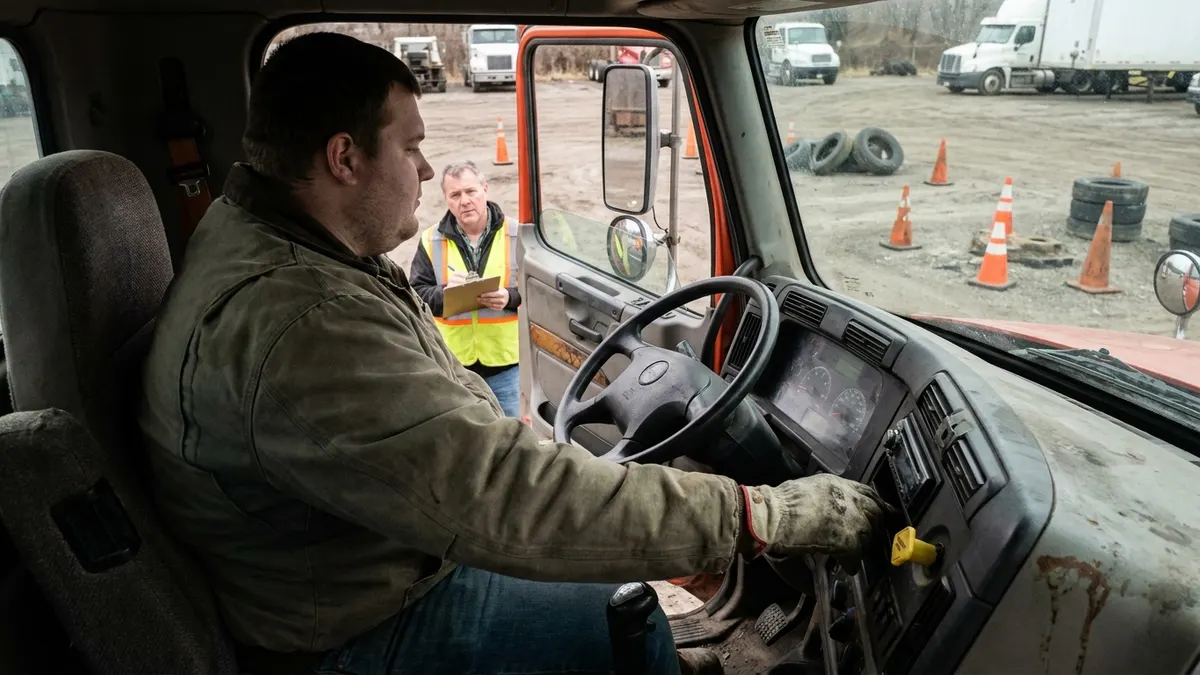
Under federal rules, no. The "air brake endorsement" drivers talk about is not an endorsement at all — it is the removal of the L restriction on a commercial driver's license, and that restriction only exists on a CDL in the first place. If the vehicle is rated 26,000 lb GVWR or less, is not placarded for hazardous materials, and is not designed to carry 16 or more people including the driver, no CDL is required, so there is no federal air brake credential to obtain — even when the truck runs full pneumatic brakes.
That is the federal floor, not the whole story. States license their own non-CDL drivers, a handful add air brake requirements of their own, and the weight math catches more people than the rule itself does.
Why it is a restriction, not an endorsement
Under 49 CFR 383.95, if you take your CDL skills test in a vehicle that is not equipped with air brakes, the state must stamp an air brake restriction on the license — code L on most licenses. With that restriction you may not operate a commercial motor vehicle equipped with air brakes. Clearing it means three things: passing the air brake knowledge test, identifying and inspecting air brake components during the pre-trip, and performing the skills and road test in a vehicle that actually has air brakes. Our CDL air brake test guide walks through what examiners look for, and the air brake endorsement overview covers the paperwork side.
One detail catches medium-duty drivers off guard: the federal definition of an air brake system includes any brake that works fully or partly on the air brake principle. Air-over-hydraulic counts. A 33,000 lb chassis with an air-over-hydraulic system is an air brake vehicle for licensing purposes, even though the wheel ends are hydraulic.
Where the 26,001 lb line actually falls
| Scenario | GVWR or GCWR | CDL required? | Air brake restriction matters? |
|---|---|---|---|
| Straight truck with air brakes, non-hazmat, under 16 passengers | 26,000 lb or less | No (federally) | No |
| Straight truck or bus with air brakes | 26,001 lb or more | Yes — Class B | Yes |
| 25,900 lb truck towing a trailer rated 10,000 lb | 35,900 lb combined | Yes — Class A | Yes |
| Shuttle or activity bus, 16+ seats including driver | Under 26,001 lb | Yes — Class C with P | Yes, if air equipped |
| Placarded hazmat load | Under 26,001 lb | Yes — Class C with H | Yes, if air equipped |
| Personal RV or motorhome with air brakes | Varies by state | Often no CDL | Check state rules |
GVWR is what the manufacturer rates the vehicle for, not what it weighs on the scale today. Running light does not lower your license class.
Light vehicles that still have air brakes
Plenty of equipment below the CDL threshold uses pneumatic brakes: Class 6 and 7 chassis specified with air, older shuttle and activity buses, fire and rescue apparatus, some utility and boom trucks, and air-braked trailers pulled behind medium-duty tractors. Motorhomes built on a commercial chassis are the most common private example. In every one of those cases the system behaves exactly like a heavy truck's — a compressor charging reservoirs, a governor cycling the compressor, and spring brakes waiting to set if pressure falls away.
The state-by-state wrinkle
Federal law sets the CDL standard, but states control everything below it. A few require an air brake knowledge component on non-CDL classes, some issue non-commercial Class A or B licenses for RVs and farm rigs with their own air brake testing, and several waive the CDL entirely for farm, firefighter, or military drivers without addressing air brake training at all. Intrastate-only operators may also fall under a different age or medical standard than interstate drivers. Before you assume you are clear, check your own jurisdiction — the state-by-state breakdown is the place to start.
Outside the United States the logic often reverses. Canadian provinces tie the air brake endorsement to the equipment, not the weight: Ontario's Z, Alberta's Q, and British Columbia's code 15 are required to operate any air-braked vehicle, so a light truck that needs nothing extra in Ohio needs a course and a practical test in Ontario.
Legal and competent are not the same thing
The bigger risk under 26,000 lb is not a citation — it is a driver who has never been taught the system. An air brake vehicle does not stop because you pushed fluid down a line; it stops because stored compressed air is metered to the chambers, and the numbers tell you whether that store is healthy. A working system charges to roughly 120 psi, with the governor cutting out somewhere in the 120 to 135 psi band and cutting back in around 100 to 110 psi. The low-air warning light and buzzer come alive near 60 psi. Keep losing air and the spring brakes set on their own, typically as pressure falls through the 20 to 45 psi range — which is protection, not a failure, but it is not something you want happening at a highway on-ramp.
None of that is intuitive to a driver coming off pickups. Even where no test is required, run a full leak-down and buildup check before the first trip, and learn the sequence in the seven-step air brake check. It is the same procedure examiners use, and it finds the faults that matter.
Mistakes that cost people a violation
- Using scale weight instead of GVWR or GCWR to decide license class.
- Forgetting the towed unit — the trailer rating is what pushes a combination past 26,001 lb.
- Assuming air-over-hydraulic is exempt from the air brake restriction. It is not.
- Believing the L restriction drops off automatically when you upgrade classes; it does not, you must retest in an air-braked vehicle.
- Treating a personal motorhome as universally exempt without reading the state's non-commercial rules.
- Assuming that no CDL means no federal oversight. FMCSA maintenance, brake adjustment, and inspection rules reach commercial vehicles over 10,000 lb in interstate commerce, and a roadside inspection can place that truck out of service for brake defects regardless of what the driver's license says.
If you do need the restriction cleared
The process is short and inexpensive compared with the initial CDL. You retake the air brake knowledge test, demonstrate component identification and the air brake portion of the pre-trip, and complete the skills test in a vehicle equipped with air brakes. Most states charge only a retest fee. Borrowing a suitable test vehicle is usually the hardest part — line that up before booking the appointment.
Need the part, not just the answer?
OE-grade air brake compressors and repair kits, manufactured and tested to commercial-vehicle standards.
Shop VADEN partsPublished by VADEN Original. Product links point to the manufacturer’s official catalogue. Specifications are general — always confirm figures against your vehicle’s service manual.