 airbrakecompressor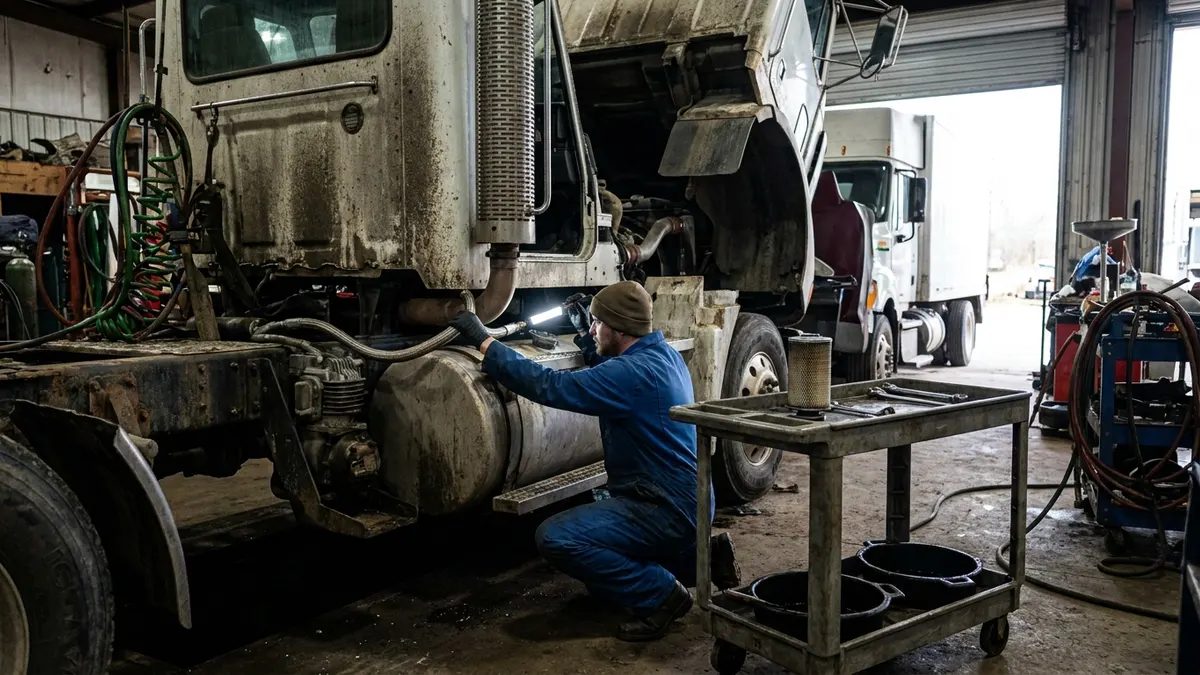
An air brake preventive maintenance schedule works on four levels: daily (drain tanks, leak test, warning devices, governor cycle), weekly (visual leak hunt, hose and gladhand condition, dryer purge), and then two or three periodic PM levels that step up in depth - a light A service roughly monthly or every 10,000-15,000 miles, a heavier B service every 25,000-50,000 miles, and a C or annual inspection that covers linings, drums, chambers and the compressor itself. Because these are pneumatic brakes, the real enemy is contaminated air: water, oil and heat kill valves and compressors long before mileage does, so the schedule is built around keeping the air clean and the foundation brakes in adjustment.
What Actually Sets the Interval
Mileage alone is a poor trigger. A city refuse truck cycles the compressor hundreds of times a shift and will foul an air dryer in a fraction of the miles a highway tractor takes to do the same. Set intervals by whichever comes first among miles, engine hours, and calendar time, then shorten them for high-cycle work, humid climates, or any unit with a history of oil carryover.
Three duty patterns to adjust for:
- High cycle - refuse, transit bus, yard spotters, dump work. Air dryer and compressor intervals roughly halve.
- Long haul - steady cruise, low duty cycle. Mileage-based intervals work, but calendar limits still apply to the dryer cartridge.
- Cold or humid climates - moisture management moves to the top of the list; check tanks daily without exception through winter.
Daily Checks (Driver, Every Shift)
These take under ten minutes and catch the majority of developing faults.
- Drain every reservoir - wet tank first, then the primary and secondary, plus trailer tanks. Note what comes out: clear water is expected, milky grey emulsion or black oil is a fault. See how to drain air tanks properly.
- Charge and observe the governor - the system should cut out somewhere in the 120-135 psi band and cut back in around 100-110 psi, with a normal differential of roughly 20-25 psi. A dryer purge burst should be audible at cut-out.
- Static leak test - engine off, fully charged near 120 psi, brakes released. Air loss should stay within about 2 psi per minute for a straight truck and 3 psi per minute for a combination. With the service brakes applied and held, allow roughly 3 and 4 psi per minute respectively.
- Low-air warning - fan the pressure down; the buzzer and light must come on at or before roughly 60 psi.
- Spring brake pop-out - keep fanning down; the parking and trailer supply valves should trip on their own in the 20-45 psi range.
- Build-up time - from about 85 to 100 psi in roughly 45 seconds at governed rpm on a dual system. Slow build points at compressor, intake, or discharge line restriction.
- Walk the vehicle - listen for leaks at chambers, gladhands and fittings; look for rubbed or chafed lines and loose slack adjusters.
The PM Interval Matrix
Treat the following as a baseline and defer to the vehicle and component manufacturer's published intervals where they differ.
| Task | Daily | A service (monthly / 10-15k mi) | B service (25-50k mi) | C / annual |
|---|---|---|---|---|
| Drain reservoirs, check for oil or emulsion | Yes | Yes | Yes | Yes |
| Leak-down test and warning device check | Yes | Yes | Yes | Yes |
| Governor cut-in / cut-out verified with a test gauge | Observe | Measure | Measure | Measure |
| Measure pushrod stroke at every chamber | Spot check | All axles | All axles | All axles |
| Grease slack adjusters and camshaft bushings | - | Yes | Yes | Yes |
| Inspect hoses, tubing, gladhand seals, chamber clamps | Visual | Yes | Yes | Yes |
| Test tractor protection, relay and quick-release valve response | - | - | Yes | Yes |
| Air dryer cartridge and purge valve service | - | Assess | Replace per duty cycle | Replace |
| Compressor discharge line, unloader and intake filter check | - | - | Yes | Yes |
| Lining thickness, drum condition, wheel-off inspection | - | Visual | Measure | Wheel off |
| Tank safety relief valve and check valve function | - | - | Yes | Yes |
Foundation Brakes: Stroke Is the Whole Ball Game
Automatic slack adjusters do not remove the need to measure. When stroke creeps past the readjustment limit for the chamber size fitted, braking force falls off sharply and the vehicle is a roadside out-of-service candidate. Measure with the system fully charged and a firm application, mark the pushrod, and compare against the published limit for that chamber type - the values differ between standard and long-stroke units, and the adjustment limit chart is worth keeping in the shop.
If an automatic slack keeps drifting out of adjustment, the fault is almost never the slack itself. Look for seized camshaft bushings, a dragging chamber return, worn clevis pins, or a chamber that is not fully releasing.
Air Quality: Dryer and Compressor
A desiccant cartridge is a consumable. Most fleets land on one to three years or a mileage figure in the 100,000-150,000 mile range for highway work, and considerably shorter for high-cycle vocational units. Practical guidance on timing and procedure is covered in the air dryer cartridge replacement guide.
What you find at the dryer tells you about the compressor. Small amounts of oil mist are normal; a saturated cartridge, oil pooling at the purge, or a carboned discharge line means the compressor is passing oil or running an excessive duty cycle. Replacing the cartridge without addressing that just resets the clock on the same failure. At B and C service, check the discharge line for carbon restriction, confirm the unloader mechanism releases cleanly at governor cut-out, and inspect the intake source - a plugged air cleaner or a restricted intake line raises crankcase depression and pulls oil past the rings.
When a compressor, governor or unloader kit does reach the end of its life, fit OE-grade components; VADEN's air brake system parts range cross-references to the major OE platforms, including Bendix, Wabco/ZF and Knorr-Bremse applications.
Records, Regulation and Seasonal Work
In the United States, carriers must run a systematic inspection, repair and maintenance program and keep records for each unit, plus an annual inspection covering the brake system. Elsewhere the framework differs but the principle is the same: the schedule has to be written down, followed, and documented. Keep stroke measurements and lining thickness numbers on the work order - trend data tells you which units are eating brakes and why.
Two seasonal add-ons are worth scheduling explicitly. Before winter, verify dryer performance, replace a marginal cartridge rather than gambling on it, and check the purge heater circuit. Before the hot season, pay attention to duty cycle and heat - a compressor working hard in high ambient temperatures is where oil carryover and discharge line coking begin.
Rule of thumb: if you are draining water out of the tanks every day, the dryer is no longer doing its job. Fix the air quality first and most downstream valve problems stop repeating.
Need the part, not just the answer?
OE-grade air brake compressors and repair kits, manufactured and tested to commercial-vehicle standards.
Shop VADEN partsPublished by VADEN Original. Product links point to the manufacturer’s official catalogue. Specifications are general — always confirm figures against your vehicle’s service manual.