 airbrakecompressor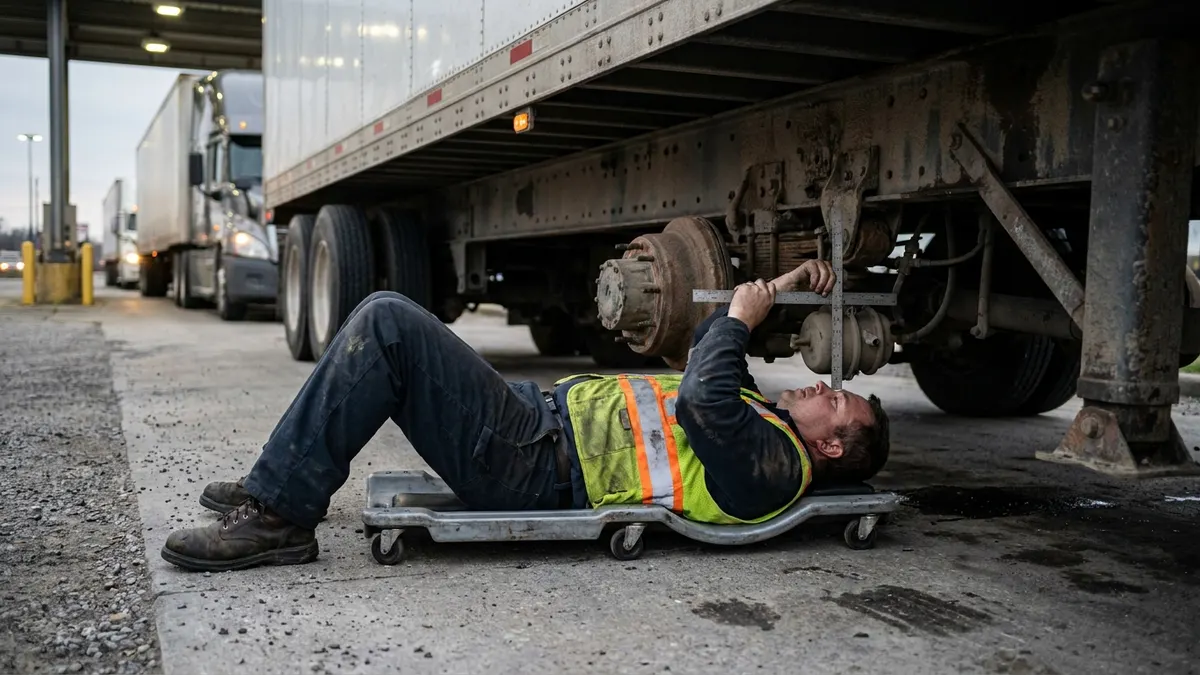
FMVSS 121 — Federal Motor Vehicle Safety Standard No. 121, codified at 49 CFR 571.121 — is the U.S. rule that sets minimum performance for new air-braked trucks, truck-tractors, buses and trailers. It dictates how quickly the compressor must charge the system, how much reservoir volume the vehicle must carry, how fast the brakes must apply and release, how far the vehicle may take to stop from 60 mph, and that the vehicle must have antilock braking. Critically, it is a build standard: NHTSA enforces it against the manufacturer at the point of manufacture, while the condition of a truck already working for a living is governed by FMCSA rules in 49 CFR Part 393.
What the standard actually regulates
FMVSS 121 is written as a set of pass/fail tests a new vehicle must survive. Broadly it covers five areas: air supply and storage, warning devices, brake application and release timing, service and emergency stopping performance, and parking brake holding force. It also carries the antilock requirement that reshaped North American air brake hardware in the late 1990s. Related standards fill the gaps — FMVSS 106 covers air brake hose and tubing, FMVSS 105 and 135 cover hydraulic-braked vehicles, and FMVSS 136 covers electronic stability control on tractors and large buses.
Air supply, reservoirs and warning devices
The charging test is the one most technicians remember: with the reservoirs starting at 85 psi and the engine at the manufacturer's maximum recommended rpm, the compressor must raise service reservoir pressure to 100 psi within 25 seconds. That is why compressor displacement is spec'd to the vehicle rather than picked off a shelf — an undersized unit on a large reservoir bank cannot meet it.
Storage is sized off the brakes it has to feed. Combined reservoir volume on a power unit must be at least twelve times the combined volume of all service brake chambers; trailers are held to a lower multiple. Each reservoir needs a drain at its lowest point and check valve protection so a failure upstream cannot bleed the whole system down. The standard does not name a governor setting — it requires the system to reach and hold working pressure — so in practice you see cut-out between 120 and 135 psi, cut-in between 100 and 110 psi, and a healthy fully charged system sitting near 120 psi. The low-air warning must operate at no less than half of governor cut-out, which lands the buzzer and light right around 60 psi on most equipment.
Application and release timing
Timing limits exist so tractor and trailer brakes come on together rather than in sequence. The tests start from about 100 psi reservoir pressure and measure at the chamber.
| Measurement | Trucks and buses | Trailers |
|---|---|---|
| Chamber pressure reaches 60 psi from first control movement | about 0.45 second | about 0.35 second |
| Chamber pressure falls from 95 psi to 5 psi on release | about 0.55 second | about 0.75 second |
These are the numbers relay valves, quick release valves and line sizing are engineered around. Replace a relay valve with the wrong crack pressure or plumb a trailer with undersized line and you can drift outside what the vehicle was certified to do, even though nothing is technically leaking.
Stopping distance
The 2009 reduced stopping distance rule cut tractor requirements by roughly 30 percent, phased in from August 2011 for most three-axle tractors and 2013 for the rest. Stops are made from 60 mph on a dry surface and the vehicle must stay inside a 12-foot lane.
| Vehicle type | Distance |
|---|---|
| Most three-axle truck-tractors | 250 feet |
| Heavy or severe-service tractors (higher GVWR or four or more axles) | 310 feet |
| Single-unit trucks and buses | 355 feet |
Separate, longer distances apply to lightly loaded stops and to emergency stops made with one circuit failed. That partial-failure test is the reason every modern air-braked power unit splits the service system into independent front and rear circuits — see how a dual air brake system works for the plumbing side of it.
ABS and stability
Antilock braking became mandatory under FMVSS 121 on air-braked truck-tractors manufactured on or after March 1, 1997, and on other air-braked trucks, buses and trailers manufactured on or after March 1, 1998. Tractors carry an in-cab ABS malfunction lamp; trailers carry an external malfunction lamp on the left side, and tractors built from March 2001 must also display a trailer ABS malfunction lamp in the cab. Trailer ABS draws power through the seven-way connector, which is why a corroded pin can present as a dead trailer ABS lamp rather than a braking fault.
Parking and emergency brakes
The parking brake must be mechanically applied — that means spring brakes, not held air — and must hold the loaded vehicle on a 20 percent grade. Springs begin to apply as system pressure bleeds down, typically somewhere in the 20 to 45 psi band, which is why a runaway leak eventually parks the vehicle instead of leaving it free-rolling. The standard also requires that a failure in the service system still leaves a means of stopping the vehicle.
Who it applies to — and who it doesn't
FMVSS 121 applies to new air-braked vehicles built for U.S. road use. Hydraulic and air-over-hydraulic systems fall under different standards, and certain trailers and off-road or special-purpose equipment are excluded or partially excluded. Nothing in FMVSS 121 tells a fleet how to maintain the truck afterward; that job belongs to the FMCSA air brake regulations in Part 393 and to the inspection criteria used at the roadside.
FMVSS 121 versus ECE R13
Outside North America most heavy vehicles are certified to UN Regulation No. 13. Both regimes chase the same outcome, but the test philosophy differs enough that a compliant U.S. truck is not automatically approvable in Europe.
| Topic | FMVSS 121 (US) | ECE R13 |
|---|---|---|
| Legal mechanism | Manufacturer self-certification, NHTSA enforcement | Type approval before the vehicle may be sold |
| Performance metric | Stopping distance from 60 mph | Deceleration and braking rate, with cold, fade and downhill tests |
| Reservoir sizing | Multiple of combined brake chamber volume | Sized by number of full-stroke applications with pressure retained |
| Load sensing | Not required | Load-sensing valve or EBS effectively required |
| Tractor–trailer matching | Not defined as bands | Compatibility bands of braking rate against coupling head pressure |
| Endurance braking | Not required | Required for many heavy categories on sustained descents |
| ABS/EBS interface | Power and lamp through the seven-way connector | ISO 7638 connector with a data link for EBS |
| Working units | psi | bar |
The ECE R13 rules also fold electronic stability into the braking regulation itself, where the U.S. handles it in a separate standard. Practically, that is why European trailers arrive with EBS and load sensing as standard fitment while North American trailers commonly run relay valves and ABS only.
What this means in the shop
You are not certifying vehicles, but you can quietly decertify one. Fit a compressor with less displacement than the original and the truck may no longer make the 85-to-100 psi charge time. Delete or downsize a reservoir and you lose reserve volume the standard assumed. Swap in a valve with different timing and the trailer no longer comes on with the tractor. Leave an ABS lamp inoperative and you have both a compliance problem and a vehicle that stops longer on ice. Match components to the OE specification — Bendix, Wabco/ZF, Knorr-Bremse, Haldex, Meritor and the truck builders all publish the numbers — and the vehicle keeps performing the way it was certified to.
Need the part, not just the answer?
OE-grade air brake compressors and repair kits, manufactured and tested to commercial-vehicle standards.
Shop VADEN partsPublished by VADEN Original. Product links point to the manufacturer’s official catalogue. Specifications are general — always confirm figures against your vehicle’s service manual.