 airbrakecompressor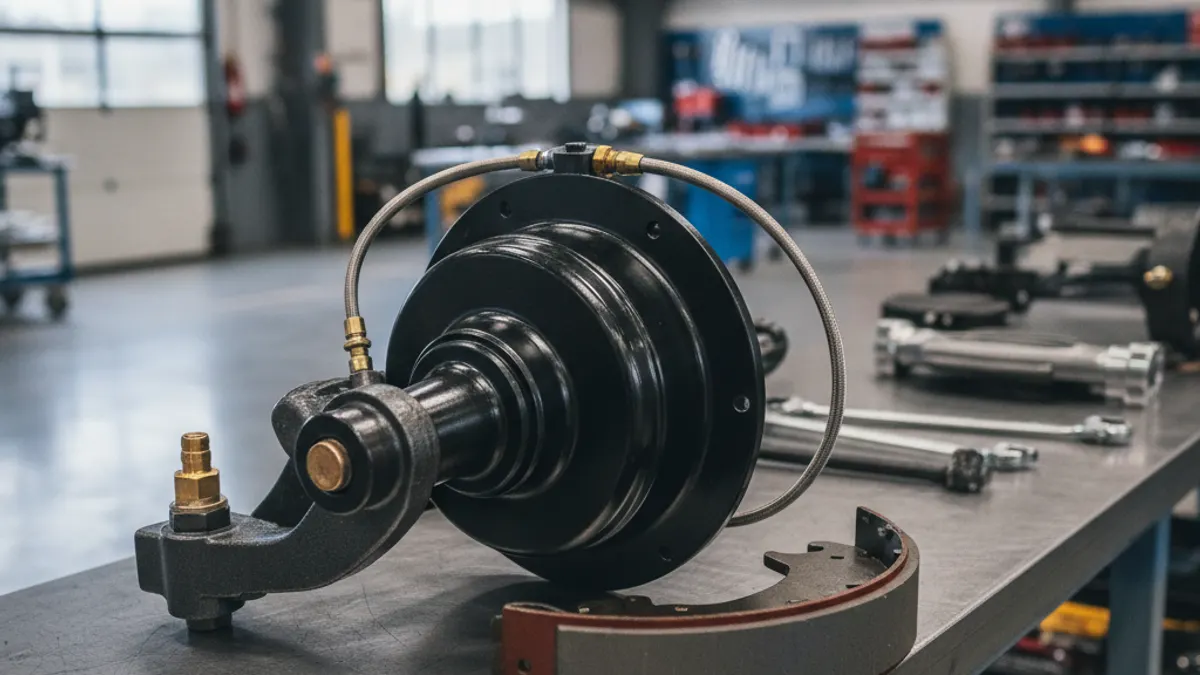
Dump truck air brakes are a conventional dual-circuit pneumatic system — compressor, governor, air dryer, wet and dry reservoirs, foot valve, relay valves and spring brake chambers — fitted to a short-wheelbase, heavily loaded vocational chassis. The pressures are the same as on any commercial vehicle: about 120 psi in the tanks when fully charged, governor cut-out typically somewhere in the 120–135 psi range, cut-in roughly 100–110 psi, and a low-air warning that must come on by about 60 psi. What changes is the workload — constant loaded stops, steep site grades, low average speed and air-driven body equipment. That combination raises compressor duty cycle, pushes more moisture and oil through the system, and wears foundation brakes faster than any highway application.
So treat a dump truck as a normal air brake system being run near its limits, and pay extra attention to the three things the vocational spec adds: lift axles, PTO and body air draw, and contamination.
How a dump truck air system differs from a highway truck
A tractor pulling a van trailer at highway speed spends most of its time on a charged, resting system. Pressure sits near the governor cut-out point, the governor unloads the compressor, and the dryer purges on a comfortable cycle. A dump truck does the opposite. Loading, spotting, dumping and short hauls mean the brakes are applied constantly, the system rarely rests at full pressure, and the compressor is loading again almost as soon as it unloads.
That has practical consequences:
- Higher compressor duty cycle. More time pumping means more heat, more carbon build-up at the discharge port and more oil carryover downstream. A compressor that lasts for years on a sleeper truck can be worn out early on a dump or mixer chassis.
- More condensate. Every pumping cycle pushes warm, wet air into the dryer. Short trips never fully heat-soak the system, so water condenses in the tanks instead of being carried out.
- Faster foundation brake wear. Loaded downhill work on a site heats drums and linings, and heat is what turns normal wear into fade and cracked drums.
- Dirt ingress. Site dust gets into slack adjuster grease points, camshaft bushings, chamber clamp bands and air line fittings that a highway truck never sees.
None of that changes the benchmarks the driver checks. Cut-in still lands roughly in the 100–110 psi band, the low-air warning should come on by about 60 psi, and spring brakes begin to apply on their own somewhere in the 20–45 psi window as pressure bleeds down. Those figures are the same for any commercial vehicle — see what a fully charged air brake system should read for the full pressure map.
Pusher and tag axle brakes
Lift axles are where dump trucks really differ. A pusher axle sits ahead of the drive axle, a tag axle sits behind it, and both exist to spread the load so the truck stays legal on axle weight limits. Depending on the spec, a lift axle may be non-braked, or fully braked with its own chambers and relay valve.
When it is braked, the plumbing has to satisfy one rule: the axle brakes only when it is down and carrying weight. If a raised axle's chambers still see service pressure, those tires are being braked while barely touching the ground — that means flat spots, and on a steerable lift axle, unpredictable handling. The control logic isolates the lift axle brake circuit whenever the axle is raised and restores it when the axle is deployed and its air bags are loaded.
What to check on a braked lift axle:
- Pushrod stroke on the lift axle chambers, adjusted to the same limits as every other axle. It is the axle most often skipped during an adjustment check.
- That the axle drops and lifts fully with the in-cab control, and that the load pressure regulator holds a steady setting rather than creeping.
- That the lift axle brakes release completely when the axle is raised, with no residual pressure at the chamber.
- Air lines to the lift axle — they flex through every up and down cycle and chafe on the frame more than any other line on the truck.
PTO, hoist and body air draw
The hoist itself is hydraulic, driven by a transmission-mounted PTO, but on most vocational trucks that PTO is air-shifted from a dash switch. Tailgate latches, body-up indicators and lift axle bags may run on air as well. All of it comes from the same reservoirs that feed the brakes.
The safeguard is a pressure protection valve on the accessory supply. It feeds auxiliary circuits only once system pressure is above a set threshold and closes again when pressure drops, so body functions cannot drain the brake supply below a safe level. If a driver reports that the PTO or lift axle will not operate until the truck has run a few minutes, that valve is usually doing exactly its job — the real fault is that the system is slow to build. Never bypass one to make an accessory work.
Continuous PTO use while parked is a hidden load too. Engine at high idle, compressor cycling, dryer purging every couple of minutes: that is real duty cycle even though the truck is not moving.
Dump truck air brake stress points
| Area | Typical symptom | First checks |
|---|---|---|
| Compressor duty cycle | Slow build after dumping, oil at the dryer purge | Governor cut-in and cut-out points, discharge line for carbon restriction, unloader operation |
| Moisture in tanks | Water at the drain valves, dryer purging often, winter freeze-ups | Daily draining, dryer cartridge age, purge valve function |
| Lift axle brakes | Flat-spotted lift axle tires, uneven wear, dragging | Chamber pressure with the axle raised, control valve logic, pushrod stroke |
| Foundation brakes | Fade on loaded grades, blued or cracked drums | Adjustment on all axles, lining thickness, drum condition, dragging shoes |
| Air lines and fittings | Audible leak, pressure drop overnight | Chafe points at the lift axle and body pivot, gladhand seals, fitting condition |
| Spring brakes | Parking brake slow to release or will not release | Supply pressure, dash control valve, contaminated or frozen lines |
Maintenance that actually matters on a dump truck
Shorten the intervals you would use on a highway truck. The system does more work in fewer miles, so mileage-based schedules badly under-service vocational equipment. Engine hours or duty cycle is the better yardstick.
- Drain every tank, every day. Wet tank first, then the service reservoirs. More than a trace of water means the dryer needs attention — water in air tanks covers what the amount and color are telling you.
- Replace the air dryer cartridge early. Heat and high duty cycle shorten desiccant life, so plan on a shorter interval than the general highway recommendation.
- Check adjustment on every axle, lift axles included. Measure pushrod stroke with the system fully charged, brakes released, then applied. Any chamber past its stroke limit puts the truck out of service.
- Grease slack adjusters and cam bushings on schedule. Site dirt turns dry cam bushings into dragging brakes quickly.
- Inspect the compressor supply and discharge. Oil in the tanks or a slow-building system usually points back to the air brake compressor and its discharge line, not to the dryer alone.
- Do the full pre-trip. Leak-down test, applied leakage test, low-air warning and spring brake application points. The standard check catches most vocational problems before they become roadside violations.
Torque, stroke and pressure settings vary by axle and valve supplier, so treat the ranges above as orientation and follow the vehicle manufacturer's current service manual for exact figures. A dump truck's air brake system is not exotic; it is simply under constant pressure. Service it on the schedule the duty cycle demands, keep the lift axle circuits honest, and keep body air isolated behind its protection valve, and the brakes behave like any other well-maintained air brake system.
That constant demand lands on the supply end first: lift axles and body air pull more than the base spec assumed, so match displacement to real duty when you choose a replacement from the truck air compressors.
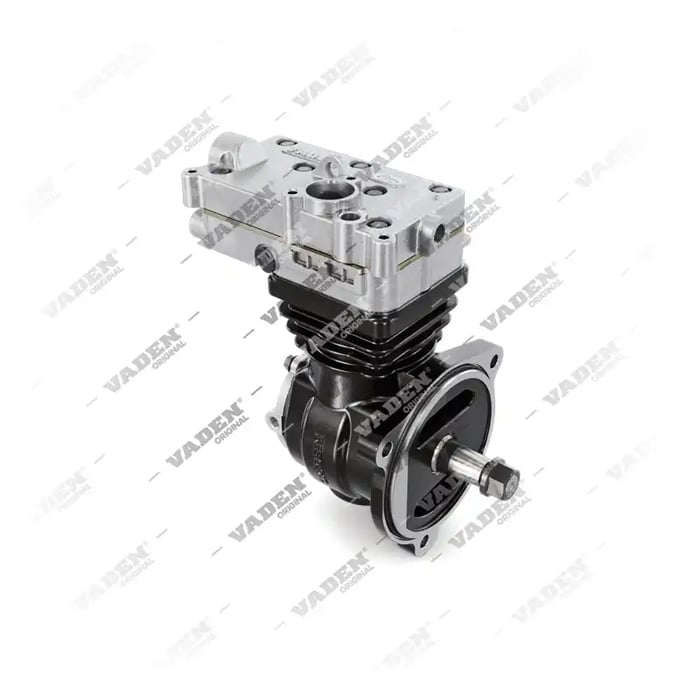
Need the part, not just the answer?
OE-grade air brake compressors and repair kits, manufactured and tested to commercial-vehicle standards.
Shop VADEN partsPublished by VADEN Original. Product links point to the manufacturer’s official catalogue. Specifications are general — always confirm figures against your vehicle’s service manual.