 airbrakecompressor
A pressure protection valve is a spring-loaded valve fitted between the air brake supply and a downstream circuit — usually an accessory or auxiliary line — that refuses to pass air until upstream pressure rises above a preset point. Once system pressure climbs past that setting (commonly somewhere in the 65-95 psi range, depending on the valve), it opens and feeds the downstream branch. If pressure later falls back below the closing point, the valve shuts and traps the remaining air on the brake side. That behaviour is what stops a burst air-seat hose or a ruptured suspension bag from bleeding the service reservoirs down to nothing.
Technicians often shorten the name to PPV, or call it an accessory protection valve. On European trucks you will find them plumbed into gearbox actuator lines, cab tilt circuits and air suspension feeds; on North American equipment they are common on air suspension, PTO, air horn and auxiliary equipment branches.
Why an air brake system needs circuit isolation
An air brake system is pneumatic: it stores its energy as compressed air rather than as fluid under pressure. A leak downstream of the reservoirs can vent an enormous volume of stored air in seconds, and every psi lost is stopping ability lost. Once system pressure drops toward the low-air warning threshold — typically around 60 psi — the buzzer and warning light come on, and if it keeps falling the spring brakes will apply on their own somewhere in the 20-45 psi band.
Modern trucks hang a lot of hardware off the same compressor: air suspension, air-ride seats, cab suspension, horns, dryer purge, gearbox and axle actuators, and on tractors the trailer supply. Without isolation, any one of those failing takes the brakes with it. Pressure protection valves partition the system so a failure stays local.
How a pressure protection valve works
Internally the valve is a piston or diaphragm loaded by a calibrated spring and seated against a port. Supply pressure acts on one side of the piston; the spring holds it shut from the other.
- Charging from zero. The compressor builds pressure into the wet tank and service reservoirs. The protection valve stays closed — the spring wins — so all available air goes to the brake circuits.
- Opening point reached. Once upstream pressure exceeds the spring setting, the piston lifts off its seat and air flows into the accessory branch. The brakes are already largely charged by this stage.
- Normal running. The governor cycles the compressor between cut-in, generally around 100-110 psi, and cut-out, generally in the 120-135 psi band, so a fully charged system typically sits near 120 psi. The valve stays open and the accessory circuit is fed continuously.
- Downstream failure. A hose bursts or a fitting lets go. Pressure in the accessory branch drops, and as the upstream side follows it down to the closing point, the spring reseats the valve. Air loss stops and the brake reservoirs keep whatever they still hold.
Most designs build in a deliberate gap between the opening and closing pressures so the valve does not chatter at the threshold. Some variants also act as a check valve and block backflow from the accessory into the supply; others allow reverse flow. Know which type you have before substituting parts.
Typical pressure settings by circuit
The figures below are general service ranges for orientation only. The actual setting is fixed at manufacture and is normally stamped, cast or printed on the valve body. Always match the replacement to the number on the old unit and to the vehicle manufacturer's current service data.
| Circuit protected | Typical opening range | Reason for the setting |
|---|---|---|
| Air suspension feed | ~65-85 psi (4.5-6 bar) | Suspension must not take air until the service brakes are usable |
| Auxiliary / PTO, gearbox actuators | ~75-95 psi (5-6.5 bar) | Lower priority, but needs solid pressure to actuate reliably |
| Cab suspension, air seat, horn | ~65-85 psi (4.5-6 bar) | Comfort items, lowest priority in the charging order |
| Trailer supply branch (where fitted) | Per OE spec | Coordinated with the tractor protection system |
| Main brake circuits | Staged, per OE spec | Handled by the multi-circuit protection valve, not a single PPV |
Never substitute a valve with a different opening pressure just because it physically fits. A setting that is too low lets accessories rob the brakes during charging; too high, and the accessory circuit may never get air on a marginal system.
Pressure protection valve vs multi-circuit protection valve
These two are confused constantly. A single pressure protection valve guards one branch: one inlet, one outlet, one spring setting. A multi-circuit protection valve — the four-circuit valve on most European trucks — is a single body containing several protection elements plus check valves, splitting the dryer outlet into primary service, secondary service, parking/spring brake and auxiliary circuits with a defined charging priority. If your truck has a four-circuit valve at the dryer outlet, that unit does the heavy lifting, and separate PPVs further downstream handle individual accessories.
Both belong to the same family as the air brake check valve, which blocks backflow but has no pressure threshold. Check valve: direction control. Protection valve: pressure-threshold control.
Symptoms of a failed pressure protection valve
Stuck closed, or opening pressure drifted too high
- Air suspension will not lift, or takes far longer than normal to inflate
- Air seat, cab suspension or horn dead while brake pressure reads normal
- Gearbox or PTO actuators sluggish, or not engaging at all
- Accessory works only at full system pressure and quits as soon as pressure cycles down toward governor cut-in
Stuck open, or leaking past the seat
- A leak in an accessory line drains the whole system — the protection function is gone
- Compressor cycles more often than it should, and charge times from cold are long
- System will not reach normal governor cut-out because the leak path never closes
- Audible leak at the valve body itself with the system charged
This complaint list overlaps heavily with charging faults that have nothing to do with the protection valve. Before condemning it, rule out a tired compressor or a leaking unloader — see air brake system losing pressure for the systematic approach.
How to test one
Chock the wheels first, and remember the vehicle may lose parking brake air during the test.
- Watch the charge sequence. Drain the system to zero, then charge and note when the accessory circuit comes alive. It should start receiving air roughly at the marked opening pressure — not immediately from zero, and not only at cut-out.
- Gauge the downstream side. Tee a test gauge into the protected branch and compare it against supply while charging. A valve that opens 20-30 psi late, or never fully opens, has failed.
- Leak-down test. Charge fully, shut the engine off, then deliberately vent the accessory branch. The supply gauge should stop falling at the valve's closing point. If supply keeps bleeding toward zero, the valve is stuck open.
- Soap the body and ports. With the system charged, check for external leakage at the housing, the exhaust port if fitted, and all fittings.
- Check the air source. Wet, oily air is what kills these valves. If the seat is gummed or the piston sticks, inspect the dryer cartridge and check whether the compressor is passing oil downstream.
Service and replacement notes
Most pressure protection valves are sealed, non-adjustable units and are replaced rather than rebuilt. When fitting a new one:
- Match the opening pressure marking exactly, along with port thread sizes and flow direction — many bodies carry an arrow or IN/OUT marking.
- Confirm whether the original was a one-way or two-way type.
- Use thread sealant sparingly and keep it off the last two threads; sealant migrating into a seat is a repeat failure waiting to happen.
- Blow out the lines before reconnecting, especially after an oil or sludge contamination failure.
- Recharge from zero and verify the opening point on a gauge before returning the vehicle to service.
If you are sourcing parts, VADEN Original manufactures OE-grade pressure limiting valves for heavy commercial vehicles, with cross-reference data for common truck and trailer applications.
Prevention beats replacement
Protection valves fail for the same reason most pneumatic components fail: contamination. Water and oil carried past a saturated dryer cartridge coat the seats, gum the pistons and, in winter, freeze them solid. Draining the tanks on schedule, replacing the dryer cartridge at the recommended interval and fixing an oil-passing compressor early will do more for protection valve life than anything you can do to the valve itself.
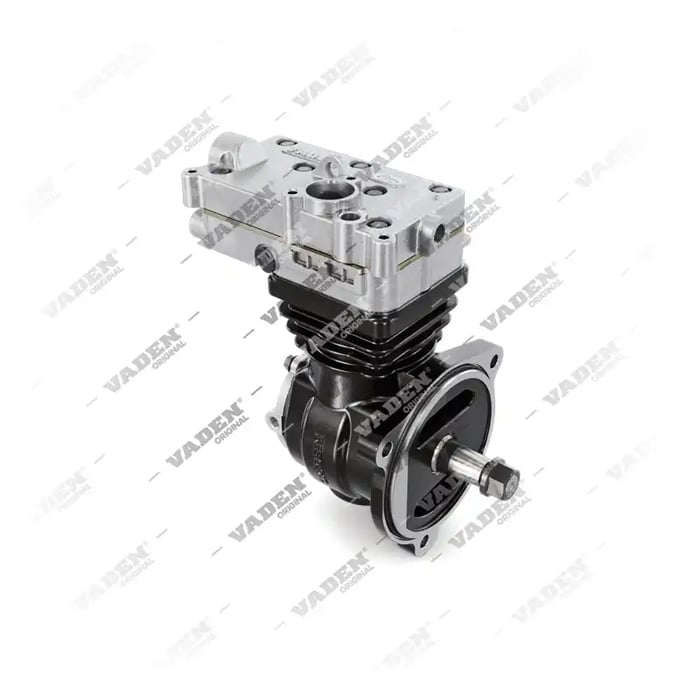
Need the part, not just the answer?
OE-grade air brake compressors and repair kits, manufactured and tested to commercial-vehicle standards.
Shop VADEN partsPublished by VADEN Original. Product links point to the manufacturer’s official catalogue. Specifications are general — always confirm figures against your vehicle’s service manual.