 airbrakecompressor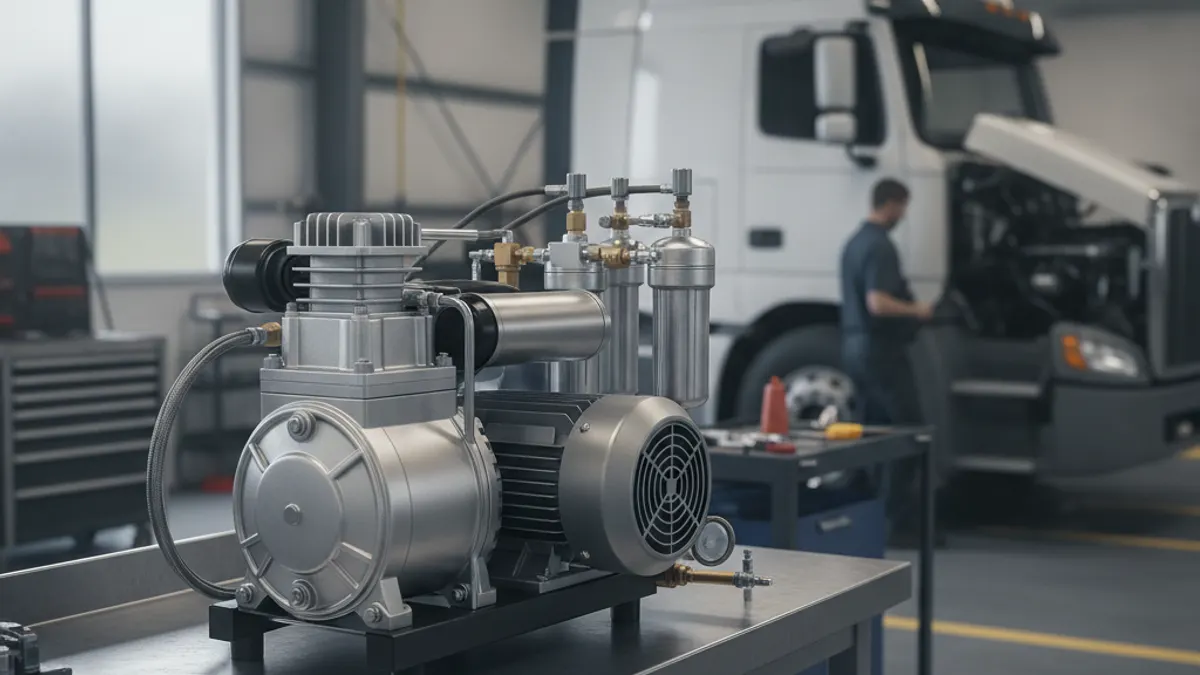
A battery-electric truck still stops on compressed air. Because there is no engine to turn a gear- or belt-driven pump, the air brake compressor gets its own electric motor and is commanded by vehicle control electronics rather than by a mechanical governor. Working pressures do not change: cut-out is still roughly 120-135 psi, cut-in roughly 100-110 psi, and a fully charged system sits near 120 psi. Everything downstream — dryer, tanks, valves, chambers, foundation brakes — is hardware you already know how to service.
Why an electric truck needs a different compressor
A conventional engine-driven air brake compressor is bolted to the diesel and is completely dependent on it. It is turned by a gear or belt at engine speed, fed pressurized engine oil through a supply line, cooled by engine coolant, and it turns continuously whenever the engine runs, loading and unloading as tank pressure rises and falls. Take the engine away and every one of those interfaces disappears.
What does not disappear is the demand for air. Service braking, spring parking brakes, air suspension and leveling, cab and seat suspension, the horn, and on transit buses the doors and kneeling function all consume air. Regenerative braking handles a large share of ordinary deceleration on an electric truck, which can reduce foundation-brake work, but it does not reduce the air needed to release spring brakes, level a chassis, or make a hard or low-speed stop. Air supply on a battery-electric truck is a safety-critical system in exactly the same way it is on a diesel.
How a motor-driven air compressor works
The compressor head itself is familiar: usually a reciprocating piston design, sometimes a scroll element. What changes is what turns it. A brushless motor drives the head, powered either from the high-voltage traction bus through an inverter (commonly 400 V or 800 V class on heavy tractors and coaches) or from the 24 V system on lighter and medium-duty applications. On most current vehicles the compressor, its motor and inverter, the air dryer and the control electronics are supplied as one assembly, often called an air supply unit or air production module.
Electronic control replaces the mechanical governor
On a diesel truck, a pneumatic governor senses tank pressure and pilots the unloader to stop pumping at cut-out and resume at cut-in. On a motor-driven system, a pressure transducer reports to the ECU, and the ECU simply starts, stops or varies the speed of the motor within the same window. Because motor speed is controllable, the unit can run slowly for a long low-noise top-up instead of hammering on and off. A mechanical safety relief valve and a dryer purge function remain, but the classic governor-and-unloader diagnostic path is largely replaced by fault codes, live pressure data and compressor run-time counters.
Oil-free heads change what reaches the dryer
Many motor-driven compressors run oil-free, using dry-running piston rings and coated bores or a scroll element, since there is no engine oil gallery to tap. That removes the most common contamination path in a conventional system: oil carryover into the dryer, tanks and valves. It does not remove water. Compressing and cooling air always drops out condensate, so the air dryer and its desiccant cartridge stay on the maintenance schedule, and tank draining or automatic drain valves still matter. Some designs retain a sealed oil sump instead of running dry; check the OEM literature before assuming either way.
Engine-driven versus motor-driven at a glance
| Item | Engine-driven compressor | Motor-driven (electric) compressor |
|---|---|---|
| Drive | Gear or belt from the engine | Dedicated brushless motor, HV bus or 24 V |
| Speed | Tied to engine rpm | Controlled by ECU, often variable |
| Lubrication | Pressurized engine oil | Oil-free or sealed sump |
| Cooling | Engine coolant and oil | Air-cooled or vehicle coolant circuit |
| Pressure control | Mechanical governor and unloader | Pressure sensor and ECU logic |
| Builds air when parked | No — engine must run | Yes, including while plugged in |
| Typical failure signs | Slow build, oil passing, knocking | Slow build, motor derate, fault codes |
| Replacement | Unbolt from engine, transfer fittings | Often a complete module swap |
On an electric truck, air costs range
This is the operational difference fleets feel first. On a diesel, compressor work is buried in fuel burn and nobody measures it. On a battery truck, every cubic foot of air comes out of the traction pack, so a slow leak that used to just make the compressor cycle a little more now shows up as extra motor run time and measurable range loss. Leak hunting becomes an efficiency job, not only a brake job.
The upside is scheduling. Because the compressor no longer depends on the engine, control software can pre-charge the system while the vehicle is plugged in or parked, so the truck leaves with a full system instead of the driver waiting on build-up. It can also bias compressor operation toward regenerative braking events and away from peak power demand on a climb.
Service, diagnostics and safety
High-voltage compressors are wired with orange cabling and must be de-energized and locked out following the manufacturer's procedure, by a technician trained and equipped for high-voltage work. Never open an HV connector or a compressor housing on a live system.
Diagnosis starts with the scan tool, not a gauge tee. Read compressor duty cycle, commanded versus actual pressure, motor current and any thermal derate history. Slow build with normal motor operation still points where it always did: a system leak, a restricted intake filter, or a worn pumping element. Intake filtration deserves extra attention on oil-free units, because dry-running rings and tight clearances are unforgiving of dust.
Parts, cross-referencing and the installed fleet
Cross-reference motor-driven units by OE part number and vehicle platform, not by engine, since there is no engine to reference. Because the compressor, motor, dryer and electronics are frequently one assembly, the repair decision is often module replacement rather than a head gasket or ring kit, although pumping-element kits do exist for some designs.
Meanwhile the overwhelming majority of trucks, buses and trailers on the road remain diesel with conventional gear-driven pumps, and that fleet will be serviced for many years yet. Workshops supporting both generations still stock OE-grade air brake compressors for heavy commercial vehicles alongside the newer electric modules.
What does not change
The safety envelope is identical. Low-air warning devices activate near 60 psi, spring brakes begin to apply somewhere in the 20-45 psi range as pressure falls, and the pre-trip air brake check, leak-down limits, pushrod stroke measurement and tank draining routines all apply exactly as before. An electric truck's brakes are pneumatic, not hydraulic, and they are held off by air pressure the same way. The compressor learned a new way to turn; the brake system did not change its mind about anything.
Need the part, not just the answer?
OE-grade air brake compressors and repair kits, manufactured and tested to commercial-vehicle standards.
Shop VADEN partsPublished by VADEN Original. Product links point to the manufacturer’s official catalogue. Specifications are general — always confirm figures against your vehicle’s service manual.