 airbrakecompressor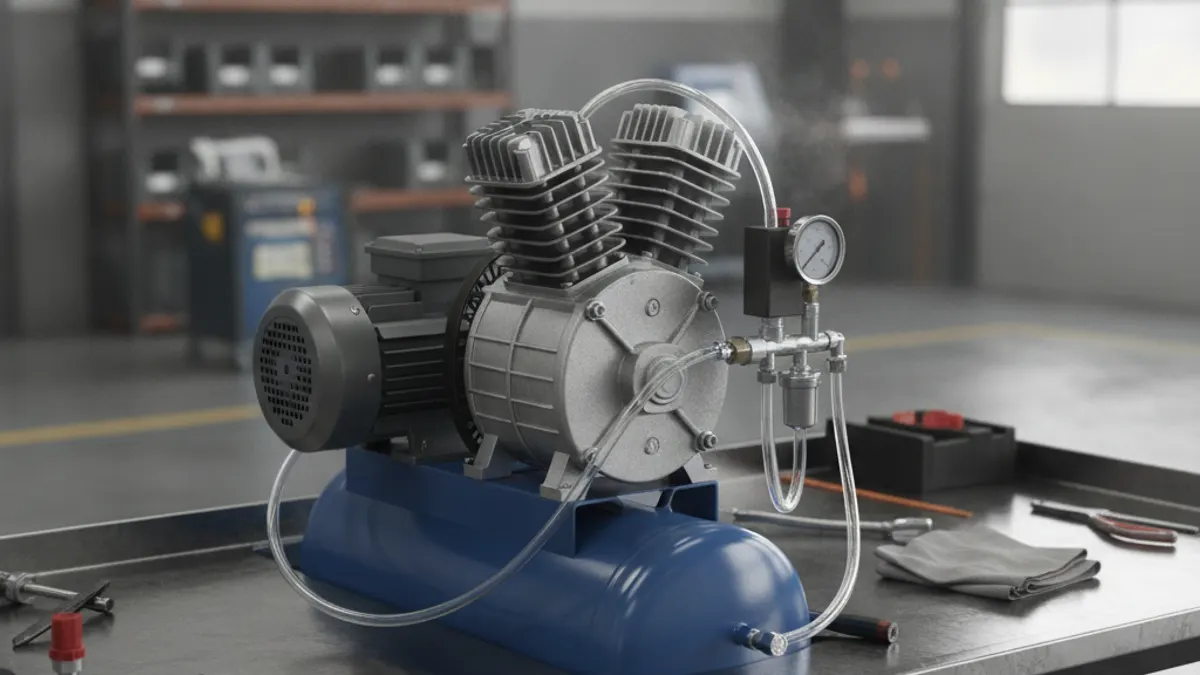
If your air compressor runs constantly, the system is either losing air as fast as the compressor makes it, or the compressor is never being told to stop pumping. On an engine-driven truck compressor the crankshaft always turns, so "runs constantly" really means it never unloads: the governor never reaches cut-out and the compressor stays loaded. Check system leakage first, then the governor, then the compressor's unloader mechanism.
What normal operation looks like
A healthy air brake system builds to governor cut-out, usually somewhere in the 120-135 psi range depending on the OEM setting. At cut-out the governor sends signal air to the compressor's unloader and the compressor stops pumping into the wet tank. As air is consumed, pressure falls to cut-in, generally around 100-110 psi, and the compressor loads again. Fully charged, a truck normally sits near 120 psi.
Over a working day the compressor should be loaded only a fraction of the time. Duty cycle varies with the vehicle: a tractor pulling a van trailer uses far less air than a dump truck with air-shift PTO, air suspension dump and constant service applications. But a compressor loaded most of the time will cook its discharge line, carbon up the head and start passing oil downstream.
The five causes, ranked by how often they show up
1. Air leaks
Leakage is the number one reason a compressor never gets a break. A leak big enough to keep the compressor loaded is often small enough that you never hear it over an idling diesel. Typical culprits: gladhand seals, trailer supply and service lines, fittings at the relay and quick release valves, cracked nylon tubing rubbed through on a frame rail, a leaking foot brake valve exhaust, brake chamber diaphragms, and air suspension bags or leveling valves. See air brake system losing pressure for the full leak-down procedure.
2. Air dryer purging continuously
The dryer should purge with a short blast at each cut-out. If the purge valve is stuck open, has a torn seal, or the dryer's own check valve has failed, the system vents to atmosphere the whole time the engine runs. You will hear a steady hiss at the dryer. A saturated or overdue cartridge also lets moisture through and can cause the purge valve to freeze open in cold weather.
3. Governor fault or wrong adjustment
A governor with a plugged filter screen, a stuck piston, a failed spring, or a cracked or blocked unloader signal line will never command unload. Cut-out set too high has much the same effect from the driver's seat, because the system takes far longer to reach the setting. The governor is a cheap part and a common first replacement, but confirm it on a gauge before you condemn it.
4. Stuck or worn unloader
If the governor is sending signal air but the compressor still pumps, the fault is in the compressor's own unloader valve: carbon-seized unloader pistons, broken springs, or a leaking plunger seal. On many designs a leaking unloader also bleeds governor signal air, so pressure at the governor port drops and the unit reloads immediately.
5. Restricted plumbing or genuine high demand
A discharge line carboned down to a pencil-lead passage, a partly closed shutoff, or a line that is undersized or has too many bends will choke delivery. The compressor works hard, the tanks fill slowly, and cut-out takes far too long. Separately, some vocational vehicles simply out-demand the compressor: air-operated tailgates, blowers, air seats, constant suspension dumping. That is a spec problem, not a failure.
Diagnosis: what to test and in what order
| Test | How to do it | What it tells you |
|---|---|---|
| Build-up time | Drain tanks, run engine at fast idle, time the rise from about 85 to 100 psi | Should typically build within roughly 45 seconds in a dual system. Slower points to a restriction, worn compressor or a large leak. |
| Static leak-down | Charge to cut-out, shut the engine off, chock, release the brakes, watch the gauges for one minute | Limits are 2 psi per minute for a single vehicle, 3 psi per minute for a combination. |
| Applied leak-down | Same setup, then hold a full brake application for one minute | Limits are 3 psi per minute single, 4 psi per minute combination. Worse than static means chambers, relay valve or foot valve. |
| Governor cut-out | Watch the dash gauge while the compressor charges | Should cut out in the 120-135 psi band with an audible dryer purge. No cut-out at all means governor, signal line or unloader. |
| Unloader signal check | Tee a gauge into the governor-to-compressor line, or crack the fitting at cut-out | Signal present but compressor still pumping isolates the fault to the compressor unloader. |
| Soap and listen | Spray joints, gladhands, chambers and suspension bags with soapy water, engine off, system charged | Finds the leaks the leak-down test proved were there. |
Chock the wheels before any leak-down test, and never work under a vehicle held only by air. Pressure, torque and adjustment values vary by OEM; the manufacturer's current service manual governs.
Reading the symptom pattern
| What you observe | Most likely cause | Next step |
|---|---|---|
| Reaches cut-out but cycles again within seconds | Leak, or dryer purge valve leaking back | Static leak-down, then soap-test the dryer |
| Never reaches cut-out; pressure plateaus below 120 psi | Large leak, restricted discharge or worn compressor | Build-up time test |
| Constant hiss at the air dryer | Purge valve stuck open or failed check valve | Rebuild or replace the purge valve, replace the cartridge |
| Pressure climbs past normal cut-out, safety valve pops | Governor not unloading, or unloader seized closed | Signal-line pressure check at the compressor |
| Low-air warning at roughly 60 psi during normal driving | Demand exceeding supply: leaks or high duty cycle | Stop and diagnose; do not drive on a warning |
| Oil in the dryer, tanks or discharge line | Overheated compressor from long loaded run time | Fix the leak first, then assess the compressor |
Why you should not just live with it
A compressor that runs loaded most of the day runs hot. Discharge temperature climbs, oil carbonizes in the head and discharge line, and that carbon migrates into the dryer and tanks. The end result is a compressor that passes oil, a dryer that stops drying and contaminated valves throughout the system. A gladhand seal fixed early is cheaper than a compressor, a dryer and a round of valve replacements later.
Treat it as a safety issue too. If supply cannot keep up with normal demand, a long downgrade with repeated brake applications can pull pressure down to the warning point and, if it keeps falling, into spring brake application: parking brakes typically begin applying somewhere in the 20-45 psi range. That is not a controlled stop.
Repair order that saves time
- Run the static and applied leak-down tests and record the numbers.
- Fix every leak you find, then retest. Most "runs constantly" complaints end here.
- Check the dryer for continuous purge; service the cartridge and purge valve on schedule.
- Verify governor cut-out and cut-in on a gauge, not by ear.
- Check for unloader signal at the compressor at cut-out.
- Only then inspect the discharge line for carbon restriction and evaluate the compressor itself.
If the compressor turns out to be worn, with low output, oil passing or a seized unloader, replace it with an OE-grade unit sized for the vehicle's actual air demand, and replace the discharge line and dryer cartridge at the same time so old carbon does not immediately contaminate the new parts.
If the diagnosis does land on the compressor rather than a leak or a lazy governor, fit a unit matched to the truck's actual air demand — VADEN builds OE-grade air compressors for exactly that duty.
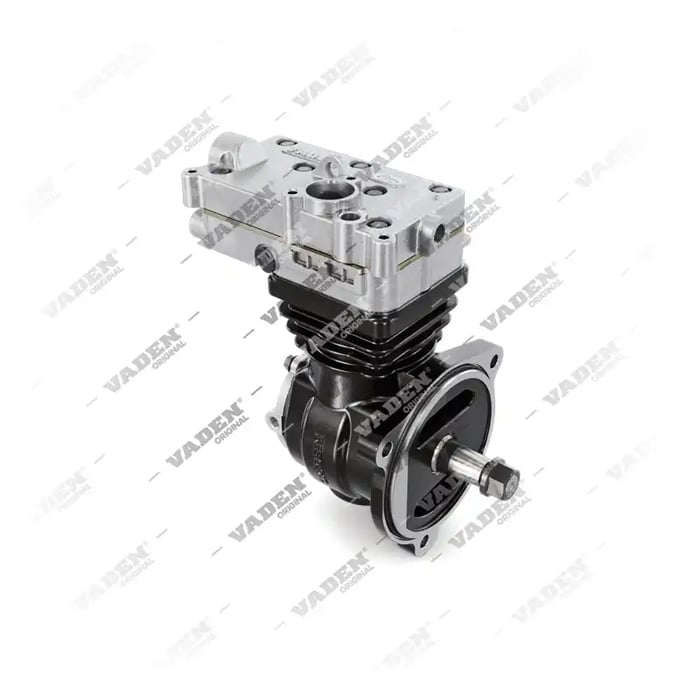
Need the part, not just the answer?
OE-grade air brake compressors and repair kits, manufactured and tested to commercial-vehicle standards.
Shop VADEN partsPublished by VADEN Original. Product links point to the manufacturer’s official catalogue. Specifications are general — always confirm figures against your vehicle’s service manual.