 airbrakecompressor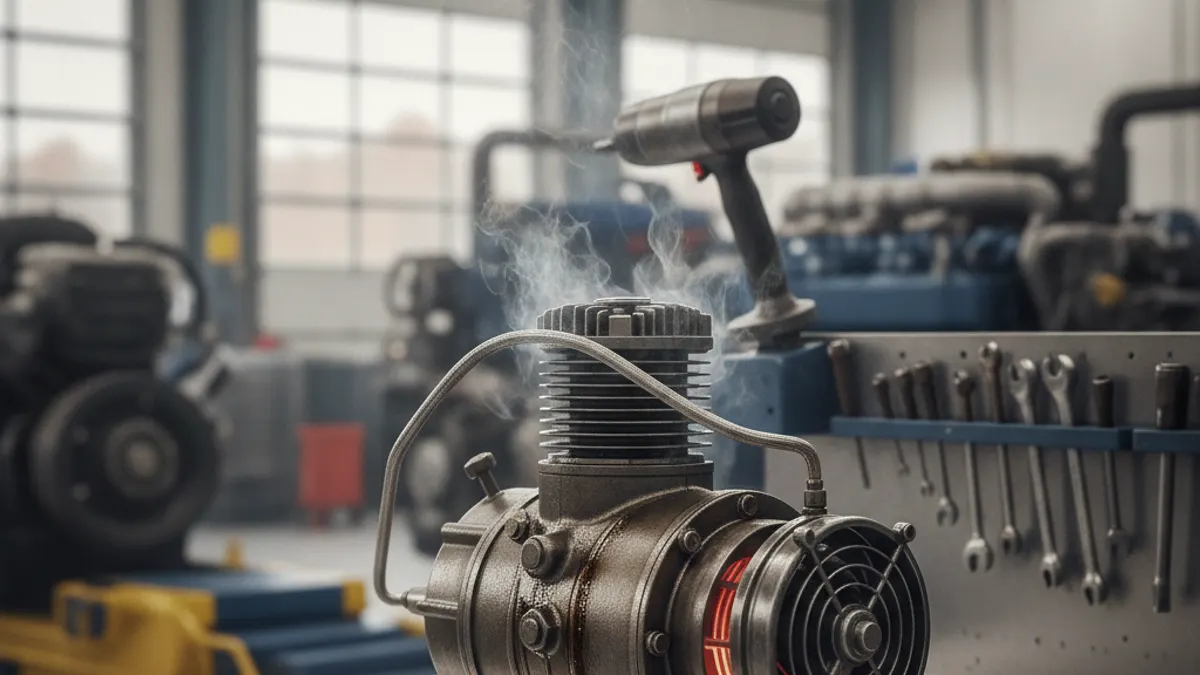
An air brake compressor overheats for one of two reasons: it is running loaded far more than it should, or the heat it normally makes cannot escape. Compression makes heat by itself — pushing atmospheric air up to a fully charged system pressure of around 120 psi generates plenty of it — so the compressor depends on engine coolant through its head and on a long discharge line acting as a heat exchanger. When duty cycle climbs, coolant flow drops or the discharge path restricts, head temperature rises, the lubricating oil carbonizes, and the unit begins a slow self-destruction that usually ends with oil in the air system.
Three checks find the cause: a discharge temperature reading, a duty cycle assessment and a look inside the discharge line. Work in that order — by the time you can smell hot oil or find carbon at the air dryer inlet, damage has already started.
How hot is too hot?
Discharge temperature is the working number. Air leaving the head should stay below the limit the manufacturer states for that unit, and by the time it has travelled the discharge line to the dryer it should have shed a large part of that heat. Above the design limit, engine oil breaks down and lays carbon on the discharge valves and in the line.
The field test: after the vehicle has been working, take infrared readings at the discharge port, halfway along the line, and at the dryer inlet. You want a clear drop across the line. If the line is nearly as hot at the dryer as at the compressor, and the dryer body is scorching rather than warm, you have a heat problem.
| Measurement point | Normal indication | What a high reading suggests |
|---|---|---|
| Discharge port at the head | Hot, within the manufacturer's stated limit | High duty cycle, cooling loss or internal wear |
| Discharge line, halfway | Noticeably cooler than at the head | Line too short, badly routed, insulated or restricted |
| Air dryer inlet fitting | Warm to hot, not scorching | Line not shedding heat; the desiccant will suffer |
| Coolant lines at the compressor | Both flowing, outlet warmer than inlet | One cool line means restricted or blocked flow |
Cause 1: excessive duty cycle
Duty cycle is the percentage of engine running time the compressor spends loaded rather than unloaded. A well-maintained vehicle sits well below 25 percent. Past that band the compressor never gets enough unloaded time to shed heat, and temperatures climb through the shift. What pushes duty cycle up is rarely the compressor itself:
- Air leaks at fittings, hoses, gladhand seals, brake chambers and valve exhaust ports.
- Accessory loads — air suspension, seats, horns, dump bodies, air-operated PTO.
- Frequent brake applications in refuse, transit and city delivery work.
- Governor faults. A governor that cuts out too high, or never cuts out, keeps the pump working. Cut-out normally lands around 120–135 psi with cut-in around 100–110 psi.
- Unloader faults. If the compressor cannot unload it builds continuously — the pattern behind an air compressor that runs constantly.
Before condemning anything, run a leak-down check: build to cut-out, shut down, then watch pressure loss with the brakes released and again applied. The low-air warning only trips at roughly 60 psi, so a vehicle can leak badly and still light no lamp during a short test.
Cause 2: cooling loss
Most heavy-duty compressors are liquid cooled, sharing engine coolant through inlet and outlet lines or a mounting flange. Cooling failures show up as collapsed or kinked hoses, scale and sludge in the head passages, air pockets left after a coolant service (a compressor mounted high on the engine is often the last place air purges from), degraded coolant, or — on air-cooled units — fins packed with oil film and grime.
Quick check: with the engine warm, feel both coolant lines. If one is hot and the other near ambient, flow is not happening. Flush or replace the lines and confirm the head passages are clear before fitting anything new.
Cause 3: restricted discharge line
The discharge line between compressor and air dryer is a heat exchanger as much as a pipe. It is deliberately long and routed in moving air so the compressed air cools and moisture condenses before the dryer. Common faults:
- Carbon build-up narrowing the bore, worst at the compressor end and at bends.
- A line shortened or undersized during a previous repair, so hot air arrives at the dryer uncooled.
- Rubber hose where steel or high-temperature reinforced line is specified — it insulates instead of radiating.
- Sags and low points that hold water, which freezes in winter and blocks the line.
- Kinks or crush damage from chassis or bodywork.
Any restriction raises the pressure the compressor works against and traps heat at the head. That heat carbonizes more oil, which lays down more carbon, which restricts further — the loop that ends in an air brake compressor pumping oil.
Cause 4: internal wear and oil supply
- Low or contaminated oil supply. Most compressors are engine-lubricated; a restricted feed line, plugged gallery or degraded oil starves the bearings, and friction becomes heat.
- Worn rings and bore. Blow-by cuts output, which lengthens build times and raises duty cycle.
- Carbon on the discharge valves. Carboned valves leak back, so the same air is compressed repeatedly instead of leaving the head.
- Head gasket failure between coolant and air passages, which puts coolant into the air system and kills cooling at the same time.
- Belt slippage on belt-driven units, making heat at the pulley and cutting output.
What overheating does downstream
Air arriving at the dryer too hot has not cooled and condensed, so the desiccant cannot do its job and moisture passes into the tanks. Hot air also cooks the cartridge and shortens its life sharply. Oil vapour that survives the trip coats the desiccant and downstream valves, causing sticky relay and quick-release valves, swollen seals and slow brake releases — see air dryers for trucks.
| What you observe | Most likely cause | First check |
|---|---|---|
| Compressor hot, dryer hot, frequent purging | High duty cycle from leaks | Leak-down test; listen at chambers and gladhands |
| Head very hot, one coolant line cold | Blocked coolant flow or air lock | Coolant lines and head passages |
| Line hot along its whole length, slow build | Discharge restriction or carbon | Remove the line, check the bore |
| Oil in the tanks, hot compressor | Carbon and wear loop already advanced | Assess the compressor; plan rebuild or replacement |
| Compressor never unloads | Governor or unloader fault | Governor signal line and cut-out test |
Diagnostic sequence
- Measure. Infrared readings at the discharge port, mid-line and dryer inlet after a normal working cycle; compare against the compressor's stated limit.
- Check duty cycle. Many chassis ECMs report it directly; otherwise observe governor cycling over several minutes and estimate the loaded fraction.
- Leak test. Build to cut-out, shut down, watch the gauges released and applied. Excessive drop means chase leaks first.
- Verify cooling. Both coolant lines flowing, no kinks, no air lock, coolant in condition; clean the fins on air-cooled units.
- Inspect the discharge line. Check the bore for carbon and confirm length, diameter and material match specification.
- Verify governor and unloader. Cut-out in the 120–135 psi window, cut-in around 100–110 psi, and a clean unload at cut-out.
- Assess the compressor only after the above, then decide between service and replacement.
Replace an overheated compressor without finding out why it overheated and you have bought a second failure on the same schedule.
Preventing it
Overheating is largely a maintenance-controlled failure. Chase leaks as they appear, replace the dryer cartridge on schedule, drain the tanks, keep coolant in specification, and inspect the discharge line whenever the compressor or dryer is serviced. On vehicles with genuinely high air demand — refuse, transit, heavy air-suspension work — specify a compressor with the displacement to match the duty rather than running an undersized unit near its limit all day.
When the heat has already cooked the valve plate or rings, size the replacement to the vehicle's real duty rather than to the old part number, and compare displacement across the air brake compressors before ordering.
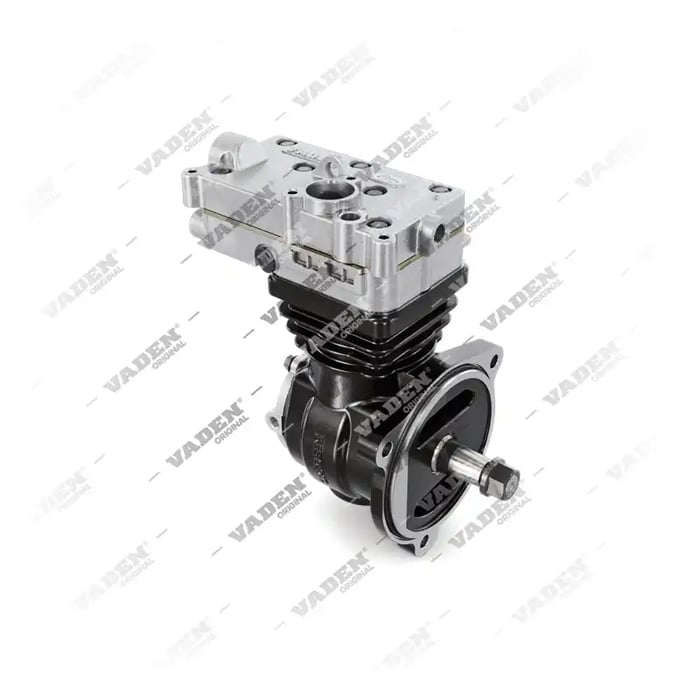
Need the part, not just the answer?
OE-grade air brake compressors and repair kits, manufactured and tested to commercial-vehicle standards.
Shop VADEN partsPublished by VADEN Original. Product links point to the manufacturer’s official catalogue. Specifications are general — always confirm figures against your vehicle’s service manual.