 airbrakecompressor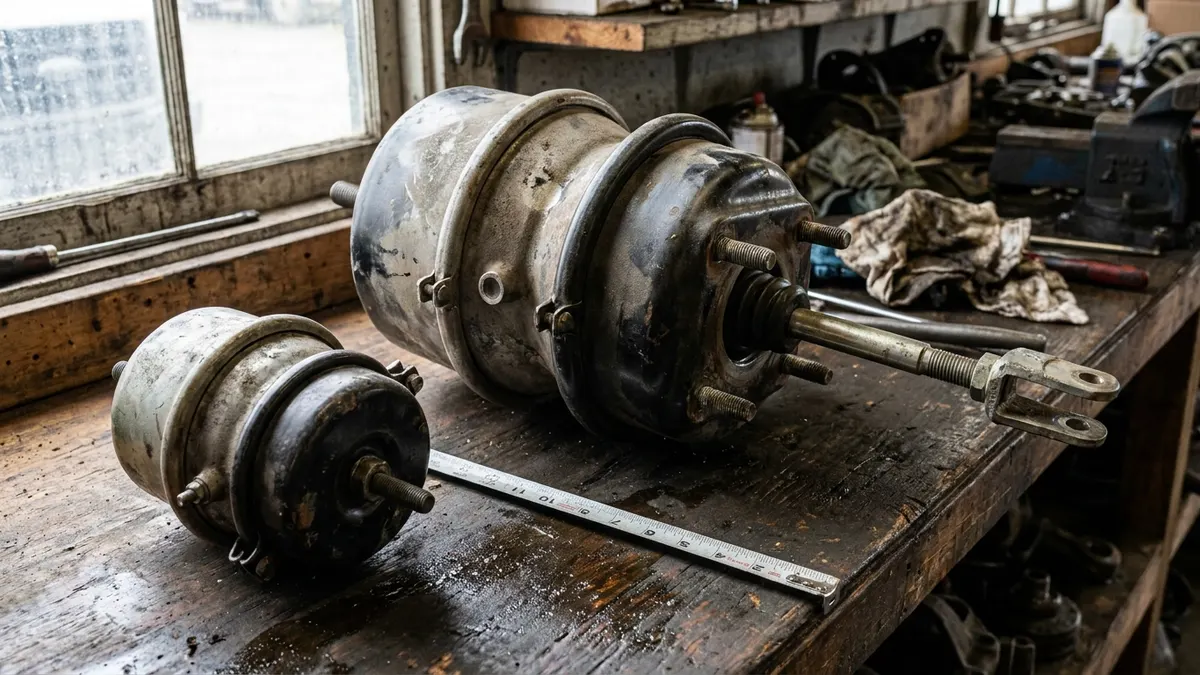
A service brake chamber (pancake) is a single-diaphragm service chamber: air goes in, the pushrod comes out, and that is the whole job. A spring brake chamber (piggyback) is that same service chamber with a second, spring-loaded section bolted to the back of it, adding parking and emergency braking to the same pushrod. On the vehicle the difference is easy to see — a service brake chamber has one air line, a spring brake chamber assembly has two air lines and a release bolt poking out of the rear cover.
Both are pneumatic. Neither one contains fluid, and neither is a hydraulic caliper cylinder. They mount to the same style of bracket, use the same pushrod-and-clevis arrangement, and act on the same slack adjuster or disc brake lever. What changes is what happens when the air is gone.
What a service brake chamber is
A service brake chamber — also called a single chamber or a clamp-type chamber — is a shallow, round can split by a clamp ring. Inside is one rubber diaphragm, a pressure plate, a return spring, and the pushrod. Service air from the foot valve or relay valve enters the single port, pushes the diaphragm, and strokes the pushrod out. Release the treadle, the air exhausts, and the internal return spring pulls the rod back in.
Because there is only one section, a service brake chamber is short, light, and cheap to replace. It is also completely inert with no air in the system: no air, no braking from that chamber at all. That is why service-only chambers are used where a separate parking system covers the vehicle, not as the vehicle's only brake.
What a spring brake chamber is
A spring brake chamber (piggyback) is the spring brake half. In everyday shop talk the word "piggyback" is used two ways, and both are correct depending on context:
- The spring section — the rear housing containing the big coil power spring, sold on its own to bolt onto a good service half.
- The complete combination chamber — service section plus spring section as one assembly, also called a double chamber or spring brake chamber.
The spring section works backwards from the service side. Air pressure in the spring port compresses the power spring and holds the brake off. Pull the park control, or lose supply pressure, and that air exhausts so the spring drives the pushrod out mechanically. In practice the spring brakes begin to drag on and then apply as system pressure falls into roughly the 20-45 psi range — well after the low-air warning has been sounding at about 60 psi. On a healthy system that stays fully charged near 120 psi, with the governor cutting out somewhere around 120-135 psi and cutting back in around 100-110 psi, the spring section simply sits held off all day. More detail on how that circuit behaves is in our guide to the spring brake and parking brake system.
Service vs spring brake chamber at a glance
| Feature | Service brake chamber (pancake) | Spring brake chamber (piggyback) |
|---|---|---|
| Sections | One diaphragm | Service diaphragm plus spring section |
| Air ports | One (service) | Two (service and spring/park) |
| Function | Service braking only | Service, parking and emergency braking |
| With no air in the system | Does nothing | Spring applies the brake mechanically |
| Release bolt | None | Yes, caging bolt in or beside the rear cover |
| Typical designations | Type 12, 16, 20, 24, 30 | 24/24, 30/30, 24/30, 30/36 |
| Length and weight | Short, light | Roughly twice as long, noticeably heavier |
| Common location | Steer axle, some lift and trailer axles | Drive axles, trailer axles |
| Field service | Diaphragm kit or full replacement | Service diaphragm kit; spring section replaced as a unit |
How to tell them apart under the truck
- Count the air lines. One hose is a service brake chamber. Two hoses means a spring section is on the back.
- Look for the release bolt. A caging bolt stored in a clip on the housing or already threaded into the rear cover is a positive spring brake ID.
- Check the length. A combination chamber is roughly double the depth of a service brake chamber of the same diameter.
- Read the tag. A single number (24, 30) is service-only; a pair separated by a slash (30/30) is service area over spring area.
- Watch it work. Charge the system, release the park control, and the pushrod should retract. Pull the yellow knob and a spring chamber strokes out and stays out.
Where each one belongs
Steer axles on most tractors and straight trucks run service brake chambers, usually a Type 20 or 24, because the parking and emergency function is provided at the drive axles and there is limited room behind the steering knuckle. Drive axles and trailer axles carry combination chambers so the vehicle has a mechanical hold when the air is dumped. Some vocational and heavy-haul specs add front spring brakes for extra parking capacity, and buses and coaches vary by chassis.
Do not swap types on your own initiative. Fitting a spring brake chamber where a service brake chamber lived means you need a park air supply to that axle, correct anti-compounding protection so service and spring force are not added together on the same foundation brake, and physical clearance through full steering and suspension travel. Fitting a service brake chamber where a spring brake chamber belongs removes the parking brake from that wheel end and will put the unit out of service at the first inspection.
Ordering the right replacement
Chambers from Bendix, Wabco/ZF, Knorr-Bremse, Haldex, Meritor and MGM share the same basic architecture, so replacement is about matching dimensions rather than brand loyalty. Write down all of the following before you order:
- Type number and, on a combination unit, both numbers (for example 30/30).
- Standard stroke or long stroke — long-stroke units are marked and generally use square or trapezoidal identification, and mixing them changes your adjustment limits.
- Pushrod length and thread, plus whether a clevis and yoke pin are included.
- Port positions and clocking relative to the mounting studs, so the hoses route without strain.
- Mounting stud pattern and bracket style.
- Sealed (non-serviceable) or clamp-band construction, if your fleet standard specifies one.
If you are unsure how the numbers translate into clamping force, our breakdown of brake chamber sizes covers the effective area and stroke relationship. Always replace chambers in axle pairs so both wheel ends develop the same force.
Safety: the spring section is not a repairable part
A compressed power spring stores enough energy to kill. It has no fuse, no bleed-down, and it does not care that the truck has been parked for a week.
Never cut, torch, drill, or pry open a spring housing, and never remove a spring brake chamber from the axle before it is caged. Wind the release bolt in to compress the spring, confirm the pushrod has retracted, then unbolt the unit. The full procedure is in our walkthrough on how to cage a brake chamber. Service diaphragms and clamp kits are fair game on the front half; the spring half gets replaced complete and scrapped intact.
Need the part, not just the answer?
OE-grade air brake compressors and repair kits, manufactured and tested to commercial-vehicle standards.
Shop VADEN partsPublished by VADEN Original. Product links point to the manufacturer’s official catalogue. Specifications are general — always confirm figures against your vehicle’s service manual.