 airbrakecompressor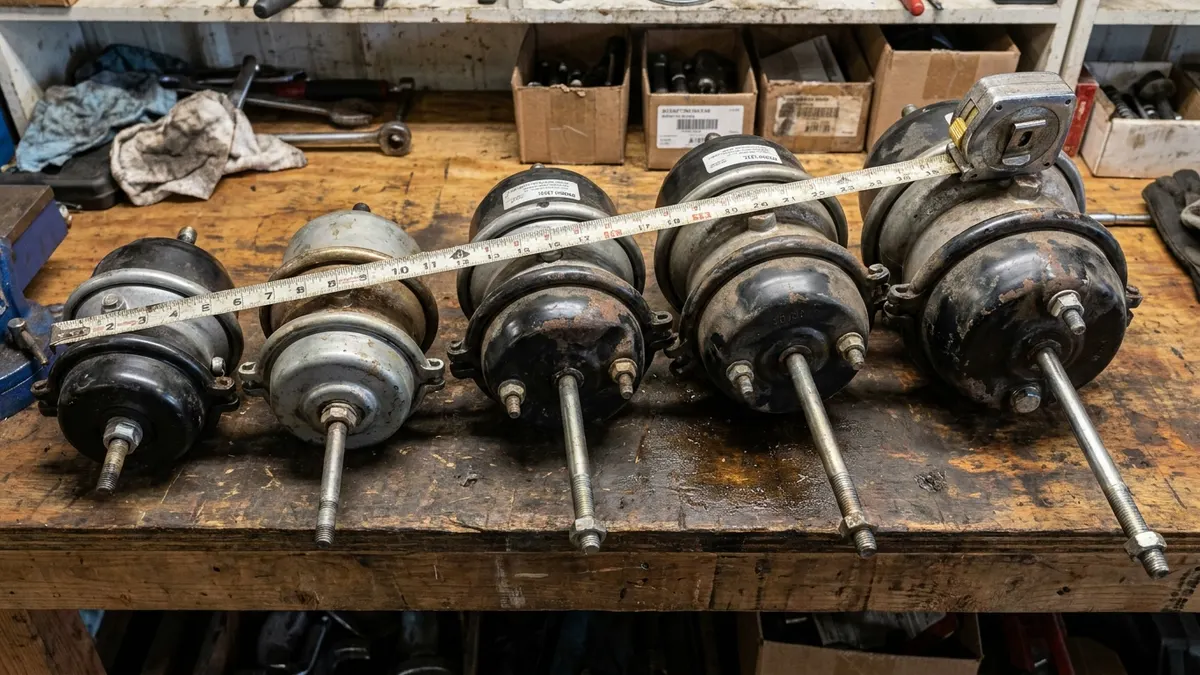
A standard-stroke and a long-stroke brake chamber carrying the same type number produce the same pushrod force at the same air pressure. The difference is travel: a long-stroke chamber gives roughly a half inch more usable stroke before the diaphragm runs out of effective movement, which means more cushion against lining wear, drum growth and slack adjuster drift before the brake is out of adjustment. You identify a long-stroke unit by its square air inlet port boss and its stamped stroke marking, and the two types must never be mixed on the same axle.
What the type number means, and what it does not
The number stamped on a service chamber - Type 12, 16, 20, 24, 30, 36 - is the approximate effective diaphragm area in square inches. Air pressure acting on that diaphragm pushes the pushrod out; the pushrod turns the slack adjuster, which twists the S-cam and forces the shoes into the drum. Because this is a pneumatic system, force is simply pressure times effective area, so a Type 30 at around 100 psi develops on the order of 2,500 to 3,000 lb of pushrod force early in its stroke, and less as the rod extends and the diaphragm rolls off the pressure plate.
What the type number does not tell you is stroke. A standard Type 30 and a long-stroke Type 30 have the same nominal area and the same mounting pattern. They are not interchangeable in service records or inspection criteria, because the maximum stroke and the readjustment limit are different. If you need a refresher on how the sizes are rated and matched to axle loads, see our breakdown of brake chamber sizes.
How to identify a long-stroke chamber
- Square air inlet port boss. Since the mid-1990s, long-stroke chambers built to FMVSS 121 have been identified by a square-shaped air inlet port boss on the service side, while standard-stroke chambers use a round boss. This is the fastest visual check under a truck.
- Marked identification tag. Long-stroke units carry a trapezoidal or square ID tag, or a stamping on the clamp band or non-pressure housing, showing type and rated stroke. Some carry "LS" or the stroke in inches.
- Part number. The most reliable method. Cross-reference the number against the OE catalog - Bendix, Wabco/ZF, Knorr-Bremse, Haldex, Meritor and MGM all publish stroke ratings by part number.
- Vehicle build sheet. On a truck that has never had chambers swapped, the original spec is the answer.
Be careful with rebuilt, repainted or mismatched-clamp chambers. A reman shell can end up with a band or tag from another unit, and a painted-over stamping is easy to misread. If the marking is unreadable, treat the chamber as unknown and replace it rather than guessing which limit applies.
Stroke limits: standard versus long stroke
The figures below follow the long-standing clamp-type chamber chart used by roadside inspectors. Maximum stroke is the mechanical limit of the chamber; the readjustment limit is the stroke at which the brake is considered defective and must be adjusted or repaired.
| Type | Standard max stroke | Standard readjustment limit | Long-stroke max stroke | Long-stroke readjustment limit |
|---|---|---|---|---|
| 12 | 1-3/4 | 1-3/8 | 2-1/2 | 1-3/4 |
| 16 | 2-1/4 | 1-3/4 | 2-1/2 | 2 |
| 20 | 2-1/4 | 1-3/4 | 2-1/2 | 2 |
| 24 | 2-1/4 | 1-3/4 | 2-1/2 | 2 |
| 30 | 2-1/2 | 2 | 3 | 2-1/2 |
| 36 | 3 | 2-1/4 | - | - |
A small number of extra-long-stroke Type 24 chambers rated at 3 in also exist, with their own limit. Always verify against the current out-of-service criteria and the marking on the chamber itself before writing up a truck. Our brake adjustment limits chart covers the full range including bolt-type and rotochamber styles.
Why long stroke buys you adjustment margin
Brake stroke is not a fixed number. As linings wear, the automatic slack adjuster takes up the slack, but it only corrects between applications and it can fall behind if the internal clutch is worn or the adjuster is dry. Heat also matters: a hot drum grows, so the same brake that strokes 1-3/4 in cold can stroke noticeably farther after a long grade. Add a slightly worn cam bushing or a stretched pushrod clevis and the margin evaporates.
The extra half inch of a long-stroke chamber absorbs those variables. It does not make the brake stronger and it is not a substitute for adjustment - it simply means the brake reaches its readjustment limit later in the lining's life. That matters commercially, because a vehicle is placed out of service when 20 percent or more of its service brakes are defective, and a single over-stroking chamber can be the one that pushes a tractor-trailer over that threshold.
The trade-offs
Longer stroke means more air volume consumed per brake application. On a well-maintained system with a healthy compressor cutting out at roughly 120 to 135 psi and cutting back in around 100 to 110 psi, that is not a problem. On a truck with a tired compressor, a restricted discharge line or nuisance leaks, the extra demand shows up as slower recovery, a compressor that runs almost continuously and, in the worst case, a low-air warning near 60 psi during repeated applications.
The second trade-off is force at the far end of stroke. Every diaphragm chamber loses output as the rod extends, because the diaphragm rolls off the pressure plate and the effective area shrinks. A long-stroke chamber holds usable force farther out than a standard unit, but the last portion of any chamber's stroke is weak. Never treat maximum stroke as working stroke.
Never mix types across an axle
Two chambers on the same axle must match in type, stroke rating, pushrod length and clevis setting. A standard chamber on one side and a long-stroke chamber on the other is a defect, not a shortcut.
Mixed chambers behave differently as the linings wear. One side reaches its effective stroke sooner, so applied torque and timing drift apart, and the truck begins to pull under moderate braking while the linings wear at different rates. Inspection is the second problem: the limits differ by side, so a technician who applies one number to both wheel ends will either condemn a good brake or pass a bad one. If you convert an axle to long stroke, convert both wheel ends at once with matching parts and re-check pushrod geometry afterwards.
Measuring stroke correctly
Chock the wheels. Build the system to governor cut-out, shut the engine off, release the parking brakes and let reservoir pressure settle to roughly 90 to 100 psi. With the brakes released, mark the pushrod flush against the chamber face, then have a helper make and hold a full service application while you measure how far the mark travels. Compare that figure against the limit for that chamber's type and stroke rating. Full detail on technique and common measuring errors is in our guide to pushrod stroke measurement.
Replacing chambers
When ordering, match five things: type number, stroke rating, port clocking and orientation, pushrod length, and mounting stud pattern and spacing. On piggyback spring brake units such as a 30/30 or 24/24, the long-stroke rating refers to the service side; the spring side must still be caged before removal. Replace in axle sets, keep the original stroke rating unless you are deliberately upgrading the whole axle, and record the change so the next inspector applies the right limit.
Need the part, not just the answer?
OE-grade air brake compressors and repair kits, manufactured and tested to commercial-vehicle standards.
Shop VADEN partsPublished by VADEN Original. Product links point to the manufacturer’s official catalogue. Specifications are general — always confirm figures against your vehicle’s service manual.