 airbrakecompressor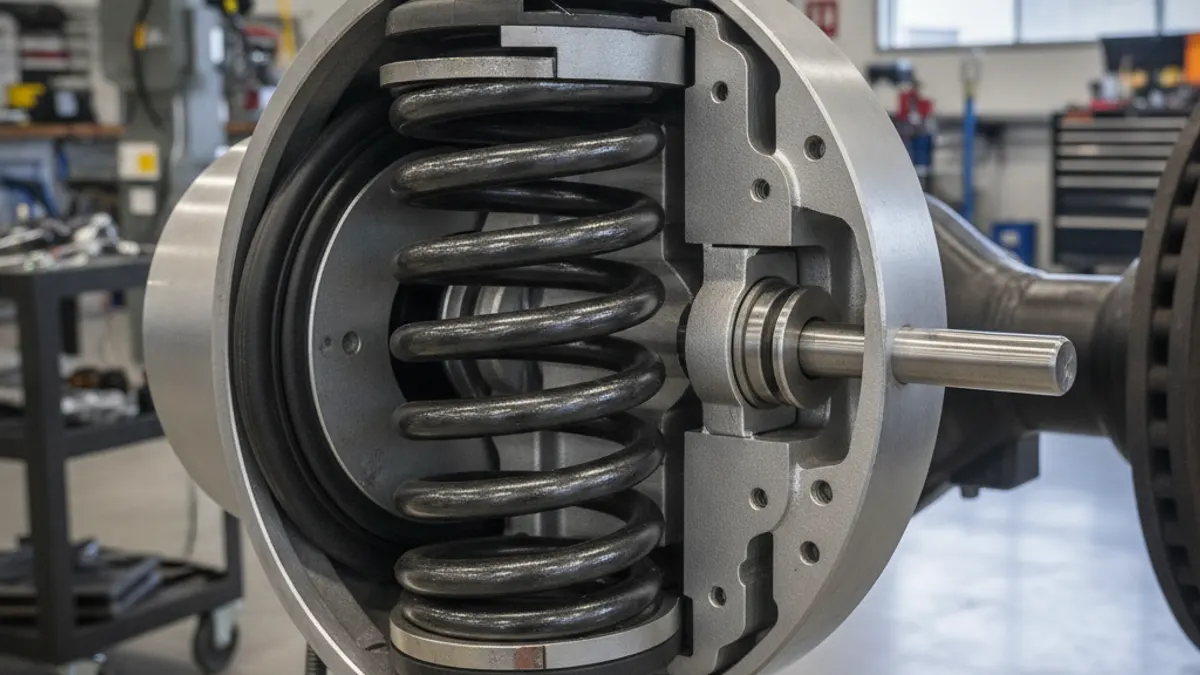
A spring brake is the parking and emergency brake on an air-brake truck, bus, or trailer. Unlike the service brake — which uses air pressure to push the brakes on — a spring brake works in reverse: a large coil spring inside the brake chamber is held compressed (brakes released) by system air pressure. When that air pressure falls into roughly the 20-45 psi range, the spring wins, extends, and mechanically applies the brakes. That inverted logic is what makes the system fail-safe: lose your air, and the vehicle stops and stays stopped.
Because the spring does the work, a spring brake needs no air, no electricity, and no driver input to hold a parked rig on a grade or to bring a truck to a halt if the air system fails catastrophically. Understanding this "held off, applied on" behavior is the key to diagnosing dragging brakes, brakes that won't release, and low-air lockups.
How a spring brake works
On tractor drive axles and most trailer axles you'll find a double-diaphragm (piggyback) brake chamber. It has two sections stacked together:
- Service side (front): This is your normal foot-brake chamber. Air from the treadle valve pushes the diaphragm and rod out to apply the brakes, and releases when you lift off the pedal.
- Spring side (rear): This houses the big power spring. Air held in this chamber keeps the spring compressed so the brakes stay released. Bleed that air off and the spring drives the push rod out, applying the brake through the same slack adjuster and cam.
In normal driving the spring side is kept charged with air, so the parking brakes are held off and you brake with the service side. When you pull the parking brake knob — or when air is lost — the spring side exhausts, the spring extends, and the brakes clamp on.
Think of it this way: on the service brake, air makes the brakes work. On the spring brake, air makes the brakes let go. That reversal is the whole safety story.
Related guides: Air Brake Chamber Size & Output Force Chart
Application point: when does the spring brake apply?
Spring brakes don't switch on and off at a single crisp number — they modulate as air bleeds down. As pressure in the spring chamber falls, the spring gradually gains the upper hand. Somewhere in the 20-45 psi band the spring force fully overcomes the remaining air and the brakes go to full mechanical application. This is well below the ~60 psi low-air warning point, so a properly working system warns the driver long before the spring brakes drag on.
| Pressure (approx.) | What is happening |
|---|---|
| ~120 psi | System fully charged; spring brakes fully released, service brakes ready |
| ~100-135 psi | Normal operating band; governor cycles cut-in/cut-out to keep reservoirs charged |
| ~60 psi | Low-air warning: buzzer and dash light alert the driver |
| ~20-45 psi | Spring brakes begin to apply and reach full mechanical application |
| 0 psi | Spring brakes fully applied and holding by spring force alone |
This layered sequence is why a slow air leak gives you warning, then a controlled automatic stop, rather than a sudden loss of braking.
Parking versus emergency: same spring, two jobs
The spring brake does double duty, and the difference is simply how the air gets released from the spring chamber:
- Parking brake: The driver pulls the yellow diamond-shaped knob on the dash. This intentionally exhausts air from the spring chambers, letting the springs apply so the vehicle stays put with the engine off.
- Emergency brake: If a hose bursts, a fitting fails, or the compressor stops building pressure, air bleeds out of the system on its own. Once it drops far enough, the same springs apply automatically — no driver action needed.
On a tractor-trailer, the tractor protection valve and the trailer supply (red octagon) valve coordinate this so that a trailer breakaway automatically sets the trailer's spring brakes while protecting the tractor's air supply. The control valves that route this air — the park, release, and emergency functions — live in the park / release / emergency valve group, which VADEN builds to OE specification.
Why spring brakes are fail-safe
The core of the design is that the energy to stop the truck is stored mechanically in the spring, not in the air system. Air is only used to hold the brake off. So every failure mode that removes air — a blown line, a dead compressor, a leaking chamber, a broken supply hose — results in the brakes coming on, never off. A vehicle that loses all air can't roll away.
The trade-off is that a spring brake demands respect during service. The power spring stores enough force to cause serious injury or death if the chamber is opened or cut apart. That safety concern shapes every maintenance procedure around these units.
Caging a spring brake
When you need to move a vehicle whose air system is down — or replace a chamber — you "cage" the spring. Every spring brake chamber includes a release (caging) bolt: you insert it into the spring, turn the nut, and mechanically wind the spring back into the compressed position so the brake releases without air.
- Always chock the wheels before caging — you're deliberately removing the parking brake.
- Follow the manufacturer's turn count and torque; over-caging can damage the chamber.
- Never attempt to disassemble a non-serviceable (sealed) spring chamber. Treat the spring as always loaded.
Common spring brake problems
| Symptom | Likely cause |
|---|---|
| Brakes won't release / drag on start-up | Low system air, restricted or leaking spring-chamber line, sticking dash valve |
| Spring brakes apply while driving | Air leak dropping pressure into the ~20-45 psi range; failing governor or compressor |
| Parking brake won't hold on a grade | Weak or broken power spring, out-of-adjustment slack adjuster, worn linings |
| Audible leak at the chamber | Ruptured diaphragm or cracked chamber housing — replace the unit |
Most "won't release" complaints trace back to insufficient air, not the spring itself. Confirm the system is charged to normal operating pressure first, then trace the spring-chamber supply line. If air is bleeding out of the system, the spring brakes are doing exactly what they're designed to do.
Maintenance and inspection
Spring brakes are largely self-contained, but a few checks keep them safe:
- Applied-stroke check: With the parking brakes set and the system charged, measure push-rod travel. Excessive stroke means the brakes are out of adjustment and won't deliver full force.
- Leak-down test: Charge the system, shut down, and watch the gauges. A rapid drop toward the spring-application range points to a leak that could set the brakes unexpectedly.
- Visual inspection: Look for cracked chambers, corroded caging bolts, chafed air lines, and oil contamination — the latter can signal a compressor pushing oil downstream.
- Replace in the applied (parked) position or after caging, never with the spring under uncontrolled load.
Keeping the compressor, governor, and air dryer healthy protects the spring brakes indirectly: clean, dry air at proper pressure is what holds them safely released. Neglect upstream, and you'll eventually find your parking brakes setting themselves at the worst possible moment.
Need the part, not just the answer?
OE-grade air brake compressors and repair kits, manufactured and tested to commercial-vehicle standards.
Shop VADEN partsPublished by VADEN Original. Product links point to the manufacturer’s official catalogue. Specifications are general — always confirm figures against your vehicle’s service manual.