 airbrakecompressor
A water-cooled truck air compressor routes engine coolant through its cylinder head, so compression heat goes into the engine cooling system and the unit can stay loaded for long periods without cooking its oil. An air-cooled compressor has no coolant connections and sheds heat through cast fins into the air around the engine, which suits lower-displacement, lower-demand installations. Cooling type is a fitment attribute like the flange, drive and ports: a replacement must match what the engine application was built with, or it will either run hot or be left without the coolant supply it depends on.
How each design gets rid of heat
Compression heat concentrates in the cylinder head around the discharge valves and discharge port. If that area runs too hot, the oil film reaching the cylinder and head turns to carbon, which fouls the discharge valves, narrows the discharge line and eventually pushes oil toward the air dryer.
Water-cooled (coolant-fed) compressors
A coolant jacket cast into the head surrounds the hottest passages. Coolant arrives through a supply line and leaves through a return line tied into the engine cooling circuit, or on some designs passes through ports in the mounting flange with no external lines. Because the head is linked to the engine's thermostat and radiator, its temperature stays in a narrower band whether the truck is pulling a grade or idling on a job site. On many designs only the head is coolant-fed, and the cylinder block below it may still carry fins.
Air-cooled (finned) compressors
An air-cooled unit carries deep cast fins on the head and cylinder block and depends on fan airflow, road speed and unloaded time to carry heat away. That works when the compressor spends most of its life unloaded on a lightly equipped vehicle with a tight air system. It works far less well in stationary work running air-operated equipment, in high ambient temperatures, and in engine bays crowded with turbocharger and exhaust heat. Oil film and road grime packed between the fins insulate the casting and make all of that worse.
Air-cooled vs water-cooled at a glance
| Attribute | Air-cooled | Water-cooled |
|---|---|---|
| Extra connections | None | Coolant supply and return lines, or coolant ports in the flange |
| Typical application | Lower displacement, low air demand, older or lighter-duty installations | Most current heavy trucks, buses and vocational chassis |
| Long loaded periods | Limited margin; sensitive to ambient heat and airflow | More margin; head temperature held by the cooling system |
| Design-specific failure | Overheating and oil coking under sustained load | Coolant entering the air system through the head gasket or a cracked head |
| Replacement labour | Lower; nothing to drain | Higher; drain, reseal and bleed the coolant circuit |
Duty cycle: where the difference shows
Duty cycle is the share of engine running time the compressor spends loaded. The governor loads it at cut-in, typically around 100-110 psi, and unloads it at cut-out, typically 120-135 psi, so a healthy system sits near 120 psi when fully charged. Commonly cited OE guidance keeps loaded time to roughly a quarter of running time or less for both designs, and cooling type does not change any of these pressures.
What changes is margin. When air suspension, PTO and shift cylinders, bus doors or body controls push loaded time past that guideline, a coolant-fed head still has somewhere to send the extra heat. An air-cooled head does not: discharge temperature climbs through the shift, oil cokes on the discharge valves, and carryover shows up at the dryer purge and in the wet tank. That is largely why transit buses and refuse trucks are normally built with coolant-fed compressors.
Before blaming the cooling design, measure demand and chase leaks with our guide to compressor duty cycle and accessory air demand. A leaking system can keep a compressor loaded for hours without the low-air warning, set near 60 psi, ever coming on.
Plumbing and service differences
Coolant-fed installations
- Routing. The OE circuit draws coolant from a higher-pressure point and returns it to a lower-pressure point, so flow is driven whenever the water pump turns. Moving a line to a convenient fitting, or teeing into a heater hose downstream of the heater control valve, can stall that flow.
- Trapped air. A compressor mounted high on the engine can hold an air pocket after a coolant drain. Bleed the circuit and confirm both lines warm up with the engine.
- Hoses and seals. Use lines rated for engine coolant temperature and pressure, renew sealing washers or O-rings at banjo and flange joints, and pressure test the cooling system afterwards.
- Coolant condition. Depleted inhibitor lets head passages and gasket faces corrode, which is where many internal leaks begin. A failed head gasket or cracked casting then drives coolant into the air system; see air compressor leaking coolant for diagnosis and cleanup.
Air-cooled installations
There is nothing to drain or bleed, but the compressor depends on its surroundings. Degrease the fins and blow them out with low-pressure air, fix engine oil leaks that coat the casting, and keep added shields, wiring looms and relocated components out of the airflow. Both designs still rely on the discharge line to shed heat before the dryer, so keep its OE length, diameter and material.
How to tell which one your truck has
- Trace the lines at the head. A coolant supply and return mean a coolant-fed head. Do not mistake the oil feed, governor signal, inlet or discharge line for coolant.
- Look at the head casting. Deep fins across the head and no coolant ports indicate air cooling. Fins on the cylinder block alone do not.
- Check the mounting flange. Flange-fed designs carry coolant ports in the flange face, so a head with no external lines can still be water-cooled.
- Read the tag. Air-cooled and coolant-fed versions of one family can share a crankcase casting yet carry OE numbers only a few characters apart. Record the full number before the old unit goes back as a core.
Will a cross-referenced unit fit?
A cross-reference that matches displacement, flange and drive can still be the wrong cooling variant. Start with this table, then run the full check in how to verify air compressor fitment before buying.
| Coming off | Going on | What to expect |
|---|---|---|
| Water-cooled | Water-cooled, same OE number or a listed cross-reference | Fits once flange, drive, ports and displacement also match |
| Water-cooled | Air-cooled, similar displacement | Runs hotter than the application allows: oil coking, discharge line carbon, early carryover |
| Air-cooled | Water-cooled | Only if the compressor maker lists it for that engine and OE-routed coolant lines can be fitted |
| External coolant lines | Flange-fed coolant, or the reverse | Not a direct swap; flange and engine mounting face must match passage for passage |
Two mistakes send trucks back to the shop: running a coolant-fed compressor with its ports capped or open because the truck had no lines for them, and fitting an air-cooled unit because it was on the shelf and the flange matched. The first overheats under load; the second can run acceptably for a while before carbon and oil show up at the dryer. When you compare cross-referenced OE-grade air brake compressors, match the cooling variant to the OE number and engine application, not just the displacement.
Which one is better?
For a modern heavy truck, bus or vocational chassis with real air demand, water cooling is the stronger design because it holds head temperature through long loaded periods and hot weather. Air cooling earns its place where demand is low, with no coolant circuit to maintain and no path for coolant into the air system. In practice, the right choice is the design your engine was built with, sized to the air it actually uses.
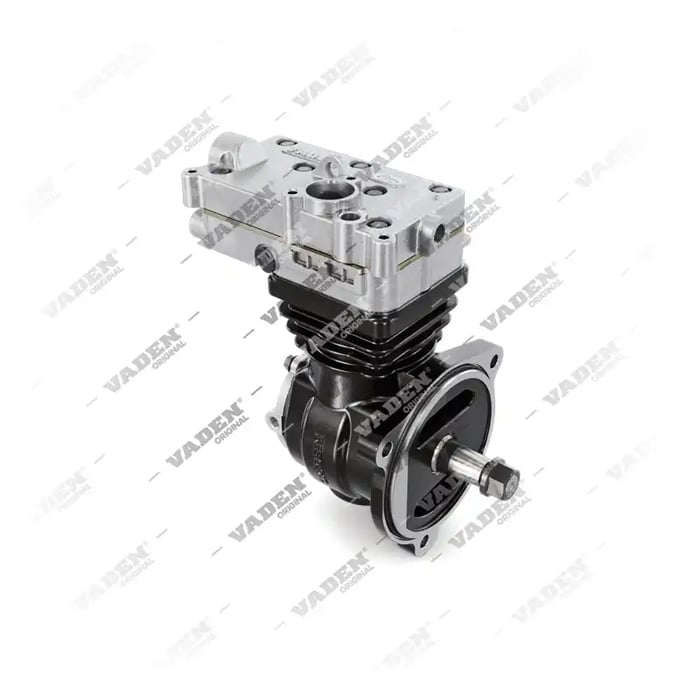
Need the part, not just the answer?
OE-grade air brake compressors and repair kits, manufactured and tested to commercial-vehicle standards.
Shop VADEN partsPublished by VADEN Original. Product links point to the manufacturer’s official catalogue. Specifications are general — always confirm figures against your vehicle’s service manual.