 airbrakecompressor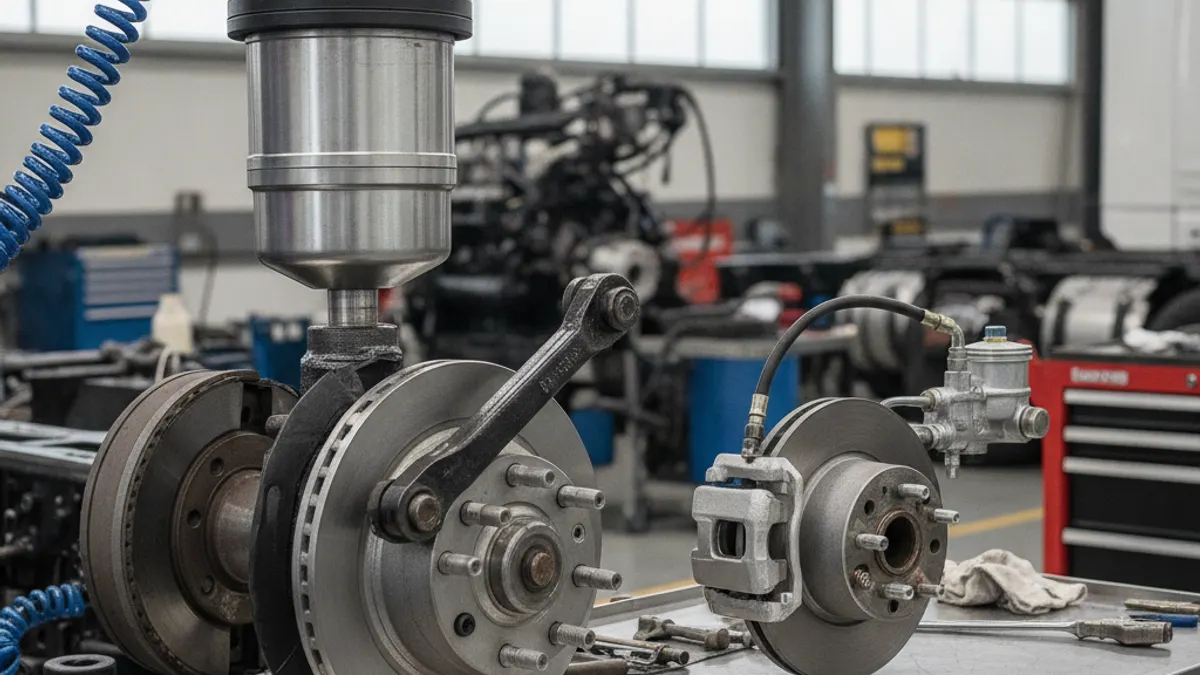
The core difference is the working medium and how each system fails. Hydraulic brakes transmit your foot pressure through incompressible fluid straight to the wheel cylinders or calipers: press the pedal, fluid moves, brakes clamp. Air brakes are pneumatic. An engine-driven compressor builds a reserve of compressed air in tanks, and the brake pedal (a foot valve) simply meters how much of that stored air reaches the brake chambers. The biggest practical distinction is that air brakes are fail-safe: when air pressure is lost, powerful springs apply the brakes and stop the vehicle. Lose fluid in a hydraulic system and you can end up with a pedal on the floor and nothing happening.
That single design choice is why every loaded semi, transit bus, and highway trailer runs air, while your pickup and car run hydraulics.
How each system moves force to the wheels
Hydraulic brakes rely on a closed, fluid-filled circuit. The pedal pushes a master cylinder piston, and because brake fluid does not compress, that pressure appears almost instantly at every caliper. A vacuum or hydraulic booster multiplies your leg effort so a driver can generate enough clamping force with light pedal pressure. It is simple, light, fast, and self-contained.
Air brakes work the other way around: the force is already stored, and the driver only controls the valve. A belt- or gear-driven air brake compressor keeps the reservoirs charged to roughly 120 psi. When you press the treadle valve, air flows through relay valves to the brake chambers, where a diaphragm pushes a pushrod, rotates a slack adjuster, and twists an S-cam that spreads the shoes against the drum. Because the air supply is generated continuously and stored, an air system can produce enormous, repeatable clamping force without asking anything extra of the driver's leg. For the full chain of components, see how air brake systems work.
Side-by-side comparison
| Characteristic | Air Brakes | Hydraulic Brakes |
|---|---|---|
| Working medium | Compressed air (~120 psi charged) | Incompressible brake fluid |
| Force source | Engine-driven compressor + stored tanks | Driver's foot + power booster |
| Failure behavior | Fail-safe: spring brakes apply on air loss (~20-45 psi) | Fluid loss can mean no braking |
| Response speed | Slight lag; air must travel and build | Nearly instant |
| Typical vehicles | Heavy trucks, buses, trailers | Cars, light trucks, motorcycles |
| Trailer coupling | Easy via gladhands and air lines | Difficult to extend safely |
| Maintenance quirks | Daily tank draining, air dryer service | Fluid flush, moisture absorption |
| Weight and complexity | Heavier: compressor, tanks, valves, dryer | Lighter, fewer parts |
Why heavy vehicles use air
Several factors push commercial vehicles to air over fluid:
- Fail-safe parking and emergency braking. Spring brakes are held off by air pressure. If a line ruptures or the system bleeds down, the springs apply automatically. A 40-ton rig cannot rely on a fluid circuit that goes dead on a single leak.
- Unlimited supply. The compressor constantly refills the tanks, so long descents and repeated hard stops do not run out of braking medium the way a fluid system's fixed volume can fade or boil.
- Easy trailer coupling. Air couples between tractor and trailer through gladhands and air lines that connect and disconnect in seconds. Running rigid hydraulic lines to a swappable trailer would be impractical and dangerous.
- Massive, consistent clamping force. Stored air pressure acting on large chamber diaphragms produces the force needed to stop fully loaded axles, without demanding brute leg strength from the driver.
- Redundancy. Trucks run a dual air brake system with separate primary and secondary circuits, so a failure in one still leaves usable braking on the other.
Why cars stay hydraulic
Light vehicles simply do not need all that. The loads are small enough that fluid pressure plus a vacuum booster produces plenty of stopping force, and hydraulic systems are lighter, cheaper, and respond instantly with no lag. There is no trailer to couple, no need for a continuously running compressor, and a modern dual-circuit hydraulic master cylinder gives adequate front/rear redundancy for the mass involved. Adding a compressor, tanks, dryer, and a web of valves to a sedan would add weight and complexity for no real benefit.
A middle ground exists: air-over-hydraulic brakes use air pressure to actuate a hydraulic master cylinder, common on medium-duty trucks that want air-style control with hydraulic wheel ends.
Trade-offs to keep in mind
Air brakes are not free of downsides. They react a fraction of a second slower because air has to travel through lines and valves before pressure builds at the chamber, which is why brake lag and stopping-distance math matter on the CDL exam. The vehicle also will not release its parking brakes until the system charges to roughly 120 psi, so you wait after startup. And because compressed air always carries moisture, water collects in the tanks and must be purged. That is why crews drain the tanks and why an air dryer is fitted to strip moisture before it reaches the reservoirs. Skip it and you invite corrosion, valve freeze-up, and winter lockups.
Hydraulic systems have their own weakness: fluid absorbs water over time, lowering its boiling point and risking brake fade under sustained heat. But for the duty cycle of a passenger car, that is easily managed with periodic fluid flushes.
Rule of thumb: if the vehicle is heavy enough to need a CDL, it almost certainly runs air brakes, precisely because a heavy vehicle cannot afford to lose all braking from one leak.
Understanding which system you are working on changes everything about diagnosis. On an air system, low pressure, slow build, or a warning buzzer points you toward the compressor, governor, or a leak: start with air brake system losing pressure. On hydraulics you are chasing fluid, seals, and boosters. Same job, stopping the vehicle, with completely different plumbing behind it.
That different plumbing needs different parts: once a fault is placed firmly on the air side, the valves, chambers and fittings that make up the circuit sit under air brake system components.
Need the part, not just the answer?
OE-grade air brake compressors and repair kits, manufactured and tested to commercial-vehicle standards.
Shop VADEN partsPublished by VADEN Original. Product links point to the manufacturer’s official catalogue. Specifications are general — always confirm figures against your vehicle’s service manual.