 airbrakecompressor
A knocking noise from an air brake compressor is almost always mechanical wear inside the compressor itself: connecting rod and crankshaft bearing clearance, a worn wrist pin or scored bore, or a loose, chipped drive gear. That is a different sound from the normal load-cycle noise every compressor makes while it charges the system. A light rhythmic tap and the hiss you hear when the governor reaches cut-out are routine; a deep metallic knock that rises and falls with engine rpm and gets louder while the unit is pumping is not, and once it is traced to the compressor the unit should come off for inspection.
Normal compressor noise you can ignore
Air brake compressors are pneumatic pumps driven off the engine, so they are never silent. Before chasing a fault, rule out these normal sounds:
- A light, even tapping in time with engine speed. Reed or disc valves seating on every stroke. It is present on healthy units and does not change character under load.
- A sharp pop or hiss at the top of the charge cycle. When system pressure reaches cut-out, typically 120-135 psi, the governor unloads the compressor and the air dryer purges. This is loud on some trucks and completely normal.
- A rise in working noise between cut-in and cut-out. The compressor loads when pressure falls to cut-in, roughly 100-110 psi, and pumps back up to a fully charged system around 120 psi. It genuinely works harder there and sounds like it.
- Belt squeal or a whine that changes when you touch the throttle only. That points at the belt, tensioner or an accessory, not the compressor internals.
What a real knock sounds like
A failure knock is deeper and heavier, metallic rather than tinny, and it keeps time with compressor speed rather than the exhaust note. Three characteristics separate it from normal noise: it is loudest while the compressor is loaded and building air, it often softens noticeably the moment the governor unloads at cut-out, and it does not go away when the engine warms up. A knock that appears only on the first minute of a cold start and then disappears usually points at piston-to-bore clearance or carbon, while a knock that is constant and load-sensitive points at the bottom end.
Common causes of an air compressor knocking noise
Connecting rod and main bearing wear
The most common cause on a high-hour unit. Bearing clearance opens up from age, contaminated oil, or oil starvation, and the rod hammers on each compression stroke. This is the knock that gets worse under load and is the one that ends careers for compressors, because the debris does not stay inside the compressor on engine-lubricated designs.
Worn wrist pin, piston or cylinder bore
A slapping or double knock, often worst cold. Scored bores and worn rings also let oil past into the discharge side, so a knock combined with oil showing up downstream is a strong signal the unit is worn out. If you are seeing oil at the dryer or in the wet tank as well, read our page on a compressor pumping oil before deciding on parts.
Loose or damaged drive gear, coupling or pulley
Gear-driven compressors knock when backlash opens up, a gear retaining nut loosens, or a tooth is chipped. Belt- or coupling-driven units knock when the hub is loose on the shaft. This one is important to identify because it can be an easy fix or, if ignored, a very expensive one when the gear train is damaged.
Loose mounting, cracked bracket, or a contacting line
A compressor that can move on its bracket produces a hammering that sounds exactly like an internal knock. So does a discharge line resting against a frame rail or bracket. Always check mounting bolt torque and line clearance before pulling the unit.
Carbon buildup and discharge restriction
Heavy carbon in the head and discharge line raises working pressure inside the compressor and can produce a harsh hammering under load, along with high head temperature. It is usually accompanied by a system that is slow to build and a discharge line that is coked at the fitting.
Oil supply problems
Low engine oil pressure, a restricted feed line, or a blocked return will starve the bearings and create a knock that comes on within minutes of a cold start. Fixing the noise means fixing the oil supply, not just replacing the compressor.
Quick diagnosis table
| What you hear | When | Likely cause | Next step |
|---|---|---|---|
| Light even tap, unchanged under load | Always | Normal valve operation | No action |
| Deep metallic knock, louder while building air | Loaded cycle | Rod or main bearing wear | Remove and inspect; plan replacement |
| Slap or double knock, fades when warm | Cold start | Piston, wrist pin or bore wear | Inspect bore and rings |
| Rattle or clatter that follows engine speed at idle | Idle, any load state | Drive gear backlash or loose hub | Check gear, retaining nut, coupling |
| Hammering that changes when you push on the unit | Any | Loose mounting or contacting line | Torque bolts, reroute or clamp line |
| Harsh knock with hot head and slow build | Loaded cycle | Carbon or discharge restriction | Inspect discharge line and head |
Isolating the noise safely
- Chock the wheels and set the parking brakes. Work from a stable position clear of belts, fans and the exhaust.
- With the engine idling, use a mechanic's stethoscope or a long screwdriver on the compressor crankcase, then on the head, then on the drive housing. Compare each with a known-good point on the engine block.
- Note whether the knock changes when the governor unloads the compressor at cut-out. A knock that quiets when unloaded is load-related and points at the bottom end or valves.
- Shut the engine down and check mounting bolt torque, bracket condition, drive gear or coupling play, and discharge line clearance.
- Drain the reservoirs and bleed system pressure before disconnecting any air line. Never crack a fitting on a charged system.
- Pull an oil sample or cut the filter. Glitter or bearing material in the oil confirms the compressor is shedding metal.
Any component you open must be fully depressurized first. A charged air brake system holds enough stored energy to injure, and lines can whip when a fitting lets go.
How urgent is it?
A confirmed internal knock is not something to run out. On engine-lubricated compressors the bearings share the engine's oil, so a failing rod bearing contaminates the whole engine. A seized compressor on a gear drive can damage the accessory gear train. And if the compressor stops pumping on the road, system pressure falls until the low-air warning activates around 60 psi and, if it keeps dropping, the spring brakes apply on their own somewhere in the 20-45 psi range. Plan the repair rather than letting it choose the moment.
Rebuild or replace?
Standard repair kits address valves, valve seats, the unloader assembly, gaskets and sometimes rings. They do not correct crankshaft, rod bearing or bore damage, which is exactly what a knock indicates. Practical rule: if the noise is a knock, the bottom end is the problem and a valve kit will not touch it. Rebuilding is reasonable when the crank and bore measure within spec and the unit is a known-good casting; replacement is the better call on a high-hour compressor that has already been apart once, on any unit that has put metal into the oil, or where downtime cost outweighs the parts saving. Our page on rebuild versus replace covers the cost side in detail.
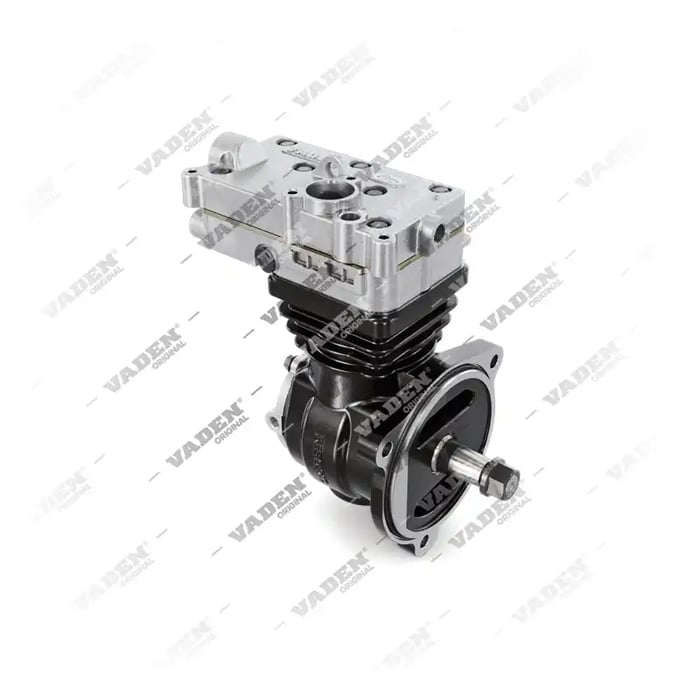
When you do replace, match the unit by OE number and by the engine and mounting configuration, not by displacement alone. Cross-referencing against the original Bendix, Wabco, Knorr-Bremse or truck OEM part number is the reliable route, and OE-grade replacements such as VADEN's air brake compressor range list those references directly. Confirm drive type, port positions, cylinder count, and the unloader and coolant arrangement before ordering.
Preventing the next one
Most compressor bottom ends die from contamination, heat and excessive duty cycle rather than mileage. Drain the reservoirs on schedule, replace the air dryer cartridge at the recommended interval, keep the intake air filter clean, and fix air leaks promptly so the compressor is not loaded most of the time. Hold engine oil change intervals, and re-torque compressor mounting hardware after any removal. A compressor that cycles normally between cut-in and cut-out, with a dry system behind it, will outlast one that runs almost constantly to feed a leaking trailer line.
Need the part, not just the answer?
OE-grade air brake compressors and repair kits, manufactured and tested to commercial-vehicle standards.
Shop VADEN partsPublished by VADEN Original. Product links point to the manufacturer’s official catalogue. Specifications are general — always confirm figures against your vehicle’s service manual.