 airbrakecompressor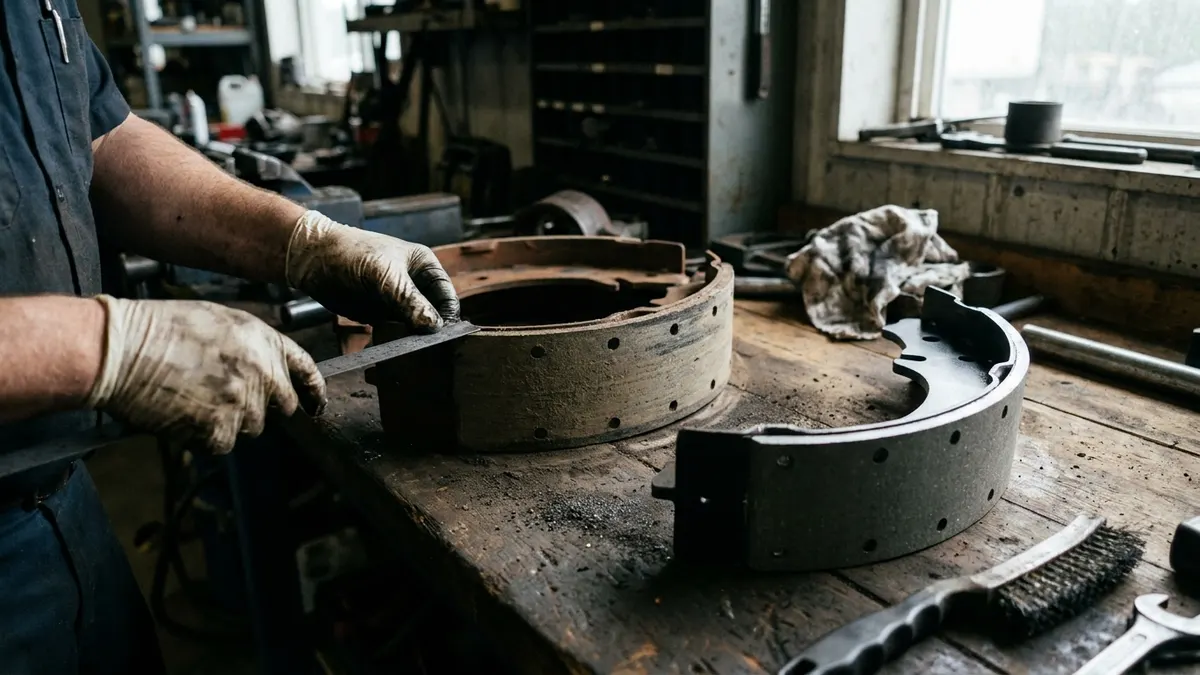
Semi-truck brakes squeal because the friction material and the drum or rotor are vibrating against each other at high frequency instead of gripping smoothly. On an air-braked truck the usual causes are glazed linings, linings worn near their limit, a scored or heat-checked drum, oil or grease contamination from a leaking wheel seal, or a brake that is dragging because it is out of adjustment or mechanically binding. Squeal on its own is not always a failure, but the same conditions that make noise also cost stopping power, so it is worth tracing.
Squeal is a vibration, not a diagnosis
Friction material does not slide silently. Under load the lining grabs and releases the drum surface thousands of times a second, and when that stick-slip cycle lands in the audible range and the shoe, drum or hardware can resonate with it, you hear squeal. That is why the same shoe kit can be quiet on the drives and scream on the steers, and why noise comes and goes with load, temperature and humidity. The useful question is not "what is squealing" but "what changed the friction surface, or what is now free to vibrate."
What makes semi-truck brakes squeal
Glazed linings
Glazing is the number one cause on highway tractors. Long, light applications - riding the brakes down a grade, holding back an empty trailer, or dragging a brake that is slightly out of adjustment - cook the resin binder at the lining surface until it turns hard and glassy. A glazed lining looks polished instead of dull and slightly grainy. It squeals, it fades early when hot, and it will not bed itself back in. Using the engine brake or a retarder to hold speed on grades, and saving the service brakes for actually slowing down, prevents most of it.
Worn linings and exposed rivets
As linings thin, the shoe table sits closer to the drum and the assembly is easier to excite. Once you reach the rivet heads the noise usually turns from squeal to scrape or grind and the drum starts taking damage. Measure at the thinnest point, not the middle of the shoe, and replace against the manufacturer's minimum and current out-of-service criteria - for air drum brakes that is commonly around 1/4 in of remaining friction material, and far less for air disc pads. Anything near the limit gets replaced in axle sets, never one wheel.
Drum and rotor condition
A drum that is heat-checked, scored, bell-mouthed, out of round or full of hard spots will make brand new linings squeal within a few hundred miles. Most drums carry a maximum diameter cast or stamped into them, commonly 0.120 in over nominal, and a drum past that figure is scrap rather than a candidate for a light cut. On air disc brakes, look for a glazed rotor face, uneven pad wear, and missing or weak pad retainer springs that let the pad backing plate chatter in the carrier.
Oil, grease or coolant on the friction surface
A weeping wheel seal, an over-greased S-cam bushing, or grease pushed straight past a slack adjuster seal puts lubricant where it does not belong. Contaminated linings squeal, grab unevenly and pull the truck to one side.
Contaminated linings cannot be washed, burned off or sanded back to life. Repair the leak first, then replace the friction material on both wheel ends of that axle.
A brake that is dragging
Air brakes are pneumatic, so nothing traps pressure the way a hydraulic caliper can. A dragging brake almost always means air is not being exhausted or something mechanical is binding: a seized S-cam bushing, a broken or tired shoe return spring, a corroded slack adjuster, a kinked hose, or a relay valve slow to release. A spring brake that never fully releases does the same thing, since the parking springs begin applying as pressure in the park circuit falls into the 20-45 psi range, and a failed service diaphragm or a partly caged chamber can leave a brake half-applied. Chase this one immediately - a dragging brake overheats, glazes its lining, cracks the drum and can start a wheel-end fire. Start with brakes that are not releasing properly.
Loose hardware and worn foundation parts
Worn cam bushings, sloppy anchor pins, worn rollers, weak return springs and mismatched lining kits all let parts move a few thousandths they should not. That movement is what turns ordinary friction into audible squeal, and it is why a shoe swap on tired foundation hardware often goes quiet for a week and then starts up again.
Telling noise from a real fault
| What you hear | When | Likely cause | Action |
|---|---|---|---|
| Sharp squeal on light braking, quiet under hard braking | Low speed, gentle stops | Glazed lining or glazed drum surface | Inspect friction surface, deglaze or replace, change braking habits |
| Constant squeal while rolling, pedal released | All the time, worse as the wheel end heats | Dragging brake | Measure pushrod stroke, compare wheel-end temperatures, repair before the next trip |
| Squeal turning to scrape or grind | Every application | Linings at or past the rivets, scored drum | Park it; replace shoes and drums in axle sets |
| Squeal with a pull to one side or a hot, smelly wheel | Braking and coasting | Wheel seal or grease contamination | Replace seal, replace linings both sides of the axle |
| Light squeal on a damp morning, gone after a few stops | First applications of the day | Surface rust or moisture film | Normal, no action |
| Squeal for the first few hundred miles after a brake job | After new shoes or pads | Burnish-in | Normal; re-inspect and recheck stroke if it persists |
| Hiss or whoosh at the pedal | Every release | Foot valve exhausting | Normal - see air noise at the brake pedal |
Normal air-system sounds you should not chase
Air brakes make plenty of noise unrelated to friction. The treadle valve exhausts on release, the air dryer purges with a sharp pop when the governor cuts out - typically somewhere between 120 and 135 psi - and the compressor loads again at cut-in, usually around 100 to 110 psi, with a fully charged system sitting near 120 psi. The low-air warning light and buzzer come on around 60 psi and always mean a real problem; a purge pop does not. Knowing which sounds belong to the pneumatics keeps you from pulling wheels to fix a valve.
Finding it in the shop
- Road test, then park level, chock, and shoot wheel-end temperatures. A wheel noticeably hotter than the same position on the opposite side is dragging.
- With the system fully charged, make a full application and measure pushrod stroke at each chamber. Anything at or beyond the readjustment limit for that chamber size is a fault, and an automatic slack adjuster that will not hold adjustment gets replaced, not cranked by hand.
- Inspect the friction surface through the port or with the drum off: shiny glaze, cracks, oil staining, rivets standing proud.
- Check drum diameter against the discard dimension and look for heat checking and hard spots.
- Spin each wheel free and feel for roughness, cam bind or bearing noise.
- Check springs, anchor pins, rollers, cam bushings, and pad retainers on air disc wheel ends.
Fixing it so it stays fixed
Light glazing on otherwise healthy friction material can sometimes be scuffed and re-bedded, but treat that as a stopgap. If the lining is heat-damaged, cracked, oil-soaked or near its wear limit, replace it in axle sets with matched friction material - mixing formulations left to right is a classic source of noise, pull and uneven wear. Match the friction rating to the duty cycle rather than buying on price, and fit fresh heavy-duty brake linings together with new springs, rollers and cam bushings, on drums that are within spec or new. Then set adjustment, road test, and recheck stroke after a short shakedown. If you are choosing between lining types, start with truck brake shoes and linings.
When to park it
Squeal by itself will not earn an out-of-service sticker, but the condition behind it often will. Metal-to-metal contact, a burning smell, smoke or a wheel too hot to stand near, visible oil on a lining, a brake that will not release, or stroke past the readjustment limit all mean the truck stops there and gets repaired before it moves again.
Need the part, not just the answer?
OE-grade air brake compressors and repair kits, manufactured and tested to commercial-vehicle standards.
Shop VADEN partsPublished by VADEN Original. Product links point to the manufacturer’s official catalogue. Specifications are general — always confirm figures against your vehicle’s service manual.