 airbrakecompressor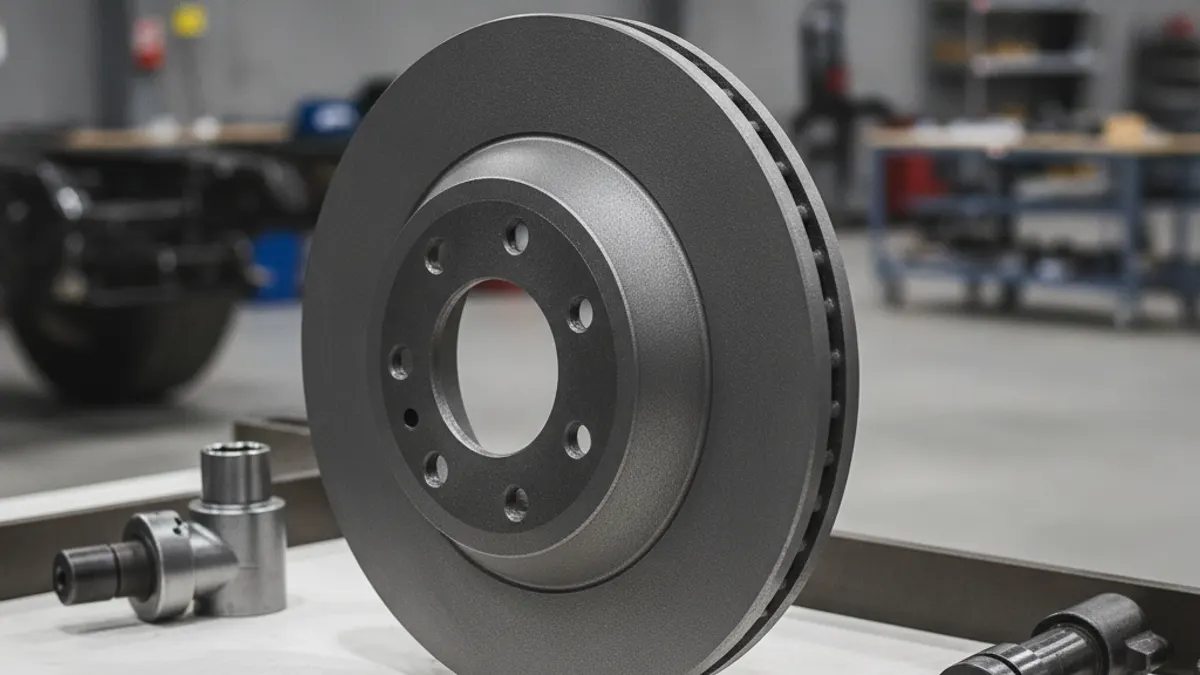
On heavy commercial vehicles a brake drum is called out as diameter x friction-surface width. For most Class 8 tractors and trailers that means two sizes: 16.5 x 7 in on steer axles and many trailer axles, and 16.5 x 8-5/8 in on drive axles and heavier trailer axles. Medium-duty trucks and older or lighter trailer axles use smaller drums such as 15 x 4 in, 16.5 x 5 in or 12.25 x 7.5 in. The width has to match the shoe exactly; get it wrong and nothing else about the job matters, because the lining will not sit correctly on the friction surface.
These are air-actuated S-cam foundation brakes, not hydraulic ones. The air system supplies force at the chamber; drum size decides how much friction area absorbs it and how much heat the wheel-end can shed.
Common heavy-truck drum sizes and where they are used
Weights vary between standard cast and lightweight castings, so treat them as a sanity check when a box turns up, not as a spec.
| Size (dia. x width) | Typical application | Typical wheel | Approx. weight |
|---|---|---|---|
| 16.5 x 8-5/8 in | Class 8 drive axles, heavy and multi-axle trailers, dump and vocational rear axles | 22.5 / 24.5 in | about 120-140 lb (55-64 kg) |
| 16.5 x 7 in | Class 8 steer axles, most standard van and reefer trailer axles | 22.5 / 24.5 in | about 95-115 lb (43-52 kg) |
| 16.5 x 6 in | Lighter Class 7 rear axles, some older trailer axles | 19.5 / 22.5 in | about 85-100 lb (39-45 kg) |
| 16.5 x 5 in | Medium-duty front axles, light trailer and converter dolly axles | 19.5 / 22.5 in | about 70-85 lb (32-39 kg) |
| 15 x 4 in | Medium-duty steer axles, older single-axle trailers, some bus front axles | 19.5 / 22.5 in | about 55-70 lb (25-32 kg) |
| 12.25 x 7.5 in | Class 6-7 medium-duty rear axles | 19.5 in | about 75-90 lb (34-41 kg) |
Two practical notes. First, 16.5 is nominal: a new drum measures very close to 16.500 in across the friction surface, and anything above that is wear or a rebore. Second, tractor and trailer are often mismatched in the same combination, so a tractor on 16.5 x 8-5/8 drive drums can be pulling a trailer on 16.5 x 7. Confirm the axle you are standing under, not the one on the invoice.
Bolt patterns and how the drum locates
On Class 7-8 axles the bolt pattern is consistent: 10 holes on a 285.75 mm (11.25 in) bolt circle. What changes is how the assembly centers itself.
- Hub-piloted, the modern standard: wheel and drum center on a machined register on the hub, held by M22 studs and single flange nuts. The drum has a matching pilot bore.
- Stud-piloted, the older Budd-style arrangement: the wheel centers on tapered inner and outer cap nuts riding on 3/4 in studs. The bolt circle is the same, but the drum's stud holes and register are not.
Medium-duty axles vary more, with 8 or 10 holes on smaller circles both common, so measure rather than assume. To find a bolt circle without a gauge, measure center-to-center between two adjacent holes and multiply: x 3.236 for 10 holes, x 2.613 for 8 holes; for 6 holes, measure directly across two opposite holes instead. Then check the pilot bore and the stud hole diameter, because a drum with the right size and bolt circle can still be wrong for a hub-piloted hub.
Balance weights and why they matter
Heavy-truck drums are cast iron, and no casting comes out perfectly balanced. Quality drums are spin-balanced at the factory and corrected with small steel weights welded to the outer band, with residual imbalance held to a stated ounce-inch figure. Unbalanced drums are also sold; they are cheaper and are expected to be corrected at the wheel-end with the tire assembly.
What that means on the shop floor:
- Never grind, cut or knock off a balance weight to clear a bracket or shield. A drum that has lost its weight will vibrate at road speed and can produce a shudder under light brake application.
- Fit balanced and unbalanced drums in matched pairs across an axle. Mixing them is a common cause of a vibration complaint nobody can pin down.
- Heavy rust scale or a thrown weight gives the same symptom as an out-of-round drum, so inspect the outer band before condemning anything.
Wear limits: when the drum is finished
Every drum carries a maximum diameter cast or stamped into it. That number, not a rule of thumb, is the limit. As general guidance for a 16.5 in drum:
| Condition | Typical value | Action |
|---|---|---|
| New / nominal | 16.500 in | Reference point |
| Maximum rebore, where machining is permitted | about +0.060 to +0.080 in | Only if the manufacturer allows it |
| Discard / maximum diameter | commonly +0.120 in (16.620 in) | Replace, do not return to service |
| Inside-diameter runout | roughly 0.010-0.015 in | Investigate hub, bearings, mounting face |
Treat these as general ranges. The values cast into the drum and the axle manufacturer's current service manual take precedence.
A drum with an external crack that opens under brake application, or with any portion missing or in danger of falling away, is an out-of-service item at roadside regardless of how much diameter is left. Heat checking and fine hairlines on the friction surface are normal; a crack that runs to the open edge is not.
Because drums grow as they wear, an oversize drum changes shoe-to-drum geometry and pushes the slack adjuster further through its stroke. If you are chasing adjustment problems, verify drum diameter before blaming the drum and foundation hardware further up the chain.
Identifying a drum with no readable markings
Rust, road salt and a few hundred thousand miles erase cast part numbers. Work through this sequence.
- Measure the inside diameter with a drum micrometer at two or three points, 90 degrees apart, at different depths. Round down to the nearest standard size: a reading of 16.58 in is a worn 16.5 in drum, not a 16.58 in drum.
- Measure the friction-surface width, meaning the machined band the shoe rides on, not the outer flange. This is the number that separates a 7 in drum from an 8-5/8 in drum.
- Count the bolt holes and calculate the bolt circle using the multipliers above.
- Measure the pilot register bore and the stud hole diameter to determine hub-piloted versus stud-piloted.
- Measure overall depth and outer band diameter to confirm clearance around the spider, dust shield and ABS sensor bracket.
- Cross-reference the shoes. Shoe and lining kits are catalogued by FMSI number, and each number corresponds to a specific shoe geometry and drum size combination. Matching a new drum to the FMSI on the shoe box is more reliable than matching by truck make and model year.
Replace drums in axle pairs, and replace shoes at the same time. New linings bedding into a worn or reground drum is one of the most common causes of a pull complaint after a brake job. The drum replacement procedure covers the full sequence, and it is worth matching friction to the application when you order heavy-duty brake lining and shoe sets rather than defaulting to whatever is on the shelf. If you are unsure which friction grade the axle was originally specified with, the notes on truck brake shoes and linings cover the differences.
A note on air disc brakes
A growing share of new tractors leaves the factory with air disc brakes, on the steer axle or on every axle. Those wheel-ends have no drum: they use a rotor and caliper, and the sizing question becomes rotor diameter and thickness. If the wheel-end in front of you has a caliper straddling a rotor, none of the dimensions above apply.
Need the part, not just the answer?
OE-grade air brake compressors and repair kits, manufactured and tested to commercial-vehicle standards.
Shop VADEN partsPublished by VADEN Original. Product links point to the manufacturer’s official catalogue. Specifications are general — always confirm figures against your vehicle’s service manual.